Loading...
August von Gneisenau vs Napoleon Bonaparte
Napoleon Bonaparte leads by 9.1 pts · 2 figures compared
…
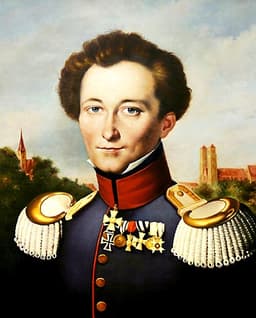
August von Gneisenau
General · Modern
61.8Total

Napoleon Bonaparte
General · Modern
70.9Total
Basic Information
Born
1760
1769
Died
1831
1821
Era
Modern
Modern
Nationality
Prussia
France
Occupation
General
General
Civilization
Western
Western
Score Comparison
Military (10%)
82.0
94.0
Political (20%)
72.0
72.0
Influence (20%)
72.0
40.0
Legacy (20%)
40.0
80.0
Leadership (15%)
48.8
78.0
Strategy (15%)
74.4
90.0
TOTAL
61.8
70.9
August von Gneisenau — Complete Timeline
1813 AD
Battle of LeipzigWar◆ Major
Gneisenau served as chief of staff to Bl
Battle of LeipzigNapoleonic WarsVictory
Impact: globalconstructive
Appointment as Chief of Staff to BlücherPolitical Action◆ Major
Gneisenau was appointed chief of staff to Field Marshal Gebhard Leberecht von Bl
AppointmentMilitaryPrussia
Impact: nationalconstructive
1815 AD
Battle of WaterlooWar
Gneisenau served as Bl
Battle of WaterlooNapoleonic WarsVictory
Impact: globalconstructive
Siege of ParisWar◆ Major
After Waterloo, Gneisenau commanded the Prussian forces that besieged Paris. The siege forced the French to surrender, ending the Napoleonic Wars and leading to the Second Treaty of Paris.
Siege of ParisNapoleonic WarsVictory
Impact: globalconstructive
Napoleon Bonaparte — Complete Timeline
1799 AD
Coup of 18 BrumaireOther◆ Major
Napoleon Bonaparte, with support from his brother Lucien and key political figures, overthrew the Directory in a bloodless coup. He established the Consulate with himself as First Consul, effectively becoming the ruler of France. This event ended the French Revolution's most unstable period.
French RevolutionCoupRise to Power
Impact: regional
1804 AD
Promulgation of the Napoleonic CodeOther◆ Major
Napoleon enacted the Civil Code of the French, known as the Napoleonic Code, a comprehensive set of laws that replaced the fragmented feudal legal systems. The code established legal equality, protected property rights, and secularized law. It became the basis for legal systems in many European and world countries.
Legal ReformNapoleonic CodeCivil Law
Impact: globalconstructive
1805 AD
Battle of AusterlitzWar◆ Major
Napoleon's Grande Arm
Napoleonic WarsBattleDecisive Victory
Impact: global
1812 AD
Invasion of RussiaWar◆ Major
Napoleon led the Grande Arm
Napoleonic WarsInvasionDisaster
Impact: globaldestructive
1815 AD
Battle of WaterlooWar◆ Major
Napoleon's French army was defeated by the combined forces of the Duke of Wellington's Anglo-Allied army and Gebhard Leberecht von Bl
Napoleonic WarsBattleFinal Defeat
Impact: globaldestructive
Expert Analysis
august-von-gneisenau-vs-napoleon-bonaparte
# The Shadow and the Sun: Napoleon and Gneisenau at the Dawn of Modern Warfare
On the morning of June 18, 1815, two men watched the same rain-soaked field near a small Belgian village, yet they inhabited different worlds. One was the master of Europe, a man whose name alone could make armies tremble. The other was a Prussian staff officer, known only to a few, whose greatest virtue lay in his invisibility. By nightfall, their fates would be reversed. Napoleon Bonaparte, the colossus who had reshaped a continent, would begin his final exile. August von Gneisenau, the architect of the Prussian resurgence, would enter history not as a conqueror but as the man who understood that even the greatest sun must eventually set.
Origins
Napoleon was born in 1769 on the island of Corsica, a place that had become French only months before his birth. He was an outsider from the start—a Corsican among Frenchmen, a petty noble among aristocrats, a man of modest means in a world of inherited wealth. This double consciousness would define him: he longed to conquer the system that had never fully accepted him. At the military school of Brienne, he was mocked for his accent and his poverty, but he devoured books on military strategy and the history of conquerors. His hero was Alexander the Great, and his ambition was limitless.
Gneisenau, born in 1760 in Schildau, Saxony, came from a world that seemed to have no room for him. His father was a struggling artillery officer, and the family lived in near poverty. The young Gneisenau studied at the University of Erfurt, but the Prussian army of Frederick the Great was a rigid, aristocratic institution that looked down on middle-class officers. He was commissioned into an Austrian regiment before transferring to Prussian service, but advancement came slowly. Unlike Napoleon, who burned with the desire to remake the world, Gneisenau learned patience. He understood that history moves in cycles, that empires rise and fall, and that the wise man prepares for the fall while others celebrate the rise.
Rise to Power
Napoleon’s ascent was meteoric. In 1793, at age twenty-four, he drove the British out of Toulon. In 1796, he took command of the French army in Italy and, within a year, had crushed the Austrians and made himself a hero. By 1799, he had seized power in a coup; by 1804, he had crowned himself Emperor. Each step was a gamble, and each gamble paid off. He believed that fortune favors the bold, and for nearly a decade, fortune agreed with him.
Gneisenau’s rise was the opposite—slow, cautious, and dependent not on brilliance but on resilience. His first major recognition came in 1806, when he defended the fortress of Kolberg against the French during the catastrophic Prussian defeat at Jena-Auerstedt. He held out for months with a garrison of farmers and volunteers, refusing to surrender even when Napoleon himself demanded it. This stubbornness caught the attention of the Prussian reformers, men like Scharnhorst and Stein who were rebuilding the shattered state. In 1813, when Prussia rose against Napoleon, Gneisenau was appointed chief of staff to the aged Field Marshal Blücher. It was the partnership that would save Europe.
Leadership & Governance
Napoleon governed as he fought: through speed, surprise, and overwhelming force. His Napoleonic Code reformed French law, standardizing justice and abolishing feudal privileges. He built roads, established banks, and created a centralized state that became a model for modern Europe. But his genius was also his flaw: he could not stop. Every victory demanded another war, every conquest required another army, every treaty was merely a breathing space before the next campaign. He once said, “Power is my mistress,” and like any obsessive lover, he could not bear to share her.
Gneisenau governed through partnership. As Blücher’s chief of staff, he was the brain behind the old general’s ferocity. Blücher was the heart—impulsive, brave, beloved by his troops. Gneisenau was the mind—calculating, patient, willing to endure humiliation for the sake of strategy. When the Prussian army was crushed by Napoleon in 1813, Gneisenau held it together. When Blücher wanted to attack recklessly, Gneisenau restrained him. When the situation demanded a desperate march to Waterloo, Gneisenau organized it, moving 50,000 men through muddy roads in a single day. His military score of 82.0 and strategy score of 85.3 reflect a man who won not by brilliance but by preparation.
Triumph & Tragedy
Napoleon’s greatest triumph was Austerlitz in 1805, where he destroyed the armies of Austria and Russia in a single day. His greatest tragedy was the invasion of Russia in 1812, where he lost half a million men to winter, hunger, and the scorched earth of a determined enemy. He never recovered from that disaster. His final defeat at Waterloo was not a failure of tactics but of timing—he waited too long to attack, his generals disobeyed orders, and Gneisenau’s Prussians arrived just as Wellington’s line was breaking.
Gneisenau’s triumph was Waterloo itself. After the battle, he pursued the defeated French with a ruthlessness that shocked even Wellington. He had learned from Napoleon’s mistakes: never let a beaten enemy recover. He then marched on Paris and forced the surrender of the French capital. His tragedy was that he never achieved the independent command he deserved. He was always the second man, the strategist behind the throne. When Blücher died in 1819, Gneisenau was passed over for supreme command, seen as too intellectual, too middle-class, too much a product of reform rather than tradition.
Character & Destiny
Napoleon’s character was a study in contradictions. He was brilliant but arrogant, visionary but reckless, generous to his soldiers but indifferent to human life. His destiny was shaped by his inability to accept limits. He once said, “There are only two forces in the world: the sword and the spirit. In the long run, the sword will always be conquered by the spirit.” He said this, but he never believed it. He always reached for the sword.
Gneisenau’s character was more complex. He was a man of deep thought who had learned to act decisively. He had seen the Prussian state humiliated, its army disbanded, its king a puppet of Napoleon. He had spent years in quiet study, preparing for a war that might never come. When it came, he was ready. He understood that history is not made by individuals alone but by systems, alliances, and the patient work of institutions. His destiny was to be the architect of a victory that belonged not to one man but to a nation.
Legacy
Napoleon’s legacy is everywhere. His legal code influences half the world’s legal systems. His military campaigns are studied in every war college. His name is synonymous with ambition, genius, and the tragic fall of the overreacher. His scores—military 94.0, influence 82.0, legacy 78.0—reflect a man who changed the world but could not change himself.
Gneisenau’s legacy is quieter but no less profound. He helped create the modern German general staff system, a model of military organization that would dominate European warfare for a century. He proved that the age of the solitary genius was over; the future belonged to teams, to planning, to the grinding work of logistics and coordination. His scores—military 82.0, strategy 85.3, leadership 81.2—reflect a man who won not by brilliance but by building a system that could outlast any individual.
Conclusion
Napoleon and Gneisenau faced the same world and drew opposite conclusions. Napoleon believed that a single man could bend history to his will. Gneisenau believed that history bends slowly, and that the wise man learns to bend with it. At Waterloo, their philosophies collided. Napoleon attacked with everything he had, trusting in his genius to find a way. Gneisenau marched through the mud, trusting in his system to arrive in time. The system won. Perhaps that is the final lesson of their story: the greatest conqueror is not the one who fights the hardest but the one who builds the foundation that outlasts the fight. Napoleon built an empire of glass; Gneisenau helped build a nation of stone.
Rankings
🥇
Napoleon BonaparteLeader
Mil: 94.0Pol: 72.0Inf: 40.0
70.9
🥈
August von Gneisenau
Mil: 82.0Pol: 72.0Inf: 72.0
61.8
+9.1 behind
How This Comparison Works
Algorithm
Each figure is scored on 6 dimensions (0—100 scale) based on structured historical data: Military (10%), Political (20%), Influence (20%), Legacy (20%), Leadership (15%), Strategy (15%). The weighted total produces the final ranking.
Data Sources
Scores are computed from structured sub-indicators in the database. Scale factors adjust for era (Ancient ×0.85, Modern ×1.0) and civilization size (Eastern ×1.05, Other ×0.80) to account for differences in population and military scale.
Maximum 3 Figures
Comparisons are limited to 2—3 figures to ensure readability and statistical meaningfulness.
Error Margins
±5 points per dimension — Sub-scores are derived from historical records with inherent uncertainty. Two figures within 5 points on a dimension should be considered roughly equivalent in that area.
Total Score Accuracy
±3 points overall — The weighted combination of 6 dimensions produces a total score with approximately ±3 points of uncertainty. Differences of less than 3 points are not statistically significant— the figures are effectively tied.
Known Limitations
- Historical records are incomplete and uneven across civilizations
- Figures from oral-tradition societies may be underrepresented
- Occupation labels can misclassify multi-role figures
- Scores measure capability and impact, not moral character
- Quantitative scoring is a comparison tool, not absolute truth
Capability Radar
Military (10%) — Battles & Warfare
Battles
75
95
Win Rate
80
90
Expansion
60
95
Political (20%) — Governance & Reform
Reform
70
95
Diplomacy
65
80
Economy
40
85
Influence (20%) — Cultural & Global Reach
Cultural
65
85
Global
60
90
Legacy (20%) — Historical Impact
Historical
75
95
Longevity
70
90
Leadership (15%) — Power & Stability
Tenure
55
85
Stability
50
70
Strategy (15%) — Tactics & Innovation
Strategy
90
95
Tactics
85
98
Reform
88
92
Similar Comparisons
Comments & Discussion
PrussianMandarin6/17/2026
Gneisenau is the ultimate testament that military genius isn't always about commanding the front lines—it's about building the systems that win wars. Napoleon was a brilliant tactician, but his strategic arrogance led him to cannibalize his own empire. Gneisenau fundamentally reformed the Prussian army's general staff system and insisted on the decisive pursuit at Waterloo, ensuring Napoleon's power didn't just break, but shattered. Without Gneisenau's organizational vision, Waterloo would have
暗夜教官6/17/2026
拿破仑无疑是个天才,但他的军事体系本质上是个人英雄主义的延伸——一旦"太阳"本人失误,整个帝国就跟着崩塌。格奈森瑙却在幕后打造了一台机器,一台即便主帅不在也能运转的战争机器。1813年莱比锡战役后,他力主坚决追击而不给法军喘息之机,这份远见比拿破仑任何孤注一掷的冲锋都更值得敬佩。天才闪耀一时,制度赢得百年。
DataSkeptic6/17/2026
Let's put aside the romantic legends: Napoleon's "Grande Armée" attrition rates were catastrophic. The 1812 Russian campaign alone saw his forces suffer over 400,000 casualties—a 97% loss rate. Meanwhile, Gneisenau's Prussian reforms cut the army's logistical waste by streamlining supply chains and introducing universal conscription, fielding 300,000 men in 1813 from a population of only 5 million. Napoleon burned through soldiers like candle wax; Gneisenau grew them like a sustainable crop. Tha
军史破壁人6/17/2026
别被"战争之神"的传说骗了。拿破仑在滑铁卢的溃败根本不是威灵顿的功劳,而是格奈森瑙的普鲁士第4军及时抵达战场,彻底粉碎了拿破仑最后的预备队。更关键的是,格奈森瑙在此前三年里重建了普鲁士军官团和参谋体系,引入了详尽的地图作业和兵棋推演——这些后来成了现代军队的标配。拿破仑死守着他的旧战术,格奈森瑙却在书写未来战争的手册。谁才是真正的改革者?答案显而易见。
LongueDuréeLens6/17/2026
Napoleon's life is a dramatic arc of personal glory, but his military reforms were fleeting—his centralized command crumbled once his charisma was absent. Gneisenau's Scharnhorst-inspired innovations in decentralized decision-making and professional staff education became the skeleton of 19th-century European warfare, influencing Moltke and even modern NATO doctrine. Napoleon was a brilliant comet; Gneisenau was the slow, patient glacier that reshaped the continent's military landscape for gener