Loading...
Atal Bihari Vajpayee vs Sanjaasuren Oyun
Atal Bihari Vajpayee leads by 19.5 pts · 2 figures compared
…
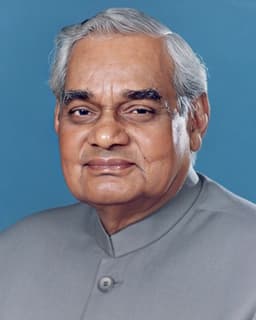
Atal Bihari Vajpayee
Politician · Modern
56.8Total

Sanjaasuren Oyun
Politician · Modern
37.3Total
Basic Information
Born
1924
1964
Died
—
—
Era
Modern
Modern
Nationality
India
Mongolia
Occupation
Politician
Politician
Civilization
Indian
Eastern
Score Comparison
Military (10%)
36.7
11.6
Political (20%)
55.0
35.1
Influence (20%)
58.3
48.6
Legacy (20%)
54.0
37.5
Leadership (15%)
72.0
41.5
Strategy (15%)
60.0
31.3
TOTAL
56.8
37.3
Atal Bihari Vajpayee — Complete Timeline
1996 AD
Appointed Prime Minister of India (First Term)Political Action◆ Major
Atal Bihari Vajpayee became Prime Minister for the first time, leading a BJP-led coalition government. His first term lasted only 13 days as the government failed to secure a majority in the Lok Sabha.
Indian PoliticsCoalition GovernmentShort Tenure
Impact: national
1998 AD
Conducted Nuclear Tests at Pokhran (Operation Shakti)War
Vajpayee's government conducted five underground nuclear tests at Pokhran, Rajasthan, making India a declared nuclear weapons state. The tests were met with international sanctions but boosted national pride and strategic autonomy.
Nuclear WeaponsPokhranStrategic Policy
Impact: global
Appointed Prime Minister of India (Full Term)Political Action◆ Major
Vajpayee became Prime Minister for a second time, leading the National Democratic Alliance (NDA) coalition. His government lasted 13 months before losing a confidence vote by one vote in 1999.
Indian PoliticsNDACoalition
Impact: national
1999 AD
Led India During Kargil WarWar◆ Major
Vajpayee's government oversaw the Indian military response to the Kargil infiltration by Pakistani forces and militants. India successfully recaptured the occupied peaks, but the conflict resulted in heavy casualties on both sides.
Kargil WarMilitary ConflictIndia-Pakistan
Impact: regional
Launched Delhi-Lahore Bus ServicePolitical Action◆ Major
Vajpayee inaugurated the Delhi-Lahore bus service as a peace initiative with Pakistan. He traveled to Lahore and signed the Lahore Declaration with Prime Minister Nawaz Sharif, aiming to reduce bilateral tensions.
Peace InitiativeIndia-PakistanDiplomacy
Impact: regionalconstructive
Sanjaasuren Oyun — Complete Timeline
2004 AD
Elected to the State Great Khural (Parliament)Political Action
Oyun was elected to the Mongolian parliament as a member of the Democratic Party. She served as a legislator, focusing on environmental and mining policy.
ParliamentElection
Impact: nationalconstructive
2005 AD
Co-founded the 'Mongolian Women's Political Network'Political Action
Oyun co-founded the Mongolian Women's Political Network, an organization aimed at increasing women's participation in politics. The network provided training and support for female candidates.
Women's RightsPolitical Participation
Impact: nationalprogressive
2007 AD
Appointed Foreign Minister of MongoliaPolitical Action◆ Major
Oyun was appointed Foreign Minister in 2007, becoming the first woman to hold the position. She served until 2008, focusing on Mongolia's foreign policy and international relations.
Foreign MinisterDiplomacyFirst Woman
Impact: nationalconstructive
2008 AD
Resigned as Foreign Minister After 2008 ElectionPolitical Action
Oyun resigned as Foreign Minister following the 2008 parliamentary elections, which were marred by allegations of fraud and violence. Her resignation was part of a broader political reshuffle.
ResignationElection
Impact: national
2012 AD
Served as Minister of Environment and Green DevelopmentPolitical Action◆ Major
Oyun was appointed Minister of Environment and Green Development in 2012, where she advocated for sustainable mining practices and environmental protection. She pushed for stricter regulations on the mining sector.
EnvironmentMiningSustainability
Impact: nationalconstructive
Expert Analysis
Origins
Atal Bihari Vajpayee was born on December 25, 1924, in Gwalior, India, into a Brahmin family. His father was a school teacher. He earned a master's degree in political science and studied law. Vajpayee's early involvement with the Rashtriya Swayamsevak Sangh (RSS) shaped his nationalist ideology. He joined the Bharatiya Jana Sangh in 1951, eventually becoming its president.
Sanjaasuren Oyun was born in 1964 in Ulaanbaatar, Mongolia. She studied geology at the Mongolian State University and later obtained a PhD from the University of Cambridge. Her background as a geologist led her to focus on environmental and mining issues. She entered politics in the 2000s as a member of the Democratic Party, becoming one of Mongolia's few female political leaders.
Rise to Power
Vajpayee rose through the ranks of the Jana Sangh and later the Bharatiya Janata Party (BJP). He was first elected to the Lok Sabha in 1957. His oratory skills and moderate image made him a key figure. In 1996, he became Prime Minister for 13 days, then again in 1998 for 13 months. His full term began in 1999 after the Kargil War, leading the National Democratic Alliance (NDA) coalition until 2004.
Oyun's rise began with her election to the State Great Khural in 2004. She quickly became chair of the parliamentary subcommittee on mining. In 2007, she was appointed Foreign Minister, the first woman to hold that post. She served until 2008, when she resigned after disputed elections. Later, in 2012, she became Minister of Environment and Green Development, advocating for sustainable mining.
Leadership & Governance
Vajpayee's governance was marked by coalition management and economic reforms. He oversaw the Golden Quadrilateral highway project and the privatization of state-owned enterprises. His government conducted the 1998 nuclear tests (Operation Shakti), defying international pressure. He also launched the Delhi-Lahore bus service in 1999 to improve relations with Pakistan, but the Kargil War later that year undermined peace efforts. Vajpayee's leadership during the war was decisive, with a clear mandate to recapture territory.
Oyun focused on foreign policy and environmental governance. As Foreign Minister, she strengthened ties with Russia, China, and the West. She promoted Mongolia's nuclear-weapon-free status and supported the UN's sustainable development goals. As Environment Minister, she pushed for stricter mining regulations and green development policies. Her leadership style was collaborative, but her influence was limited by Mongolia's small population and economy.
Triumph & Tragedy
Vajpayee's greatest triumph was the 1998 nuclear tests, which established India as a nuclear power. His successful handling of the Kargil War in 1999 boosted national morale. His economic reforms spurred growth. However, his failure to prevent the 2002 Gujarat riots and the subsequent criticism of his government's response tarnished his legacy. The NDA's defeat in 2004 was a personal setback, as his coalition lost despite a strong economy.
Oyun's triumph was becoming Mongolia's first female Foreign Minister and championing environmental issues. She co-founded the Mongolian Women's Political Network, increasing female political participation. Her tragedy was the resignation after the 2008 election violence, which ended her foreign policy career. Her environmental initiatives faced resistance from mining interests, limiting their impact. She scored 48.6 in influence, while Vajpayee scored 58.3.
Character & Destiny
Vajpayee was known as a consensus-builder and a moderate within the BJP. His poetic nature and oratory earned him respect across parties. He often prioritized stability over ideology. His character shaped a destiny of leading a coalition government through crises. However, his failure to control hardliners in his party led to events like the Gujarat riots.
Oyun is characterized by her scientific background and rational approach. She is a pragmatist who focuses on achievable goals. Her destiny was to be a trailblazer for women in Mongolian politics but ultimately constrained by the political system. Her leadership score of 41.5 reflects her limited command authority compared to Vajpayee's 72.0.
Legacy
Vajpayee's legacy includes India's nuclear arsenal, the Golden Quadrilateral, and the foundation of the NDA coalition. His economic reforms set the stage for India's later growth. He is remembered as one of India's most respected prime ministers, with a lasting impact on foreign policy and infrastructure.
Oyun's legacy is more niche: she raised awareness of environmental issues in Mongolia and advanced women in politics. The Mongolian Women's Political Network continues to operate. However, her impact is limited by the scale of her country. Her legacy score of 37.5 contrasts with Vajpayee's 54.0.
Conclusion
Atal Bihari Vajpayee had a greater impact than Sanjaasuren Oyun. His decisions shaped India's strategic posture and economic trajectory, affecting over a billion people. Oyun's achievements are significant for Mongolia but remain regional. Vajpayee's total score of 56.8 versus Oyun's 37.3 reflects his broader influence. While Oyun's environmental advocacy is vital, Vajpayee's leadership during nuclear tests and war, along with his economic reforms, place him in a higher tier of historical significance.
Rankings
🥇
Atal Bihari VajpayeeLeader
Mil: 36.7Pol: 55.0Inf: 58.3
56.8
🥈
Sanjaasuren Oyun
Mil: 11.6Pol: 35.1Inf: 48.6
37.3
+19.5 behind
How This Comparison Works
Algorithm
Each figure is scored on 6 dimensions (0—100 scale) based on structured historical data: Military (10%), Political (20%), Influence (20%), Legacy (20%), Leadership (15%), Strategy (15%). The weighted total produces the final ranking.
Data Sources
Scores are computed from structured sub-indicators in the database. Scale factors adjust for era (Ancient ×0.85, Modern ×1.0) and civilization size (Eastern ×1.05, Other ×0.80) to account for differences in population and military scale.
Maximum 3 Figures
Comparisons are limited to 2—3 figures to ensure readability and statistical meaningfulness.
Error Margins
±5 points per dimension — Sub-scores are derived from historical records with inherent uncertainty. Two figures within 5 points on a dimension should be considered roughly equivalent in that area.
Total Score Accuracy
±3 points overall — The weighted combination of 6 dimensions produces a total score with approximately ±3 points of uncertainty. Differences of less than 3 points are not statistically significant— the figures are effectively tied.
Known Limitations
- Historical records are incomplete and uneven across civilizations
- Figures from oral-tradition societies may be underrepresented
- Occupation labels can misclassify multi-role figures
- Scores measure capability and impact, not moral character
- Quantitative scoring is a comparison tool, not absolute truth
Capability Radar
Military (10%) — Battles & Warfare
Battles
43
15
Win Rate
46
20
Expansion
52
18
Political (20%) — Governance & Reform
Reform
60
20
Diplomacy
70
40
Economy
55
15
Influence (20%) — Cultural & Global Reach
Cultural
50
10
Global
60
20
Legacy (20%) — Historical Impact
Historical
65
15
Longevity
50
10
Leadership (15%) — Power & Stability
Tenure
65
15
Stability
60
15
Strategy (15%) — Tactics & Innovation
Strategy
55
23
Tactics
57
26
Reform
57
30
Similar Comparisons
Comments & Discussion
No comments yet. Be the first to share your thoughts!