Loading...
Atal Bihari Vajpayee vs C. R. Das
Atal Bihari Vajpayee leads by 3.8 pts · 2 figures compared
…
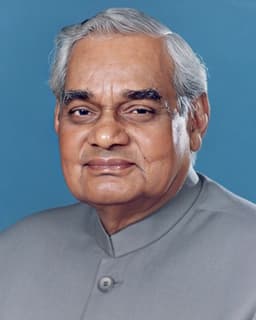
Atal Bihari Vajpayee
Politician · Modern
56.8Total
C. R. Das
Politician · Modern
53.0Total
Basic Information
Born
1924
1869
Died
—
1925
Era
Modern
Modern
Nationality
India
India
Occupation
Politician
Politician
Civilization
Indian
Indian
Score Comparison
Military (10%)
36.7
41.5
Political (20%)
55.0
53.8
Influence (20%)
58.3
58.0
Legacy (20%)
54.0
49.2
Leadership (15%)
72.0
53.2
Strategy (15%)
60.0
60.0
TOTAL
56.8
53.0
Atal Bihari Vajpayee — Complete Timeline
1996 AD
Appointed Prime Minister of India (First Term)Political Action◆ Major
Atal Bihari Vajpayee became Prime Minister for the first time, leading a BJP-led coalition government. His first term lasted only 13 days as the government failed to secure a majority in the Lok Sabha.
Indian PoliticsCoalition GovernmentShort Tenure
Impact: national
1998 AD
Conducted Nuclear Tests at Pokhran (Operation Shakti)War
Vajpayee's government conducted five underground nuclear tests at Pokhran, Rajasthan, making India a declared nuclear weapons state. The tests were met with international sanctions but boosted national pride and strategic autonomy.
Nuclear WeaponsPokhranStrategic Policy
Impact: global
Appointed Prime Minister of India (Full Term)Political Action◆ Major
Vajpayee became Prime Minister for a second time, leading the National Democratic Alliance (NDA) coalition. His government lasted 13 months before losing a confidence vote by one vote in 1999.
Indian PoliticsNDACoalition
Impact: national
1999 AD
Led India During Kargil WarWar◆ Major
Vajpayee's government oversaw the Indian military response to the Kargil infiltration by Pakistani forces and militants. India successfully recaptured the occupied peaks, but the conflict resulted in heavy casualties on both sides.
Kargil WarMilitary ConflictIndia-Pakistan
Impact: regional
Launched Delhi-Lahore Bus ServicePolitical Action◆ Major
Vajpayee inaugurated the Delhi-Lahore bus service as a peace initiative with Pakistan. He traveled to Lahore and signed the Lahore Declaration with Prime Minister Nawaz Sharif, aiming to reduce bilateral tensions.
Peace InitiativeIndia-PakistanDiplomacy
Impact: regionalconstructive
C. R. Das — Complete Timeline
1908 AD
Defended Aurobindo Ghosh in the Alipore Bomb CasePolitical Action◆ Major
Das successfully defended Aurobindo Ghosh in the Alipore Bomb Case, securing his acquittal. The case involved charges of sedition and conspiracy against the British government, and Das's legal skills earned him national fame.
Legal DefenseAlipore Bomb CaseAurobindo Ghosh
Impact: nationalconstructive
1921 AD
Led the Bengal Provincial Congress CommitteePolitical Action◆ Major
Das became the president of the Bengal Provincial Congress Committee and led the non-cooperation movement in Bengal. He organized mass protests, boycotts of British goods, and resignations from government positions.
Non-CooperationBengal CongressMass Movement
Impact: regionalconstructive
1922 AD
Presided over the Indian National Congress session in GayaPolitical Action◆ Major
Das presided over the Gaya session of the Indian National Congress. He advocated for council entry and the formation of the Swaraj Party to fight for self-rule from within the legislative councils, a departure from Gandhi's non-cooperation.
Congress PresidencySwaraj PartyCouncil Entry
Impact: nationalconstructive
1923 AD
Founded the Swaraj PartyPolitical Action◆ Major
Along with Motilal Nehru, Das founded the Swaraj Party within the Indian National Congress. The party aimed to enter legislative councils to obstruct British governance and demand self-rule, marking a shift from boycott to participation.
Swaraj PartyCouncil EntrySelf-Rule
Impact: nationalconstructive
1924 AD
Elected Mayor of CalcuttaPolitical Action◆ Major
Das was elected the first Mayor of the Calcutta Municipal Corporation under the reformed municipal act. He used the position to implement welfare measures and assert Indian control over urban governance.
MayorCalcuttaMunicipal Governance
Impact: regionalconstructive
Expert Analysis
Origins
Atal Bihari Vajpayee was born on December 25, 1924, in Gwalior, Madhya Pradesh, into a Brahmin family. His father, Krishna Bihari Vajpayee, was a schoolteacher and poet. Vajpayee completed his schooling in Gwalior and earned a master's degree in political science from DAV College, Kanpur. He was drawn to the Rashtriya Swayamsevak Sangh (RSS) at a young age, joining the organization in 1939. His early political involvement included participation in the Quit India Movement in 1942, which led to his imprisonment. Vajpayee's background in journalism and poetry shaped his oratory skills.
Chittaranjan Das, known as C. R. Das or Deshbandhu, was born on November 5, 1870, in Calcutta (now Kolkata), Bengal, into a Brahmo Samaj family. His father, Bhuban Mohan Das, was a lawyer and journalist. Das was educated in England, where he studied at the University of Cambridge and later qualified as a barrister from Middle Temple. He returned to India in 1893 and started a successful legal practice in Calcutta. His early career included defending Indian nationalists, which brought him into the political fold.
Rise to Power
Vajpayee's rise in politics was gradual. He became a member of the Bharatiya Jana Sangh, founded in 1951, and served as its president from 1968 to 1972. He was elected to the Lok Sabha in 1957 from Balrampur, Uttar Pradesh. His oratory skills made him a prominent opposition leader. In 1977, he became the External Affairs Minister under Prime Minister Morarji Desai, where he gained diplomatic experience. The turning point came in 1996 when he was appointed Prime Minister for a 13-day term, followed by a 13-month term in 1998. His full term began in 1999 after the Kargil War, leading the National Democratic Alliance (NDA) coalition until 2004.
C. R. Das rose to prominence as a lawyer and nationalist. He defended Aurobindo Ghosh in the Alipore Bomb Case in 1908, securing his acquittal, which made him a national figure. He joined the Indian National Congress and became a leader in Bengal. In 1921, he was elected president of the Bengal Provincial Congress Committee. He presided over the Gaya session of the Congress in 1922, where he advocated for council entry, leading to a split with Gandhi. He then founded the Swaraj Party in 1923 with Motilal Nehru, which contested elections and won seats in the Central Legislative Assembly. In 1924, he was elected the first Mayor of Calcutta, using the position to implement reforms.
Leadership & Governance
Vajpayee's leadership style was pragmatic and consensus-building. He led a coalition government, which required constant negotiation with allies. His governance focused on economic reforms, infrastructure, and foreign policy. He launched the Golden Quadrilateral highway project, which connected major cities. On the nuclear front, he authorized Operation Shakti in May 1998, making India a declared nuclear state. This scored him a leadership score of 72.0. His peace initiative with Pakistan, the Delhi-Lahore bus service in 1999, was a bold move, though it was followed by the Kargil War. Vajpayee's strategic score of 60.0 reflects his ability to balance diplomacy and military action.
C. R. Das's leadership was rooted in mass mobilization and legal obstruction. He believed in using constitutional means to challenge British rule. As Mayor of Calcutta, he focused on education, health, and municipal reforms. He introduced free primary education and improved sanitation. His governance style was confrontational within the councils, aiming to disrupt British administration. His political score of 53.8 reflects his effectiveness in building the Swaraj Party, which became a significant force in Indian politics. However, his early death in 1925 limited his direct impact on governance.
Triumph & Tragedy
Vajpayee's greatest triumph was the successful nuclear tests in 1998, which elevated India's global standing. He also led India during the Kargil War in 1999, ensuring a military victory while maintaining international support. His economic reforms laid the groundwork for India's growth in the 2000s. A major failure was the 2002 Gujarat riots, which occurred under his watch and tarnished his secular image. His government's response was criticized for being slow. Additionally, his coalition management sometimes led to policy paralysis.
C. R. Das's greatest triumph was founding the Swaraj Party, which effectively used legislative councils to oppose British policies. His defense of Aurobindo Ghosh showcased his legal brilliance. His mayoral tenure in Calcutta was marked by progressive reforms. His tragedy was his early death in 1925 at age 54, which cut short his political career. The Swaraj Party declined after his death. He also failed to bridge the gap between the Congress's moderate and extremist factions, as seen in the Gaya session split.
Character & Destiny
Vajpayee was known as a poet-politician, often using verse to communicate. He was a moderate within the BJP, advocating for Hindutva but also reaching out to minorities. His character was marked by patience and coalition-building, which allowed him to lead a diverse alliance. His destiny was shaped by the rise of the BJP and the fragmentation of national politics. He scored 58.3 in influence, reflecting his ability to shape India's nuclear and economic trajectory.
C. R. Das was a charismatic orator and a fierce nationalist. He was known for his legal acumen and his willingness to challenge Gandhi's leadership. His character was confrontational yet principled. His destiny was to be a pioneer of council entry, but his early death prevented him from seeing the Swaraj Party's long-term impact. His influence score of 58.0 is comparable to Vajpayee's, but his legacy is more localized to Bengal.
Legacy
Vajpayee's legacy is tied to India's emergence as a nuclear power and its economic transformation. The Golden Quadrilateral remains a key infrastructure project. His political legacy includes the NDA coalition model, which has been replicated. He is remembered as a statesman who balanced nationalism with diplomacy. His total score of 56.8 reflects a well-rounded impact across military, political, and leadership dimensions.
C. R. Das's legacy is as the founder of the Swaraj Party, which influenced later parliamentary strategies. He is revered in Bengal as Deshbandhu (Friend of the Nation). His municipal reforms in Calcutta set precedents for urban governance. However, his national impact was limited by his early death. His legacy score of 49.2 is lower than Vajpayee's 54.0, reflecting a narrower scope.
Conclusion
Atal Bihari Vajpayee had a greater impact on India than C. R. Das. Vajpayee's actions—nuclear tests, economic reforms, and infrastructure projects—shaped modern India's trajectory. His leadership score of 72.0 dwarfs Das's 53.2. While Das was a pioneer in legislative politics, his influence was cut short. Vajpayee's total score of 56.8 compared to Das's 53.0 underscores his broader and more lasting effect. Vajpayee's ability to govern at the national level and make decisions with global implications gives him the edge.
Rankings
🥇
Atal Bihari VajpayeeLeader
Mil: 36.7Pol: 55.0Inf: 58.3
56.8
🥈
C. R. Das
Mil: 41.5Pol: 53.8Inf: 58.0
53.0
+3.8 behind
How This Comparison Works
Algorithm
Each figure is scored on 6 dimensions (0—100 scale) based on structured historical data: Military (10%), Political (20%), Influence (20%), Legacy (20%), Leadership (15%), Strategy (15%). The weighted total produces the final ranking.
Data Sources
Scores are computed from structured sub-indicators in the database. Scale factors adjust for era (Ancient ×0.85, Modern ×1.0) and civilization size (Eastern ×1.05, Other ×0.80) to account for differences in population and military scale.
Maximum 3 Figures
Comparisons are limited to 2—3 figures to ensure readability and statistical meaningfulness.
Error Margins
±5 points per dimension — Sub-scores are derived from historical records with inherent uncertainty. Two figures within 5 points on a dimension should be considered roughly equivalent in that area.
Total Score Accuracy
±3 points overall — The weighted combination of 6 dimensions produces a total score with approximately ±3 points of uncertainty. Differences of less than 3 points are not statistically significant— the figures are effectively tied.
Known Limitations
- Historical records are incomplete and uneven across civilizations
- Figures from oral-tradition societies may be underrepresented
- Occupation labels can misclassify multi-role figures
- Scores measure capability and impact, not moral character
- Quantitative scoring is a comparison tool, not absolute truth
Capability Radar
Military (10%) — Battles & Warfare
Battles
43
46
Win Rate
46
44
Expansion
52
50
Political (20%) — Governance & Reform
Reform
60
65
Diplomacy
70
60
Economy
55
50
Influence (20%) — Cultural & Global Reach
Cultural
50
55
Global
60
35
Legacy (20%) — Historical Impact
Historical
65
55
Longevity
50
40
Leadership (15%) — Power & Stability
Tenure
65
55
Stability
60
45
Strategy (15%) — Tactics & Innovation
Strategy
55
55
Tactics
57
53
Reform
57
58
Similar Comparisons
Comments & Discussion
No comments yet. Be the first to share your thoughts!