Loading...
Atal Bihari Vajpayee vs Ciro Gomes
Atal Bihari Vajpayee leads by 14.5 pts · 2 figures compared
…
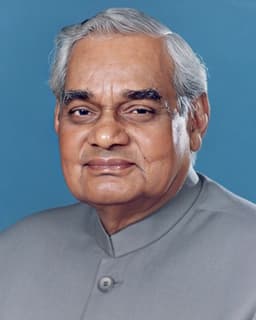
Atal Bihari Vajpayee
Politician · Modern
56.8Total

Ciro Gomes
Politician · Modern
42.3Total
Basic Information
Born
1924
1957
Died
—
—
Era
Modern
Modern
Nationality
India
Brazil
Occupation
Politician
Politician
Civilization
Indian
Western
Score Comparison
Military (10%)
36.7
49.5
Political (20%)
55.0
30.8
Influence (20%)
58.3
47.9
Legacy (20%)
54.0
37.5
Leadership (15%)
72.0
48.4
Strategy (15%)
60.0
41.4
TOTAL
56.8
42.3
Atal Bihari Vajpayee — Complete Timeline
1996 AD
Appointed Prime Minister of India (First Term)Political Action◆ Major
Atal Bihari Vajpayee became Prime Minister for the first time, leading a BJP-led coalition government. His first term lasted only 13 days as the government failed to secure a majority in the Lok Sabha.
Indian PoliticsCoalition GovernmentShort Tenure
Impact: national
1998 AD
Conducted Nuclear Tests at Pokhran (Operation Shakti)War
Vajpayee's government conducted five underground nuclear tests at Pokhran, Rajasthan, making India a declared nuclear weapons state. The tests were met with international sanctions but boosted national pride and strategic autonomy.
Nuclear WeaponsPokhranStrategic Policy
Impact: global
Appointed Prime Minister of India (Full Term)Political Action◆ Major
Vajpayee became Prime Minister for a second time, leading the National Democratic Alliance (NDA) coalition. His government lasted 13 months before losing a confidence vote by one vote in 1999.
Indian PoliticsNDACoalition
Impact: national
1999 AD
Led India During Kargil WarWar◆ Major
Vajpayee's government oversaw the Indian military response to the Kargil infiltration by Pakistani forces and militants. India successfully recaptured the occupied peaks, but the conflict resulted in heavy casualties on both sides.
Kargil WarMilitary ConflictIndia-Pakistan
Impact: regional
Launched Delhi-Lahore Bus ServicePolitical Action◆ Major
Vajpayee inaugurated the Delhi-Lahore bus service as a peace initiative with Pakistan. He traveled to Lahore and signed the Lahore Declaration with Prime Minister Nawaz Sharif, aiming to reduce bilateral tensions.
Peace InitiativeIndia-PakistanDiplomacy
Impact: regionalconstructive
Ciro Gomes — Complete Timeline
1994 AD
Appointed Minister of FinancePolitical Action
Ciro Gomes was appointed Minister of Finance under President Itamar Franco. He oversaw the implementation of the Plano Real, the economic stabilization plan that ended hyperinflation and introduced a new currency, the real.
Economic ReformPlano Real
Impact: nationalconstructive
1998 AD
Presidential candidate in 1998 electionPolitical Action
Ciro Gomes ran for President of Brazil in the 1998 election, finishing third with 11.0% of the vote. He ran on a left-wing platform but was defeated by Fernando Henrique Cardoso.
Presidential ElectionPolitical Campaign
Impact: national
2002 AD
Presidential candidate in 2002 electionPolitical Action
Ciro Gomes ran for President of Brazil in the 2002 election, finishing fourth with 12.0% of the vote. He ran as a left-wing candidate but was defeated by Luiz In
Presidential ElectionPolitical Campaign
Impact: national
2018 AD
Presidential candidate in 2018 electionPolitical Action
Ciro Gomes ran for President of Brazil in the 2018 election, finishing third with 12.5% of the vote. He ran on a left-wing platform but was defeated by Jair Bolsonaro.
Presidential ElectionPolitical Campaign
Impact: national
Expert Analysis
Origins
Atal Bihari Vajpayee was born on December 25, 1924, in Gwalior, India, into a Brahmin family. His father was a schoolteacher. Vajpayee earned a master's degree in political science from DAV College, Kanpur, and later studied law. He was drawn to the Rashtriya Swayamsevak Sangh (RSS) in his youth, becoming a full-time pracharak. His early political involvement was with the Bharatiya Jana Sangh, where he co-founded the party in 1951. Ciro Gomes was born on November 6, 1957, in Pindamonhangaba, Brazil, into a political family. His father was a mayor and his brother a senator. Gomes studied law at the University of São Paulo and later earned a degree in economics. He entered politics early, serving as a state deputy in Ceará. His formative years were shaped by Brazil's military dictatorship and the subsequent democratic transition.
Rise to Power
Vajpayee rose through the ranks of the Jana Sangh, becoming its president in 1968. He was first elected to the Lok Sabha in 1957. His oratory skills and moderate image made him a key opposition figure. In 1977, he became Minister of External Affairs in the Janata Party government, where he famously addressed the UN in Hindi. After the Janata Party's collapse, he helped found the Bharatiya Janata Party (BJP) in 1980. Vajpayee became the BJP's prime ministerial candidate, and in 1996 he was appointed Prime Minister for 13 days after the BJP emerged as the largest party. His first full term began in 1998, leading the National Democratic Alliance (NDA). Ciro Gomes entered national politics as a federal deputy in 1982. He served as mayor of Fortaleza (1989-1990) and governor of Ceará (1991-1994). In 1994, President Itamar Franco appointed him Minister of Finance, where he oversaw the implementation of the Plano Real, a stabilization plan that ended hyperinflation. He left the ministry before the plan's full success to run for president in 1998, finishing third with 11% of the vote.
Leadership & Governance
Vajpayee's leadership style was consensual and coalition-friendly. He governed with the NDA, a diverse coalition, and was known for his inclusive approach. His government focused on economic reforms, including privatization and fiscal consolidation. He launched the Golden Quadrilateral highway project and the Sarva Shiksha Abhiyan for education. In foreign policy, he pursued peace with Pakistan through the Lahore Declaration (1999) and later the Agra Summit (2001). However, his government also faced the Kargil War (1999) and the 2001 Indian Parliament attack. Vajpayee scored 72.0 in leadership and 60.0 in strategy. Ciro Gomes, as Finance Minister, implemented the Plano Real, which involved fiscal adjustment, currency reform, and inflation control. The plan succeeded in stabilizing the economy, with inflation dropping from 2,477% in 1993 to 9% in 1995. Gomes left the ministry in 1995, before the plan's full effect, but his role was pivotal. As a presidential candidate, he proposed left-wing policies but struggled to gain traction against Luiz Inácio Lula da Silva and others. His leadership score is 48.4, and strategy 41.4.
Triumph & Tragedy
Vajpayee's greatest triumph was the 1998 nuclear tests (Operation Shakti), which made India a declared nuclear weapons state and bolstered its strategic autonomy. He successfully navigated international sanctions and later gained U.S. recognition through the 2005 civil nuclear deal (though after his term). His peace initiative with Pakistan, the Lahore Declaration, was a high point but was undermined by the Kargil War months later. Domestically, his government's economic reforms laid the groundwork for India's subsequent growth. His greatest failure was the inability to resolve the India-Pakistan conflict, as tensions persisted. The 2002 Gujarat riots occurred under his watch, drawing criticism for his government's handling. Ciro Gomes's triumph was his role in the Plano Real, which ended hyperinflation and stabilized Brazil's economy. However, he left the ministry before the plan's full success, and credit largely went to his successor, Fernando Henrique Cardoso. His repeated presidential campaigns (1998, 2002, 2018) all ended in defeat, with his best result being 12.5% in 2018. He never reached a runoff, a major failure for a three-time candidate. His military score of 49.5 reflects his lack of military experience.
Character & Destiny
Vajpayee was known as a moderate and a poet, with a conciliatory style. He was a skilled orator and a consensus-builder, which allowed him to lead a coalition government. However, his indecisiveness on some issues, such as the response to the 2002 Gujarat riots, drew criticism. His character shaped his destiny as a leader who advanced India's strategic interests while promoting democratic values. He scored 58.3 in influence and 54.0 in legacy. Ciro Gomes is known for his intelligence and strong opinions but also for a confrontational style that alienated allies. His economic expertise was clear in the Plano Real, but his inability to build a broad coalition limited his electoral success. His character as a principled but polarizing figure led to his destiny as a perennial candidate rather than a national leader. He scored 47.9 in influence and 37.5 in legacy.
Legacy
Vajpayee's legacy is significant: he transformed India's nuclear posture, initiated economic reforms that spurred growth, and established the BJP as a major national party. His government's highway project and education initiatives had lasting impact. He is remembered as a statesman who balanced nationalism with pragmatism. His total score of 56.8 reflects his multifaceted impact. Ciro Gomes's legacy is tied to the Plano Real, which stabilized Brazil's economy, but his personal political legacy is limited. He is known as a competent economist but an unsuccessful presidential candidate. His total score of 42.3 reflects his narrower impact.
Conclusion
Atal Bihari Vajpayee had a greater impact than Ciro Gomes, as shown by his higher total score (56.8 vs. 42.3). Vajpayee shaped India's strategic trajectory through nuclear tests and economic reforms, while Gomes's main achievement was as a finance minister in a successful stabilization plan. Vajpayee's leadership and strategic scores (72.0 and 60.0) far exceed Gomes's (48.4 and 41.4). While Gomes contributed to Brazil's economic stability, Vajpayee's legacy as a prime minister who redefined India's role in the world is more enduring.
Rankings
🥇
Atal Bihari VajpayeeLeader
Mil: 36.7Pol: 55.0Inf: 58.3
56.8
🥈
Ciro Gomes
Mil: 49.5Pol: 30.8Inf: 47.9
42.3
+14.5 behind
How This Comparison Works
Algorithm
Each figure is scored on 6 dimensions (0—100 scale) based on structured historical data: Military (10%), Political (20%), Influence (20%), Legacy (20%), Leadership (15%), Strategy (15%). The weighted total produces the final ranking.
Data Sources
Scores are computed from structured sub-indicators in the database. Scale factors adjust for era (Ancient ×0.85, Modern ×1.0) and civilization size (Eastern ×1.05, Other ×0.80) to account for differences in population and military scale.
Maximum 3 Figures
Comparisons are limited to 2—3 figures to ensure readability and statistical meaningfulness.
Error Margins
±5 points per dimension — Sub-scores are derived from historical records with inherent uncertainty. Two figures within 5 points on a dimension should be considered roughly equivalent in that area.
Total Score Accuracy
±3 points overall — The weighted combination of 6 dimensions produces a total score with approximately ±3 points of uncertainty. Differences of less than 3 points are not statistically significant— the figures are effectively tied.
Known Limitations
- Historical records are incomplete and uneven across civilizations
- Figures from oral-tradition societies may be underrepresented
- Occupation labels can misclassify multi-role figures
- Scores measure capability and impact, not moral character
- Quantitative scoring is a comparison tool, not absolute truth
Capability Radar
Military (10%) — Battles & Warfare
Battles
43
31
Win Rate
46
29
Expansion
52
36
Political (20%) — Governance & Reform
Reform
60
20
Diplomacy
70
20
Economy
55
20
Influence (20%) — Cultural & Global Reach
Cultural
50
15
Global
60
10
Legacy (20%) — Historical Impact
Historical
65
15
Longevity
50
10
Leadership (15%) — Power & Stability
Tenure
65
25
Stability
60
15
Strategy (15%) — Tactics & Innovation
Strategy
55
35
Tactics
57
38
Reform
57
46
Similar Comparisons
Comments & Discussion
No comments yet. Be the first to share your thoughts!