Loading...
This comparison has not been analyzed yet.
One-time AI generation (~1 minute). Scores and timeline are already available below.
Askia Muhammad vs Kutlug I Bilge Kagan
Askia Muhammad leads by 15.7 pts · 2 figures compared
…
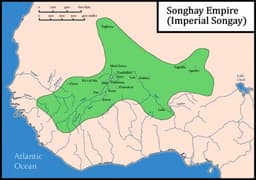
Askia Muhammad
Emperor · Medieval
71.2Total

Kutlug I Bilge Kagan
Emperor · Medieval
55.5Total
Basic Information
Born
1443
705
Died
1538
747
Era
Medieval
Medieval
Nationality
Songhai Empire
Uyghur Khaganate
Occupation
Emperor
Emperor
Civilization
Other
Eastern
Score Comparison
Military (10%)
78.0
72.5
Political (20%)
70.3
68.0
Influence (20%)
82.0
57.2
Legacy (20%)
55.0
49.2
Leadership (15%)
78.0
40.0
Strategy (15%)
69.1
55.0
TOTAL
71.2
55.5
Askia Muhammad — Complete Timeline
1493 AD
Coup against Sonni BaruPolitical Action
Askia Muhammad overthrew Sonni Baru, the son of Sonni Ali, in a coup. Muhammad, a general under Sonni Ali, seized power after Baru refused to embrace Islam more fully, establishing the Askia dynasty.
CoupAskia DynastyIslam
Impact: regional
1496 AD
Pilgrimage to MeccaCultural◆ Major
Askia Muhammad made a pilgrimage to Mecca, traveling with a large retinue and distributing gold. He was appointed Caliph of the Sudan by the Abbasid caliph, enhancing his religious and political legitimacy.
PilgrimageMeccaCaliph
Impact: regionalconstructive
1498 AD
Administrative ReformsReform◆ Major
Askia Muhammad reorganized the Songhai Empire into provinces governed by appointed officials. He standardized weights, measures, and currency, and established a professional bureaucracy, improving tax collection and governance.
AdministrationBureaucracyTaxation
Impact: regionalconstructive
1500 AD
Promotion of Islamic ScholarshipCultural◆ Major
Askia Muhammad patronized Islamic scholars and built mosques and schools in Timbuktu, Gao, and Djenn
ScholarshipTimbuktuIslam
Impact: regionalconstructive
1512 AD
Conquest of the Hausa StatesWar◆ Major
Askia Muhammad led a military campaign against the Hausa city-states, including Kano and Katsina. He conquered them and imposed tribute, extending Songhai control over the Hausa region and securing trade routes.
ConquestHausa StatesTrade Routes
Impact: regional
Kutlug I Bilge Kagan — Complete Timeline
744 AD
Foundation of the Uyghur KhaganatePolitical Action
Kutlug I Bilge Kagan led the Uyghur tribes in overthrowing the Second Turkic Khaganate. He proclaimed himself khagan, establishing the Uyghur Khaganate with its capital at Ordu-Baliq.
FoundationUyghur KhaganateIndependence
Impact: regionalconstructive
745 AD
Alliance with the Tang dynastyPolitical Action◆ Major
Kutlug I Bilge Kagan formed an alliance with the Tang dynasty against the remnants of the Turkic Khaganate. This alliance secured Tang recognition of the Uyghur Khaganate and provided military support.
AllianceTang DynastyDiplomacy
Impact: regionalconstructive
747 AD
Consolidation of Uyghur powerPolitical Action◆ Major
Kutlug I Bilge Kagan consolidated Uyghur control over the former Turkic territories, incorporating tribes such as the Basmyls and Karluks. He established a centralized administration and promoted trade.
ConsolidationAdministrationTrade
Impact: regionalconstructive
Death and successionPolitical Action
Kutlug I Bilge Kagan died in 747, succeeded by his son Bogu Qaghan. His death marked the end of the founding phase of the Uyghur Khaganate, which continued to expand under his successors.
DeathSuccessionLegacy
Impact: regional
This comparison has not been analyzed yet.
One-time AI generation (~1 minute). Scores and timeline are already available below.
Rankings
🥇
Askia MuhammadLeader
Mil: 78.0Pol: 70.3Inf: 82.0
71.2
🥈
Kutlug I Bilge Kagan
Mil: 72.5Pol: 68.0Inf: 57.2
55.5
+15.7 behind
How This Comparison Works
Algorithm
Each figure is scored on 6 dimensions (0—100 scale) based on structured historical data: Military (10%), Political (20%), Influence (20%), Legacy (20%), Leadership (15%), Strategy (15%). The weighted total produces the final ranking.
Data Sources
Scores are computed from structured sub-indicators in the database. Scale factors adjust for era (Ancient ×0.85, Modern ×1.0) and civilization size (Eastern ×1.05, Other ×0.80) to account for differences in population and military scale.
Maximum 3 Figures
Comparisons are limited to 2—3 figures to ensure readability and statistical meaningfulness.
Error Margins
±5 points per dimension — Sub-scores are derived from historical records with inherent uncertainty. Two figures within 5 points on a dimension should be considered roughly equivalent in that area.
Total Score Accuracy
±3 points overall — The weighted combination of 6 dimensions produces a total score with approximately ±3 points of uncertainty. Differences of less than 3 points are not statistically significant— the figures are effectively tied.
Known Limitations
- Historical records are incomplete and uneven across civilizations
- Figures from oral-tradition societies may be underrepresented
- Occupation labels can misclassify multi-role figures
- Scores measure capability and impact, not moral character
- Quantitative scoring is a comparison tool, not absolute truth
Capability Radar
Military (10%) — Battles & Warfare
Battles
75
55
Win Rate
80
60
Expansion
80
65
Political (20%) — Governance & Reform
Reform
90
55
Diplomacy
80
60
Economy
85
50
Influence (20%) — Cultural & Global Reach
Cultural
70
40
Global
60
35
Legacy (20%) — Historical Impact
Historical
75
50
Longevity
65
45
Leadership (15%) — Power & Stability
Tenure
85
60
Stability
80
55
Strategy (15%) — Tactics & Innovation
Strategy
75
55
Tactics
70
50
Reform
85
45
Similar Comparisons
Comments & Discussion
No comments yet. Be the first to share your thoughts!