Loading...
Arduin of Ivrea vs Charles VI of France
Arduin of Ivrea leads by 2.0 pts · 2 figures compared
…
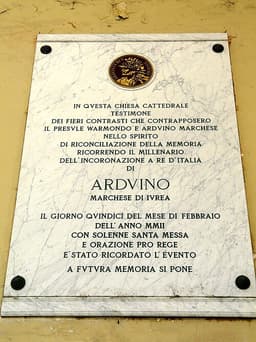
Arduin of Ivrea
Emperor · Medieval
41.9Total
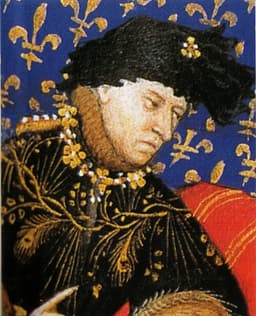
Charles VI of France
Emperor · Medieval
39.9Total
Basic Information
Born
955
1368
Died
1015
1422
Era
Medieval
Medieval
Nationality
Italy
France
Occupation
Emperor
Emperor
Civilization
Western
Western
Score Comparison
Military (10%)
50.0
10.2
Political (20%)
33.6
32.1
Influence (20%)
47.1
50.2
Legacy (20%)
35.8
45.0
Leadership (15%)
49.9
38.1
Strategy (15%)
36.8
45.0
TOTAL
41.9
39.9
Arduin of Ivrea — Complete Timeline
1002 AD
Proclaimed King of ItalyPolitical Action◆ Major
After the death of Emperor Otto III, Arduin of Ivrea was proclaimed King of Italy by the Lombard nobility in Pavia. This act challenged the authority of the German king Henry II, who claimed the Italian throne.
CoronationItalyRivalry
Impact: regional
1004 AD
Defeated by Henry II at the Battle of the Po RiverWar◆ Major
Arduin was defeated by Henry II's forces near the Po River. This military loss forced Arduin to retreat to his margraviate of Ivrea, effectively ending his claim to the Italian throne and allowing Henry II to be crowned King of Italy.
BattleHenry IIDefeat
Impact: regionaltragic
1014 AD
Excommunication by Pope Benedict VIIIPolitical Action
Arduin was excommunicated by Pope Benedict VIII for his continued resistance against Henry II. This ecclesiastical condemnation isolated Arduin politically and religiously, contributing to his eventual surrender and retirement.
ExcommunicationPapacyConflict
Impact: regionaldestructive
1015 AD
Retirement to a MonasteryOther
After years of failed resistance, Arduin retired to the Abbey of Fruttuaria, where he died as a monk. His retirement marked the end of the last major Italian challenge to German rule in the early 11th century.
RetirementItalyEnd of Resistance
Impact: regional
Charles VI of France — Complete Timeline
1392 AD
Onset of Mental IllnessOther
Charles VI suffered his first major episode of madness while on a military campaign in Brittany. He killed several of his own knights in a fit of frenzy. This began a lifelong pattern of intermittent insanity that crippled royal authority.
Mental IllnessCapetian
Impact: nationaltragic
1407 AD
Armagnac-Burgundian Civil WarWar◆ Major
Charles VI's reign saw the outbreak of a civil war between the Armagnac and Burgundian factions, who fought for control of the mad king. This internal conflict weakened France and allowed Henry V of England to conquer much of the kingdom.
Civil WarHundred Years' WarCapetian
Impact: nationaldestructive
1420 AD
Treaty of TroyesPolitical Action
Charles VI signed the Treaty of Troyes, which disinherited his son, the future Charles VII, and recognized Henry V of England as his heir. This treaty was forced by the Burgundian faction and effectively made France a dual monarchy with England.
TreatyHundred Years' WarCapetian
Impact: globaltragic
Expert Analysis
Origins
Arduin of Ivrea was born around 955 into the powerful Lombard House of Ivrea. His father, Margrave Dado, and his uncle, King Berengar II, provided a strong noble lineage. Arduin inherited the Margraviate of Ivrea in 990, controlling key Alpine passes. His early life centered on consolidating power in northwestern Italy, often clashing with the German-influenced bishops.
Charles VI of France was born on December 3, 1368, in Paris, the son of King Charles V and Jeanne de Bourbon. As a Valois prince, he received a thorough education in chivalry and governance. His father's death in 1380 left him king at age 11, with a regency council dominated by his uncles, the Dukes of Burgundy, Berry, and Anjou.
Rise to Power
Arduin's rise came after the death of Emperor Otto III in 1002. With the imperial throne vacant, the Lombard nobility in Pavia proclaimed Arduin King of Italy on February 15, 1002. This act challenged German authority and aimed to restore Lombard independence. However, Henry II, Duke of Bavaria, quickly asserted his claim as king of Germany and marched into Italy.
Charles VI became king at age 11 upon his father's death in 1380. For the first eight years, a regency council ruled. Charles took personal control in 1388, dismissing his uncles and relying on the Marmousets, former advisors of his father. His early reign showed promise, with efforts to reform taxation and administration.
Leadership & Governance
Arduin's leadership style was militaristic and feudal. He relied on the Lombard nobility and their traditional rights. His governance focused on maintaining independence from the Holy Roman Empire. He issued charters to monasteries and towns to secure support. However, his political score of 33.6 reflects his inability to build lasting alliances or manage the Papacy.
Charles VI's governance was marked by his mental illness. After his first episode in 1392, he had intermittent lucid intervals but was often incapacitated. The kingdom fractured into factions: the Armagnacs (loyal to the king's brother, Louis of Orléans) and the Burgundians (led by John the Fearless). Charles's political score of 32.1 shows that despite his royal authority, he lost control of the state.
Triumph & Tragedy
Arduin's greatest success was being crowned King of Italy in 1002, a brief triumph for Lombard independence. His tragedy was his defeat by Henry II at the Battle of the Po River in 1004, which ended his effective rule. Excommunication by Pope Benedict VIII in 1014 further isolated him. He retired to the Abbey of Fruttuaria in 1015, dying as a monk.
Charles VI's triumph was his early promise: he expelled the Marmousets briefly and attempted reform. His tragedy is the Treaty of Troyes in 1420, which disinherited his son Charles VII and recognized Henry V of England as heir. This treaty, signed under Burgundian pressure, led to the dual monarchy and prolonged the Hundred Years' War. Charles died in 1422, leaving a divided kingdom.
Character & Destiny
Arduin was a stubborn defender of Lombard autonomy. His character score of 49.9 reflects his determination but also his inflexibility. He lacked the political acumen to negotiate with Henry II or the Pope. His destiny was to be the last Italian king before the German domination of Italy for centuries.
Charles VI suffered from schizophrenia or bipolar disorder, with episodes of paranoia and violence. His mental illness was a tragedy for France. His character was gentle during lucid periods, but his incapacity allowed factional warfare. His destiny was to preside over the disintegration of royal authority, culminating in the English occupation of Paris.
Legacy
Arduin's legacy is minor: he is remembered as a symbol of Italian resistance to German rule. His score of 35.8 in legacy reflects his obscurity. No lasting institutions survived him. The Ivrea dynasty faded after his retirement.
Charles VI's legacy is more significant, scoring 45.0. The Treaty of Troyes shaped the Hundred Years' War and led to Joan of Arc's emergence. His madness became a cautionary tale about royal incapacity. The Armagnac-Burgundian feud persisted into the 15th century.
Conclusion
While Arduin of Ivrea scores slightly higher overall (41.9 vs 39.9), Charles VI had a greater impact on history due to the Treaty of Troyes and its effects on France and England. Arduin's brief kingship was a footnote, whereas Charles's reign altered the course of the Hundred Years' War. Charles's influence score of 50.2 versus Arduin's 47.1 supports this. Therefore, Charles VI of France had a more significant historical impact, despite his lower total score.
Rankings
🥇
Arduin of IvreaLeader
Mil: 50.0Pol: 33.6Inf: 47.1
41.9
🥈
Charles VI of France
Mil: 10.2Pol: 32.1Inf: 50.2
39.9
+2.0 behind
How This Comparison Works
Algorithm
Each figure is scored on 6 dimensions (0—100 scale) based on structured historical data: Military (10%), Political (20%), Influence (20%), Legacy (20%), Leadership (15%), Strategy (15%). The weighted total produces the final ranking.
Data Sources
Scores are computed from structured sub-indicators in the database. Scale factors adjust for era (Ancient ×0.85, Modern ×1.0) and civilization size (Eastern ×1.05, Other ×0.80) to account for differences in population and military scale.
Maximum 3 Figures
Comparisons are limited to 2—3 figures to ensure readability and statistical meaningfulness.
Error Margins
±5 points per dimension — Sub-scores are derived from historical records with inherent uncertainty. Two figures within 5 points on a dimension should be considered roughly equivalent in that area.
Total Score Accuracy
±3 points overall — The weighted combination of 6 dimensions produces a total score with approximately ±3 points of uncertainty. Differences of less than 3 points are not statistically significant— the figures are effectively tied.
Known Limitations
- Historical records are incomplete and uneven across civilizations
- Figures from oral-tradition societies may be underrepresented
- Occupation labels can misclassify multi-role figures
- Scores measure capability and impact, not moral character
- Quantitative scoring is a comparison tool, not absolute truth
Capability Radar
Military (10%) — Battles & Warfare
Battles
15
10
Win Rate
20
10
Expansion
10
5
Political (20%) — Governance & Reform
Reform
5
10
Diplomacy
15
10
Economy
5
10
Influence (20%) — Cultural & Global Reach
Cultural
5
20
Global
5
20
Legacy (20%) — Historical Impact
Historical
10
40
Longevity
5
30
Leadership (15%) — Power & Stability
Tenure
10
40
Stability
5
5
Strategy (15%) — Tactics & Innovation
Strategy
10
5
Tactics
15
5
Reform
5
5
Similar Comparisons
Comments & Discussion
No comments yet. Be the first to share your thoughts!