Loading...
Charles VI of France vs Julius Caesar
Julius Caesar leads by 42.9 pts · 2 figures compared
…
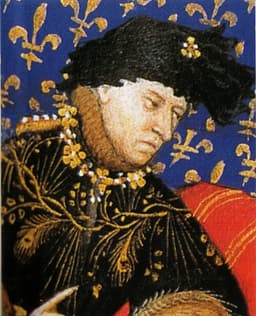
Charles VI of France
Emperor · Medieval
39.9Total

Julius Caesar
General · Ancient
82.8Total
Basic Information
Born
1368
-100
Died
1422
-44
Era
Medieval
Ancient
Nationality
France
Roman Republic
Occupation
Emperor
General
Civilization
Western
Western
Score Comparison
Military (10%)
10.2
88.0
Political (20%)
32.1
78.0
Influence (20%)
50.2
85.0
Legacy (20%)
45.0
82.0
Leadership (15%)
38.1
80.0
Strategy (15%)
45.0
85.0
TOTAL
39.9
82.8
Charles VI of France — Complete Timeline
1392 AD
Onset of Mental IllnessOther
Charles VI suffered his first major episode of madness while on a military campaign in Brittany. He killed several of his own knights in a fit of frenzy. This began a lifelong pattern of intermittent insanity that crippled royal authority.
Mental IllnessCapetian
Impact: nationaltragic
1407 AD
Armagnac-Burgundian Civil WarWar◆ Major
Charles VI's reign saw the outbreak of a civil war between the Armagnac and Burgundian factions, who fought for control of the mad king. This internal conflict weakened France and allowed Henry V of England to conquer much of the kingdom.
Civil WarHundred Years' WarCapetian
Impact: nationaldestructive
1420 AD
Treaty of TroyesPolitical Action
Charles VI signed the Treaty of Troyes, which disinherited his son, the future Charles VII, and recognized Henry V of England as his heir. This treaty was forced by the Burgundian faction and effectively made France a dual monarchy with England.
TreatyHundred Years' WarCapetian
Impact: globaltragic
Julius Caesar — Complete Timeline
58 BC
Gallic WarsWar◆ Major
Caesar, as proconsul of Gaul, launched a series of campaigns that conquered all of Gaul (modern France, Belgium, and parts of Switzerland). He fought numerous battles, including against the Helvetii, the Belgae, and the Gallic chieftain Vercingetorix. The wars brought immense wealth and a loyal army to Caesar.
Gallic WarsConquestRoman Expansion
Impact: regional
49 BC
Crossing the RubiconPolitical Action◆ Major
Caesar led Legio XIII across the Rubicon River into Italy, defying the Roman Senate's order to disband his army. This act triggered a civil war against Pompey and the Optimates, ultimately leading to Caesar's dictatorship and the end of the Roman Republic.
Roman Civil WarEnd of RepublicPower Struggle
Impact: global
48 BC
Battle of PharsalusWar◆ Major
Caesar's outnumbered army defeated the larger forces of Pompey the Great at Pharsalus in Greece. Caesar's tactical use of a reserve line to counter Pompey's cavalry charge proved decisive. Pompey fled to Egypt, where he was assassinated, leaving Caesar as the undisputed master of the Roman world.
Roman Civil WarBattleDecisive Victory
Impact: regional
44 BC
Appointment as Dictator for LifePolitical Action◆ Major
The Roman Senate appointed Caesar dictator perpetuo (dictator for life), granting him unprecedented personal power. This move concentrated military, legislative, and judicial authority in one person, effectively ending the Roman Republic's traditional system of checks and balances and alarming many senators.
DictatorshipEnd of RepublicPower Consolidation
Impact: regionaldestructive
Assassination on the Ides of MarchPolitical Action◆ Major
A group of Roman senators, led by Marcus Junius Brutus and Gaius Cassius Longinus, stabbed Caesar to death at a meeting of the Senate in the Theatre of Pompey. The assassination was intended to restore the Republic, but instead triggered another civil war that led to the rise of the Roman Empire.
AssassinationRoman PoliticsEnd of Republic
Impact: globaldestructive
Expert Analysis
charles-vi-of-france-vs-julius-caesar
# The Crossroads of Fate: Caesar and the Mad King
On a March morning in 44 BCE, Julius Caesar walked into the Senate chamber and met his end beneath twenty-three daggers. Nearly fifteen centuries later, in October 1420, another ruler—Charles VI of France—signed a document that would disinherit his own son and hand his kingdom to a foreign king. Both men stood at pivotal moments in Western history. One built an empire that reshaped the world; the other watched his realm collapse into civil war and foreign conquest. What separates a titan from a tragedy? The answer lies not merely in talent, but in the cruel lottery of the human mind.
Origins
Gaius Julius Caesar was born into the patrician Julian clan in 100 BCE, a time when the Roman Republic was already cracking under the weight of its own success. His family claimed descent from the goddess Venus, but in practical terms they were political outsiders, aligned with the popular reformist faction against the conservative Senate. Caesar grew up in the shadow of his uncle Gaius Marius, a military reformer who had defied tradition, and he learned early that power belonged to those who seized it.
Charles VI inherited the French throne at age twelve in 1380, a boy king in a kingdom still recovering from the Black Death and the Hundred Years' War. Unlike Caesar, who had to claw his way upward, Charles was born into absolute authority. His father, Charles V the Wise, had restored French fortunes after the disasters of Crécy and Poitiers. But the son lacked the father's steadiness. In 1392, while on a military campaign in Brittany, Charles suffered his first major episode of madness. He killed several of his own knights before being subdued. From that moment, France belonged not to its king, but to his illness.
Rise to Power
Caesar's path was a masterclass in strategic patience. He served as a military tribune, then quaestor in Spain, where he reportedly wept before a statue of Alexander the Great because he had achieved so little by the same age. He built alliances with the wealthy Crassus and the powerful Pompey, forming the First Triumvirate in 60 BCE. His consulship in 59 BCE was marked by aggressive land reforms that won him the loyalty of veterans and the poor—and the hatred of the optimates, the aristocratic faction that controlled the Senate.
Charles VI, by contrast, never rose to power; power was thrust upon him, then stripped away by madness. After 1392, he experienced lucid intervals, but they grew rarer. The vacuum was filled by his queen, Isabeau of Bavaria, and by his uncle, Philip the Bold of Burgundy. By 1407, the rivalry between the Armagnac and Burgundian factions had erupted into open civil war. The king became a pawn, his name used to authorize atrocities he could not comprehend.
Leadership & Governance
Caesar's military genius is beyond dispute. His conquest of Gaul (58–50 BCE) was a feat of logistics, tactics, and psychological warfare. He crossed the Rhine, invaded Britain, and at Alesia besieged and starved a Gallic army that outnumbered his own. His Commentaries remain a masterpiece of propaganda and self-fashioning. Politically, he was equally ambitious: as dictator, he reformed the calendar, granted citizenship to provincials, initiated public works, and centralized authority. His score of 88 in military and 78 in political affairs reflects a man who understood that war and governance were two sides of the same coin.
Charles VI's scores—43.3 military, 45.2 political—tell a story of paralysis. He was not stupid; during his lucid periods, he showed intelligence and even kindness. But a kingdom cannot be ruled by intermittent sanity. The Treaty of Troyes in 1420 was the culmination of his tragedy. Surrounded by Burgundian allies who had captured Paris, Charles signed away his son's inheritance, recognizing Henry V of England as heir to France. The document claimed that Charles VII was illegitimate—a fiction, but one that the English used to press their claim for decades.
Triumph & Tragedy
Caesar's greatest moment came in 49 BCE when he crossed the Rubicon River with a single legion, defying the Senate's order to disband his army. "The die is cast," he reportedly said. Within five years, he had defeated Pompey, pacified the East, and returned to Rome as dictator for life. His tragedy was that he understood power better than its limits. The Ides of March in 44 BCE proved that even a genius cannot outrun the resentment he inspires.
Charles VI's tragedy is simpler and more heartbreaking. His triumph, if it can be called that, was surviving. He reigned for forty-two years, but for most of them he was a ghost king, wandering the corridors of the Hôtel Saint-Pol in Paris, believing he was made of glass. When he died in 1422, he left a kingdom occupied by the English, torn by civil war, and ruled by a regent who was not his son.
Character & Destiny
Caesar was audacious, calculating, and supremely confident. He pardoned his enemies, promoted talent regardless of birth, and understood that spectacle—triumphs, games, statues—could cement loyalty. But his ambition was insatiable. He refused to disband his army, refused to accept a subordinate role, and in doing so, guaranteed his own destruction. His character was his destiny.
Charles VI was gentle and well-meaning, but his mind was a battlefield he could not control. His madness took the form of violent rages, delusions, and catatonia. He believed he was made of glass, and ordered his servants not to touch him. He forgot his wife, his children, his own name. His character was not his destiny; his illness was.
Legacy
Caesar's legacy is immeasurable. His name became synonymous with imperial power: Kaiser, Tsar, Caesar. The Roman Empire he unwittingly created lasted five hundred years in the West and a thousand in the East. His reforms—the calendar, the census, the centralization of authority—shaped the structure of European governance. His assassination sparked a civil war that ended the Republic forever. He is remembered as a genius, a tyrant, and the man who made the modern world possible.
Charles VI's legacy is a cautionary tale. He is remembered as the Mad King, the monarch who lost France. But his story is also one of institutional failure: a system that placed absolute power in one man, with no safeguard against his collapse. The Treaty of Troyes was a disaster, but it was signed by a man who did not know what he was doing. The tragedy is not that Charles was mad, but that France had no way to govern without him.
Conclusion
Standing at the edge of history, Caesar and Charles VI reveal the terrifying randomness of human destiny. One man bent the world to his will; the other was broken by a world he could not comprehend. Both were shaped by their eras, but one era produced a conqueror, the other a casualty. Caesar's ambition destroyed the Republic but built an empire. Charles's madness destroyed a kingdom and nearly a dynasty. In the end, the difference between them was not intelligence or opportunity, but the cruelest variable of all: the soundness of the mind that must bear the weight of power. The Ides of March claimed Caesar; the darkness within claimed Charles. History remembers both, but only one as the architect of our world.
Rankings
🥇
Julius CaesarLeader
Mil: 88.0Pol: 78.0Inf: 85.0
82.8
🥈
Charles VI of France
Mil: 10.2Pol: 32.1Inf: 50.2
39.9
+42.9 behind
How This Comparison Works
Algorithm
Each figure is scored on 6 dimensions (0—100 scale) based on structured historical data: Military (10%), Political (20%), Influence (20%), Legacy (20%), Leadership (15%), Strategy (15%). The weighted total produces the final ranking.
Data Sources
Scores are computed from structured sub-indicators in the database. Scale factors adjust for era (Ancient ×0.85, Modern ×1.0) and civilization size (Eastern ×1.05, Other ×0.80) to account for differences in population and military scale.
Maximum 3 Figures
Comparisons are limited to 2—3 figures to ensure readability and statistical meaningfulness.
Error Margins
±5 points per dimension — Sub-scores are derived from historical records with inherent uncertainty. Two figures within 5 points on a dimension should be considered roughly equivalent in that area.
Total Score Accuracy
±3 points overall — The weighted combination of 6 dimensions produces a total score with approximately ±3 points of uncertainty. Differences of less than 3 points are not statistically significant— the figures are effectively tied.
Known Limitations
- Historical records are incomplete and uneven across civilizations
- Figures from oral-tradition societies may be underrepresented
- Occupation labels can misclassify multi-role figures
- Scores measure capability and impact, not moral character
- Quantitative scoring is a comparison tool, not absolute truth
Capability Radar
Military (10%) — Battles & Warfare
Battles
10
95
Win Rate
10
92
Expansion
5
97
Political (20%) — Governance & Reform
Reform
10
90
Diplomacy
10
85
Economy
10
82
Influence (20%) — Cultural & Global Reach
Cultural
20
88
Global
20
94
Legacy (20%) — Historical Impact
Historical
40
95
Longevity
30
96
Leadership (15%) — Power & Stability
Tenure
40
75
Stability
5
60
Strategy (15%) — Tactics & Innovation
Strategy
5
94
Tactics
5
96
Reform
5
88
Similar Comparisons
Comments & Discussion
SenatorSkeptic6/17/2026
Caesar’s genius wasn’t divine—it was a PR campaign. He inflated his Gallic victories, wrote his own press releases (those “Commentaries”), and controlled the narrative. Charles VI lacked that media machine; his madness was documented by chroniclers who painted him as a grotesque. If Caesar had lost his mind after Alesia, history would’ve called him a tyrant too. Show me one unbiased source from either era, and I’ll reconsider. Sparta had it right—public opinion is just another battlefield.
MadKingRealist6/17/2026
查理六世不是失败者,他是一场不可抗力下的悲剧。公元1392年,他第一次发疯时刺死了自己的侍从,这不是懦弱,而是命运的捉弄。凯撒选择了他的死亡,去元老院赴约时知道自己可能送死——这是一种清醒的掌控。而查理在1420年签下《特鲁瓦条约》时,已经狂躁症发作多年,他根本不懂自己在做什么。拿一个石雕意志的将军跟一个精神崩溃的病人比,就像拿火炬比烛光,不公平。历史是冷酷的,但你可以更公平。
CohortCritic6/17/2026
Let’s get real—Caesar’s “empire” was built on borrowed cash and slave labor. He used Gaul’s wealth to bribe Rome’s elite, while Charles VI inherited a bankrupt crown from the Plague. The 1420 treaty wasn’t weakness; it was a desperate power play by the Burgundians who exploited his mental state. Caesar had the luxury of a stable republic (if you call slave revolts “stable”) to grind into a dictatorship. Charles had the Hundred Years’ War and a schizophrenic brain. Apples and oranges, people.
帝国观察者6/17/2026
凯撒是外向的天才,查理六世是内向的受害者。凯撒的“我来了,我看到了,我征服了”是一句征服者的狂言,而查理的“我是谁?”在1393年的那次疯症中反复呢喃。凯撒用剑指挥历史,查理被历史拖着走。但别搞错了,凯撒的《高卢战记》是我们唯一知道的叙事——如果查理六世写了书,或许我们会看到另一个版本的欧洲。可惜他的大脑从没给他这个机会。
ReformCritic6/17/2026
Caesar died a dictator’s death—stabbed for fear he’d crown himself. Charles VI died from a fever in 1422, his kingdom already sold to England by the Treaty of Troyes. Which is worse? Caesar’s assassination was a political statement; Charles’s death was a footnote in a war. Don’t romanticize the Mad King: he disinherited his own son, the future Charles VII, because his wife Isabeau of Bavaria and the Duke of