Loading...
Arduin of Ivrea vs Julius Caesar
Julius Caesar leads by 40.9 pts · 2 figures compared
…
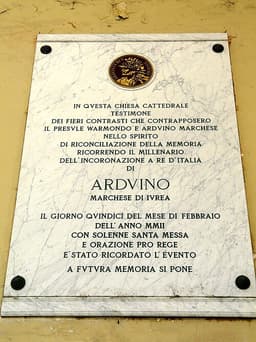
Arduin of Ivrea
Emperor · Medieval
41.9Total

Julius Caesar
General · Ancient
82.8Total
Basic Information
Born
955
-100
Died
1015
-44
Era
Medieval
Ancient
Nationality
Italy
Roman Republic
Occupation
Emperor
General
Civilization
Western
Western
Score Comparison
Military (10%)
50.0
88.0
Political (20%)
33.6
78.0
Influence (20%)
47.1
85.0
Legacy (20%)
35.8
82.0
Leadership (15%)
49.9
80.0
Strategy (15%)
36.8
85.0
TOTAL
41.9
82.8
Arduin of Ivrea — Complete Timeline
1002 AD
Proclaimed King of ItalyPolitical Action◆ Major
After the death of Emperor Otto III, Arduin of Ivrea was proclaimed King of Italy by the Lombard nobility in Pavia. This act challenged the authority of the German king Henry II, who claimed the Italian throne.
CoronationItalyRivalry
Impact: regional
1004 AD
Defeated by Henry II at the Battle of the Po RiverWar◆ Major
Arduin was defeated by Henry II's forces near the Po River. This military loss forced Arduin to retreat to his margraviate of Ivrea, effectively ending his claim to the Italian throne and allowing Henry II to be crowned King of Italy.
BattleHenry IIDefeat
Impact: regionaltragic
1014 AD
Excommunication by Pope Benedict VIIIPolitical Action
Arduin was excommunicated by Pope Benedict VIII for his continued resistance against Henry II. This ecclesiastical condemnation isolated Arduin politically and religiously, contributing to his eventual surrender and retirement.
ExcommunicationPapacyConflict
Impact: regionaldestructive
1015 AD
Retirement to a MonasteryOther
After years of failed resistance, Arduin retired to the Abbey of Fruttuaria, where he died as a monk. His retirement marked the end of the last major Italian challenge to German rule in the early 11th century.
RetirementItalyEnd of Resistance
Impact: regional
Julius Caesar — Complete Timeline
58 BC
Gallic WarsWar◆ Major
Caesar, as proconsul of Gaul, launched a series of campaigns that conquered all of Gaul (modern France, Belgium, and parts of Switzerland). He fought numerous battles, including against the Helvetii, the Belgae, and the Gallic chieftain Vercingetorix. The wars brought immense wealth and a loyal army to Caesar.
Gallic WarsConquestRoman Expansion
Impact: regional
49 BC
Crossing the RubiconPolitical Action◆ Major
Caesar led Legio XIII across the Rubicon River into Italy, defying the Roman Senate's order to disband his army. This act triggered a civil war against Pompey and the Optimates, ultimately leading to Caesar's dictatorship and the end of the Roman Republic.
Roman Civil WarEnd of RepublicPower Struggle
Impact: global
48 BC
Battle of PharsalusWar◆ Major
Caesar's outnumbered army defeated the larger forces of Pompey the Great at Pharsalus in Greece. Caesar's tactical use of a reserve line to counter Pompey's cavalry charge proved decisive. Pompey fled to Egypt, where he was assassinated, leaving Caesar as the undisputed master of the Roman world.
Roman Civil WarBattleDecisive Victory
Impact: regional
44 BC
Appointment as Dictator for LifePolitical Action◆ Major
The Roman Senate appointed Caesar dictator perpetuo (dictator for life), granting him unprecedented personal power. This move concentrated military, legislative, and judicial authority in one person, effectively ending the Roman Republic's traditional system of checks and balances and alarming many senators.
DictatorshipEnd of RepublicPower Consolidation
Impact: regionaldestructive
Assassination on the Ides of MarchPolitical Action◆ Major
A group of Roman senators, led by Marcus Junius Brutus and Gaius Cassius Longinus, stabbed Caesar to death at a meeting of the Senate in the Theatre of Pompey. The assassination was intended to restore the Republic, but instead triggered another civil war that led to the rise of the Roman Empire.
AssassinationRoman PoliticsEnd of Republic
Impact: globaldestructive
Expert Analysis
arduin-of-ivrea-vs-julius-caesar
# The Dictator and the Margrave: Two Paths to Power in the Roman and Medieval Worlds
On the Ides of March, 44 BCE, Gaius Julius Caesar fell beneath the daggers of Roman senators, his blood pooling at the base of Pompey’s statue. A thousand years later, in 1015, Arduin of Ivrea died quietly in an abbey, a monk’s robe his final garment. One man’s death shook the foundations of the ancient world; the other’s passed with barely a whisper. What drove these two men—both rulers of Italy, both claimants to supreme power—to such radically different ends? The answer lies not in their ambitions, which were equally fierce, but in the worlds they inhabited and the tools they wielded.
Origins
Julius Caesar was born into the twilight of the Roman Republic, a world of iron discipline and silver ambition. His family, the Julii, claimed descent from the goddess Venus, but their political fortunes had faded. Raised in the turbulent streets of Rome, Caesar absorbed the lessons of Marius and Sulla—that military glory and popular favor could break the stranglehold of the Senate. He was a patrician by birth, but a populist by instinct.
Arduin of Ivrea, by contrast, emerged from the fractured landscape of post-Carolingian Italy. Born in 955, he was a Lombard noble, the Margrave of Ivrea, a title that placed him at the head of a feudal patchwork. His world was not one of republican institutions but of oaths, fiefs, and the ever-present shadow of the Holy Roman Empire. Where Caesar saw a state to be conquered, Arduin saw a kingdom to be claimed. The difference in their starting points—a centralized republic versus a decentralized feudal order—shaped everything that followed.
Rise to Power
Caesar’s ascent was a masterpiece of calculated risk. He climbed the Roman political ladder—quaestor, aedile, praetor—but his true springboard was Gaul. From 58 to 50 BCE, he conquered a vast territory, amassing wealth, a loyal army, and a reputation for genius. His crossing of the Rubicon in 49 BCE was a point of no return, a gamble that turned him from general to dictator.
Arduin’s rise was simpler and more desperate. In 1002, Emperor Otto III died without an heir. Sensing opportunity, Arduin was proclaimed King of Italy by the Lombard nobility in Pavia. It was a crown offered, not seized—a feudal election, not a military conquest. Where Caesar built his power over years of war, Arduin’s came in a moment of political vacuum. This fragility would prove fatal.
Leadership & Governance
Caesar ruled with a blend of clemency and iron. He pardoned former enemies, reformed the calendar, and extended citizenship to provincials. His military strategy was audacious—siege works at Alesia, double lines at Pharsalus—and his political wisdom lay in understanding that the Republic could not be saved, only replaced. He centralized power, but he also gave Rome stability.
Arduin, by contrast, governed a kingdom that existed mostly on parchment. His military score of 22.0 reflects his defeat at the Battle of the Po River in 1004, where Henry II’s forces crushed his army. His political score of 48.7 suggests a man who could negotiate but not dominate. He lacked Caesar’s strategic vision—his score of 41.7 against Caesar’s 88.0—and his leadership was too weak to hold the Lombard nobles together. Where Caesar reformed institutions, Arduin could barely defend his throne.
Triumph & Tragedy
Caesar’s greatest triumph was the conquest of Gaul, a feat that doubled Rome’s territory and made him the richest man in the Republic. His tragedy was the assassination—a failure to understand that the Senate would never accept a king in all but name. His final words, according to legend, were “Et tu, Brute?”—a recognition that even friendship could not survive absolute power.
Arduin’s triumph was his coronation itself, a fleeting moment when a Lombard noble sat on the Italian throne. His tragedy unfolded in slow motion: defeat at the Po, excommunication by Pope Benedict VIII in 1014, and finally, retirement to the Abbey of Fruttuaria. He died a monk, his kingdom absorbed into the Empire. Where Caesar’s end was violent and dramatic, Arduin’s was quiet and forgotten.
Character & Destiny
Caesar was ruthless, brilliant, and charismatic. He wrote his own history, both in prose and in blood. His personality—audacity tempered by calculation—drove him to the brink of kingship. He believed in his own star, and for a time, the world agreed.
Arduin was stubborn but outmatched. He lacked Caesar’s strategic genius and the institutional support that Rome provided. His character was that of a feudal lord, not a world-conqueror. Destiny, in his case, was shaped by forces he could not control: the power of the German emperor, the hostility of the pope, and the fragmentation of Italy itself.
Legacy
Caesar’s legacy is immortal. His name became a title—Kaiser, Tsar—and his reforms laid the foundation for the Roman Empire. He is remembered as a military genius, a political revolutionary, and a cautionary tale about ambition. His total score of 83.3 reflects a man who reshaped Western history.
Arduin’s legacy is a footnote. His score of 46.3 marks him as a minor figure, remembered only by specialists. He was the last Lombard king of Italy, a symbol of a world that was passing away. His failure was not personal but structural: he tried to revive an independent Italian kingdom in an age of empires.
Conclusion
The difference between Caesar and Arduin is not one of talent alone, but of context. Caesar inherited a Republic ripe for transformation; Arduin inherited a kingdom already lost. One man’s ambition matched his moment; the other’s did not. In the end, history remembers those who shape their age, not those who are crushed by it. Caesar fell, but his shadow lingers; Arduin faded, and his name is dust. The Ides of March and the quiet abbey—two endings, one world apart.
Rankings
🥇
Julius CaesarLeader
Mil: 88.0Pol: 78.0Inf: 85.0
82.8
🥈
Arduin of Ivrea
Mil: 50.0Pol: 33.6Inf: 47.1
41.9
+40.9 behind
How This Comparison Works
Algorithm
Each figure is scored on 6 dimensions (0—100 scale) based on structured historical data: Military (10%), Political (20%), Influence (20%), Legacy (20%), Leadership (15%), Strategy (15%). The weighted total produces the final ranking.
Data Sources
Scores are computed from structured sub-indicators in the database. Scale factors adjust for era (Ancient ×0.85, Modern ×1.0) and civilization size (Eastern ×1.05, Other ×0.80) to account for differences in population and military scale.
Maximum 3 Figures
Comparisons are limited to 2—3 figures to ensure readability and statistical meaningfulness.
Error Margins
±5 points per dimension — Sub-scores are derived from historical records with inherent uncertainty. Two figures within 5 points on a dimension should be considered roughly equivalent in that area.
Total Score Accuracy
±3 points overall — The weighted combination of 6 dimensions produces a total score with approximately ±3 points of uncertainty. Differences of less than 3 points are not statistically significant— the figures are effectively tied.
Known Limitations
- Historical records are incomplete and uneven across civilizations
- Figures from oral-tradition societies may be underrepresented
- Occupation labels can misclassify multi-role figures
- Scores measure capability and impact, not moral character
- Quantitative scoring is a comparison tool, not absolute truth
Capability Radar
Military (10%) — Battles & Warfare
Battles
15
95
Win Rate
20
92
Expansion
10
97
Political (20%) — Governance & Reform
Reform
5
90
Diplomacy
15
85
Economy
5
82
Influence (20%) — Cultural & Global Reach
Cultural
5
88
Global
5
94
Legacy (20%) — Historical Impact
Historical
10
95
Longevity
5
96
Leadership (15%) — Power & Stability
Tenure
10
75
Stability
5
60
Strategy (15%) — Tactics & Innovation
Strategy
10
94
Tactics
15
96
Reform
5
88
Similar Comparisons
Comments & Discussion
ShadowLegion6/17/2026
Caesar’s real strategic genius wasn’t just winning battles—it was understanding that Roman politics was a bloodsport where you either climbed or died. Arduin? He played feudal chess in Italy thinking oaths and titles mattered. Wake up, Margrave: when Otto III dies, the Empire’s wolves don’t care about your Lombard pedigree. Caesar crossed the Rubicon knowing exactly what it cost. Arduin fought three emperors and ended up in a monastery. That’s the difference between a dictator and a footnote.
铁幕铁骑6/17/2026
别跟我提什么阿尔杜因跟凯撒比军事生涯——根本不配。一个守着阿尔卑斯山脚小领地的封建领主,跟征服高卢、跨过卢比孔河的男人比?凯撒在阿莱西亚围城时十二万高卢联军都能粉碎,阿尔杜因连个亨利二世都摆不平。散了吧,这比较就像拿蜡烛跟太阳比光。