Loading...
Anxi Khan vs Fruzhin
Fruzhin leads by 1.8 pts · 2 figures compared
…
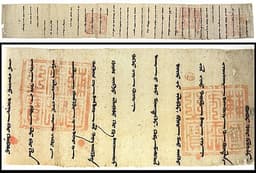
Anxi Khan
Emperor · Medieval
40.0Total

Fruzhin
Emperor · Medieval
41.8Total
Basic Information
Born
832
1380
Died
847
1460
Era
Medieval
Medieval
Nationality
Uyghur Khaganate
Bulgaria
Occupation
Emperor
Emperor
Civilization
Eastern
Western
Score Comparison
Military (10%)
50.0
50.0
Political (20%)
29.3
29.3
Influence (20%)
47.1
49.4
Legacy (20%)
37.5
39.2
Leadership (15%)
39.0
39.0
Strategy (15%)
35.7
43.7
TOTAL
40.0
41.8
Anxi Khan — Complete Timeline
840 AD
Collapse of the Uyghur KhaganateWar◆ Major
Anxi Khan's reign saw the final collapse of the Uyghur Khaganate after a Kyrgyz invasion. The Kyrgyz sacked the capital Ordu-Baliq and destroyed Uyghur power, forcing the Uyghurs to flee south and west, ending their empire.
CollapseKyrgyz InvasionEnd of Empire
Impact: regionaltragic
843 AD
Flight to the Tarim BasinPolitical Action◆ Major
After the fall of the Khaganate, Anxi Khan led a remnant of Uyghurs to the Tarim Basin, where they established the Kingdom of Qocho. This migration preserved Uyghur culture and led to the formation of the Uyghur states in Xinjiang.
MigrationUyghur DiasporaQocho
Impact: regional
847 AD
Death in ExileOther
Anxi Khan died in exile in the Tarim Basin, likely killed by local rivals or in a skirmish. His death marked the end of the Uyghur imperial line, though Uyghur successor states continued to exist in the region.
DeathExileEnd of Dynasty
tragic
Fruzhin — Complete Timeline
1404 AD
Leadership of the Uprising of Konstantin and FruzhinWar◆ Major
Fruzhin, son of Tsar Ivan Shishman, led an anti-Ottoman uprising in Bulgaria along with his cousin Konstantin. The rebellion aimed to restore the Bulgarian Empire but was ultimately suppressed by the Ottomans.
UprisingOttoman WarsBulgarian Resistance
Impact: regionaltragic
1408 AD
Exile and service in the Kingdom of HungaryPolitical Action
After the failure of the uprising, Fruzhin fled to the Kingdom of Hungary, where he served as a military commander. He participated in campaigns against the Ottoman Empire, seeking to liberate Bulgaria.
ExileHungaryAnti-Ottoman Resistance
Impact: regional
1444 AD
Participation in the Crusade of Varna (1444)War◆ Major
Fruzhin joined the Crusade of Varna, a combined Christian effort to drive the Ottomans from the Balkans. The crusade ended in defeat at the Battle of Varna, where Fruzhin's hopes for Bulgarian liberation were dashed.
CrusadeOttoman WarsBulgarian Resistance
Impact: regionaltragic
Expert Analysis
Origins
Anxi Khan was the last ruler of the Uyghur Khaganate, born into the royal Yaglakar clan. His early life remains obscure, but he likely received training in steppe governance and warfare. The Uyghur Empire, centered at Ordu-Baliq, had dominated Central Asia since 744 CE, but by Anxi's accession, internal strife and external threats were mounting. Fruzhin, born circa 1380, was a son of Tsar Ivan Shishman of Bulgaria. He grew up during the Ottoman conquest of the Balkans; his father's kingdom fell in 1395 after the Battle of Nicopolis. Fruzhin escaped to the West, where he sought aid from Hungary and the Papacy, becoming a symbol of Bulgarian resistance.
Rise to Power
Anxi Khan became khagan in 840 CE, inheriting a crumbling empire. The Uyghurs faced a Kyrgyz invasion, and their capital Ordu-Baliq was sacked in 840. Anxi fled with remnants to the Tarim Basin, where he established the Kingdom of Qocho. His power rested on his royal lineage and the loyalty of Uyghur nobles, but he never regained the Khaganate's former strength. Fruzhin rose to prominence in the early 1400s as a claimant to the Bulgarian throne. In 1404, he and his cousin Konstantin launched an uprising against Ottoman rule, rallying support from local boyars and neighboring Christian states. The rebellion initially succeeded in parts of northwestern Bulgaria, but was crushed by 1413. Fruzhin then fled to Hungary, where he served King Sigismund as a military commander.
Leadership & Governance
Anxi Khan's leadership was reactive; he focused on preserving Uyghur identity and Buddhism in Qocho rather than reconquest. He adopted a sedentary lifestyle, patronizing Buddhist monasteries and fostering trade along the Silk Road. His governance score of 29.3 reflects limited administrative control. Fruzhin, with a political score of 29.3, also struggled to govern effectively. His uprising lacked a solid territorial base, and he relied heavily on Hungarian support. After the uprising, he served as a mercenary commander, leading troops in Hungary's campaigns against the Ottomans, such as the Crusade of Varna in 1444. His leadership style was martial, but he failed to unite Bulgarian factions.
Triumph & Tragedy
Anxi Khan's greatest triumph was leading a successful migration to Qocho, preserving Uyghur culture and establishing a kingdom that lasted until the 13th century. His tragedy was the loss of the Khaganate; he died in exile, likely assassinated, around 850 CE. Fruzhin's triumph was his role in the Crusade of Varna, where he fought alongside European allies, though the battle ended in disaster. His tragedy was the failure of his uprising and the permanent loss of Bulgarian independence until 1878. Both men scored 50.0 in military, indicating competent but not exceptional commanders.
Character & Destiny
Anxi Khan appears pragmatic, adapting to exile and religious change. His decision to flee rather than fight to the death preserved his people but ended his dynasty's imperial claim. Fruzhin was persistent, continuously seeking foreign aid, but his reliance on external powers limited his autonomy. His character was that of a prince without a kingdom, destined to be a pawn in larger conflicts. Historical assessments note Anxi as a cultural preserver, while Fruzhin is seen as a symbol of resistance.
Legacy
Anxi Khan's legacy is the Uyghur Kingdom of Qocho, which became a center of Buddhism and Nestorian Christianity, influencing Central Asian culture. His migration is credited with creating the modern Uyghur identity. His influence score of 47.1 reflects this. Fruzhin's legacy is as a Bulgarian national hero; his uprising is remembered as an early attempt to throw off Ottoman rule. His legacy score of 39.2 is lower, as Bulgaria remained under Ottoman control for centuries. The Uyghur legacy proved more enduring in cultural terms.
Conclusion
Anxi Khan had a greater long-term impact. Despite a lower total score (40.0 vs. 41.8), his establishment of Qocho created a lasting Uyghur civilization that persists today. Fruzhin's rebellion, while heroic, failed to restore Bulgarian independence and his influence was limited to military service. Anxi's strategy score of 35.7 vs. Fruzhin's 43.7 suggests Fruzhin was more tactically adept, but Anxi's strategic migration was more consequential. Therefore, Anxi Khan's legacy outweighs Fruzhin's.
Rankings
🥇
FruzhinLeader
Mil: 50.0Pol: 29.3Inf: 49.4
41.8
🥈
Anxi Khan
Mil: 50.0Pol: 29.3Inf: 47.1
40.0
+1.8 behind
How This Comparison Works
Algorithm
Each figure is scored on 6 dimensions (0—100 scale) based on structured historical data: Military (10%), Political (20%), Influence (20%), Legacy (20%), Leadership (15%), Strategy (15%). The weighted total produces the final ranking.
Data Sources
Scores are computed from structured sub-indicators in the database. Scale factors adjust for era (Ancient ×0.85, Modern ×1.0) and civilization size (Eastern ×1.05, Other ×0.80) to account for differences in population and military scale.
Maximum 3 Figures
Comparisons are limited to 2—3 figures to ensure readability and statistical meaningfulness.
Error Margins
±5 points per dimension — Sub-scores are derived from historical records with inherent uncertainty. Two figures within 5 points on a dimension should be considered roughly equivalent in that area.
Total Score Accuracy
±3 points overall — The weighted combination of 6 dimensions produces a total score with approximately ±3 points of uncertainty. Differences of less than 3 points are not statistically significant— the figures are effectively tied.
Known Limitations
- Historical records are incomplete and uneven across civilizations
- Figures from oral-tradition societies may be underrepresented
- Occupation labels can misclassify multi-role figures
- Scores measure capability and impact, not moral character
- Quantitative scoring is a comparison tool, not absolute truth
Capability Radar
Military (10%) — Battles & Warfare
Battles
20
20
Win Rate
15
15
Expansion
10
10
Political (20%) — Governance & Reform
Reform
10
10
Diplomacy
20
20
Economy
10
10
Influence (20%) — Cultural & Global Reach
Cultural
10
15
Global
10
10
Legacy (20%) — Historical Impact
Historical
15
20
Longevity
10
15
Leadership (15%) — Power & Stability
Tenure
15
15
Stability
10
10
Strategy (15%) — Tactics & Innovation
Strategy
15
20
Tactics
20
25
Reform
10
10
Similar Comparisons
Comments & Discussion
No comments yet. Be the first to share your thoughts!