Loading...
This comparison has not been analyzed yet.
One-time AI generation (~1 minute). Scores and timeline are already available below.
Antonio Ramalho Eanes vs Charles William Ferdinand
Charles William Ferdinand leads by 7.2 pts · 2 figures compared
…

Antonio Ramalho Eanes
General · Modern
52.9Total
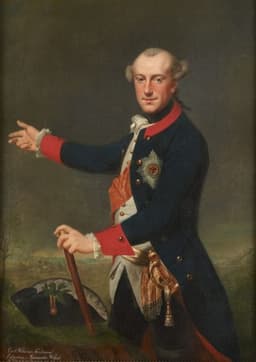
Charles William Ferdinand
General · Modern
60.1Total
Basic Information
Born
1935
1735
Died
—
1806
Era
Modern
Modern
Nationality
Portugal
Brunswick
Occupation
General
General
Civilization
Western
Western
Score Comparison
Military (10%)
22.6
61.7
Political (20%)
72.0
68.0
Influence (20%)
54.9
54.9
Legacy (20%)
46.7
49.2
Leadership (15%)
79.8
80.0
Strategy (15%)
25.0
57.5
TOTAL
52.9
60.1
Antonio Ramalho Eanes — Complete Timeline
1974 AD
Led the Military During the Carnation RevolutionPolitical Action◆ Major
Eanes was a key military figure in the Carnation Revolution, commanding the forces that overthrew the Estado Novo. He later became the first Chief of Staff of the Army under the new democratic regime.
RevolutionMilitaryDemocracy
Impact: nationalconstructive
1976 AD
Elected President of PortugalPolitical Action◆ Major
Eanes was elected as the first constitutional President of Portugal after the Carnation Revolution, winning 61% of the vote. He was a general who had played a key role in the revolution and the transition to democracy.
PresidencyDemocracyTransition
Impact: nationalconstructive
1980 AD
Re-elected as President of PortugalPolitical Action◆ Major
Eanes was re-elected as President with 56% of the vote, defeating conservative candidate Ant
PresidencyRe-electionStability
Impact: nationalconstructive
1985 AD
Founded the Democratic Renewal PartyPolitical Action
After his presidency, Eanes founded the Democratic Renewal Party, a centrist political party. The party won seats in the 1985 election but later declined, and Eanes retired from active politics.
Party FoundationCentrismPost-Presidency
Impact: national
Charles William Ferdinand — Complete Timeline
1757 AD
Served as a general in the Seven Years' WarWar◆ Major
Charles William Ferdinand served as a general under Frederick the Great during the Seven Years' War. He distinguished himself in several battles, including the Battle of Rossbach, gaining a reputation as a capable military commander.
Seven Years' WarMilitary ServiceFrederick the Great
Impact: regional
1792 AD
Issued the Brunswick ManifestoPolitical Action◆ Major
As commander of the Allied army during the French Revolutionary Wars, Charles William Ferdinand issued the Brunswick Manifesto, threatening Paris with destruction if the French royal family was harmed. This document backfired, galvanizing French resistance and contributing to the fall of the monarchy.
French RevolutionManifestoThreat
Impact: globaldestructive
1806 AD
Commanded the Prussian army at the Battle of AuerstedtWar
Charles William Ferdinand, as Prussian field marshal, commanded the main Prussian army at the Battle of Auerstedt against Napoleon's forces. The Prussian army was decisively defeated, and Charles William Ferdinand was mortally wounded, dying two days later.
Napoleonic WarsBattleDefeat
Impact: globaltragic
This comparison has not been analyzed yet.
One-time AI generation (~1 minute). Scores and timeline are already available below.
Rankings
🥇
Charles William FerdinandLeader
Mil: 61.7Pol: 68.0Inf: 54.9
60.1
🥈
Antonio Ramalho Eanes
Mil: 22.6Pol: 72.0Inf: 54.9
52.9
+7.2 behind
How This Comparison Works
Algorithm
Each figure is scored on 6 dimensions (0—100 scale) based on structured historical data: Military (10%), Political (20%), Influence (20%), Legacy (20%), Leadership (15%), Strategy (15%). The weighted total produces the final ranking.
Data Sources
Scores are computed from structured sub-indicators in the database. Scale factors adjust for era (Ancient ×0.85, Modern ×1.0) and civilization size (Eastern ×1.05, Other ×0.80) to account for differences in population and military scale.
Maximum 3 Figures
Comparisons are limited to 2—3 figures to ensure readability and statistical meaningfulness.
Error Margins
±5 points per dimension — Sub-scores are derived from historical records with inherent uncertainty. Two figures within 5 points on a dimension should be considered roughly equivalent in that area.
Total Score Accuracy
±3 points overall — The weighted combination of 6 dimensions produces a total score with approximately ±3 points of uncertainty. Differences of less than 3 points are not statistically significant— the figures are effectively tied.
Known Limitations
- Historical records are incomplete and uneven across civilizations
- Figures from oral-tradition societies may be underrepresented
- Occupation labels can misclassify multi-role figures
- Scores measure capability and impact, not moral character
- Quantitative scoring is a comparison tool, not absolute truth
Capability Radar
Military (10%) — Battles & Warfare
Battles
10
75
Win Rate
10
65
Expansion
5
55
Political (20%) — Governance & Reform
Reform
65
45
Diplomacy
60
55
Economy
50
40
Influence (20%) — Cultural & Global Reach
Cultural
30
30
Global
30
30
Legacy (20%) — Historical Impact
Historical
40
50
Longevity
30
35
Leadership (15%) — Power & Stability
Tenure
60
50
Stability
70
45
Strategy (15%) — Tactics & Innovation
Strategy
10
72
Tactics
10
70
Reform
15
60
Similar Comparisons
Comments & Discussion
No comments yet. Be the first to share your thoughts!