Loading...
Charles William Ferdinand vs Napoleon Bonaparte
Napoleon Bonaparte leads by 10.8 pts · 2 figures compared
…
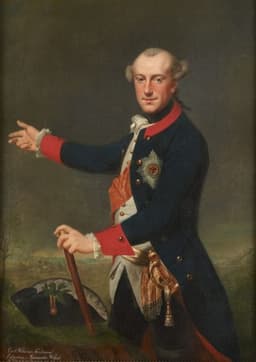
Charles William Ferdinand
General · Modern
60.1Total

Napoleon Bonaparte
General · Modern
70.9Total
Basic Information
Born
1735
1769
Died
1806
1821
Era
Modern
Modern
Nationality
Brunswick
France
Occupation
General
General
Civilization
Western
Western
Score Comparison
Military (10%)
61.7
94.0
Political (20%)
68.0
72.0
Influence (20%)
54.9
40.0
Legacy (20%)
49.2
80.0
Leadership (15%)
80.0
78.0
Strategy (15%)
57.5
90.0
TOTAL
60.1
70.9
Charles William Ferdinand — Complete Timeline
1757 AD
Served as a general in the Seven Years' WarWar◆ Major
Charles William Ferdinand served as a general under Frederick the Great during the Seven Years' War. He distinguished himself in several battles, including the Battle of Rossbach, gaining a reputation as a capable military commander.
Seven Years' WarMilitary ServiceFrederick the Great
Impact: regional
1792 AD
Issued the Brunswick ManifestoPolitical Action◆ Major
As commander of the Allied army during the French Revolutionary Wars, Charles William Ferdinand issued the Brunswick Manifesto, threatening Paris with destruction if the French royal family was harmed. This document backfired, galvanizing French resistance and contributing to the fall of the monarchy.
French RevolutionManifestoThreat
Impact: globaldestructive
1806 AD
Commanded the Prussian army at the Battle of AuerstedtWar
Charles William Ferdinand, as Prussian field marshal, commanded the main Prussian army at the Battle of Auerstedt against Napoleon's forces. The Prussian army was decisively defeated, and Charles William Ferdinand was mortally wounded, dying two days later.
Napoleonic WarsBattleDefeat
Impact: globaltragic
Napoleon Bonaparte — Complete Timeline
1799 AD
Coup of 18 BrumaireOther◆ Major
Napoleon Bonaparte, with support from his brother Lucien and key political figures, overthrew the Directory in a bloodless coup. He established the Consulate with himself as First Consul, effectively becoming the ruler of France. This event ended the French Revolution's most unstable period.
French RevolutionCoupRise to Power
Impact: regional
1804 AD
Promulgation of the Napoleonic CodeOther◆ Major
Napoleon enacted the Civil Code of the French, known as the Napoleonic Code, a comprehensive set of laws that replaced the fragmented feudal legal systems. The code established legal equality, protected property rights, and secularized law. It became the basis for legal systems in many European and world countries.
Legal ReformNapoleonic CodeCivil Law
Impact: globalconstructive
1805 AD
Battle of AusterlitzWar◆ Major
Napoleon's Grande Arm
Napoleonic WarsBattleDecisive Victory
Impact: global
1812 AD
Invasion of RussiaWar◆ Major
Napoleon led the Grande Arm
Napoleonic WarsInvasionDisaster
Impact: globaldestructive
1815 AD
Battle of WaterlooWar◆ Major
Napoleon's French army was defeated by the combined forces of the Duke of Wellington's Anglo-Allied army and Gebhard Leberecht von Bl
Napoleonic WarsBattleFinal Defeat
Impact: globaldestructive
Expert Analysis
charles-william-ferdinand-vs-napoleon-bonaparte
# The General and the Duke: Two Paths Through the Storm of Revolution
On a foggy October morning in 1806, two men faced each other across the fields of Auerstedt, neither knowing that their fates were already sealed. One was a grizzled Prussian field marshal of seventy-one, blind in one eye, commanding an army that still believed it fought for the old order of Europe. The other, though not present on that particular field, was the thirty-seven-year-old Emperor of the French, whose shadow loomed over every battle of the age. Within hours, the old marshal would be mortally wounded, his army shattered, and the Prussian state that Frederick the Great had built would lie in ruins. The young emperor, meanwhile, was just reaching the zenith of his power. How did two men, both products of the same European military tradition, arrive at such different destinations?
Origins
Charles William Ferdinand was born in 1735 into the ruling house of Brunswick-Wolfenbüttel, a minor German principality whose princes had long served the great powers as soldiers. He was raised in the rigid, hierarchical world of the Holy Roman Empire, where birth determined destiny and military service was the natural calling of nobility. His education was that of an eighteenth-century prince: languages, history, the art of war as practiced by Frederick the Great, whose campaigns he would later witness firsthand.
Napoleon Bonaparte, born thirty-four years later on the Mediterranean island of Corsica, entered a world already in ferment. His family were minor Corsican nobility, but their island had only recently been annexed by France. Young Napoleon spoke Italian before French, and his early heroes were not French kings but Corsican patriots fighting for independence. He arrived at military school as an outsider, mocked for his accent and his poverty, but driven by a hunger that the well-born Charles William Ferdinand never needed to feel.
Rise to Power
Charles William Ferdinand’s ascent followed the predictable path of the Prussian nobility. He served under Frederick the Great during the Seven Years’ War, distinguishing himself in 1757 at the Battle of Rossbach, where Prussian discipline crushed a larger Franco-Imperial army. He learned war as a craft from its greatest living practitioner, inheriting a system that emphasized rigid drill, linear tactics, and unquestioning obedience. By 1792, when revolution had engulfed France, he was the natural choice to command the Allied armies marching to restore the French monarchy.
Napoleon’s rise was a story of revolution itself. A young artillery officer in 1793, he seized his opportunity at the Siege of Toulon, where his bold plan drove the British from the harbor. Promoted brigadier general at twenty-four, he survived the political purges of the Terror, then saved the revolutionary government from a royalist uprising in 1795 with a “whiff of grapeshot.” Each step was a gamble, each success a leap over men who had started ahead of him. By 1796, at twenty-six, he commanded the Army of Italy—a post Charles William Ferdinand had earned only after forty years of service.
Leadership & Governance
Their styles of command reflected their worlds. Charles William Ferdinand was a competent administrator and a brave soldier, but he led by the book—the Prussian book, which Frederick had written. When he issued the Brunswick Manifesto in 1792, threatening Paris with “exemplary and ever-memorable vengeance” if the royal family were harmed, he was following the logic of old-regime warfare: terrorize civilians into submission. The manifesto backfire catastrophically, inflaming revolutionary passions and sealing the fate of Louis XVI. It was a miscalculation born of a mind that could not comprehend the forces unleashed in 1789.
Napoleon governed through speed, surprise, and psychological warfare. His military genius lay not in inventing new tactics but in combining existing ones with unprecedented velocity. He divided his armies into corps that could march separately and concentrate rapidly, he used artillery as a mobile battering ram rather than a static support, and he understood that morale was the decisive factor in battle. “In war,” he said, “the moral is to the physical as three to one.” His political reforms—the Napoleonic Code, the centralized bureaucracy, the merit-based promotions—showed the same revolutionary energy. He did not merely defeat old-regime armies; he dismantled the old-regime itself wherever he conquered.
Triumph & Tragedy
Charles William Ferdinand’s greatest moment came early, in the Seven Years’ War, when he proved himself a capable subordinate in Prussia’s struggle for survival. But his tragedy was that he lived long enough to face Napoleon. At Auerstedt in 1806, he commanded an army that still marched in Frederick’s formations, still fired by volley at close range, still believed that courage and discipline could overcome any innovation. Napoleon’s corps system, his skirmishers, his massed artillery—these were not just different tactics but a different conception of war. The old duke was wounded leading a bayonet charge, the last gesture of a warrior outliving his era. He died two days later, blind to the new world he could not see.
Napoleon’s triumph was the Empire itself—the conquest of Europe from Madrid to Moscow, the transformation of law and society across a continent. His tragedy was that he could not stop. After 1807, when he had defeated every major power, he might have consolidated his gains. Instead, he invaded Spain, then Russia, then Germany. The Peninsular War bled his army dry; the Russian winter destroyed it; the Battle of Leipzig ended his empire. Waterloo was the final act, a masterpiece of improvisation that failed because his enemies had finally learned his lessons.
Character & Destiny
Charles William Ferdinand was a man shaped by duty, hierarchy, and a world that believed in fixed stars. He fought for a king, a system, a tradition that had existed for centuries and seemed eternal. When that world crumbled, he could only brace himself against the storm. Napoleon was a man who believed he could make his own stars. “Impossible is a word to be found only in the dictionary of fools,” he said. His ambition was boundless, his energy inexhaustible, his confidence absolute. But that same confidence became hubris, and hubris became blindness. He could not see that even the greatest genius cannot defy the limits of geography, logistics, and human endurance.
Legacy
Charles William Ferdinand is remembered, if at all, as a footnote—the man who issued the Brunswick Manifesto, the general who lost at Auerstedt. His defeat marked the death of old Prussia and the birth of the reforms that would eventually create a new one, but he did not live to see it. Napoleon’s legacy is everywhere: in the legal codes of Europe, in the structure of modern armies, in the very idea of the self-made man who rises by merit alone. Yet his end was a lonely exile on Saint Helena, dictating memoirs to justify his life to posterity.
Conclusion
Walking through the streets of Braunschweig or Paris today, one finds monuments to both men, but they speak different languages. The duke’s statue is a memorial to what was lost; Napoleon’s tomb is a shrine to what was achieved. Yet perhaps the deeper lesson is that neither man fully controlled his destiny. Charles William Ferdinand was born into a world that was already dying; Napoleon was born into a world that was being born. The tragedy of the first was that he could not adapt; the tragedy of the second was that he could not stop. Between them, they remind us that history is not made by will alone, but by the collision of will with circumstance—a collision that crushes some and elevates others, often for reasons that have little to do with merit or virtue.
Rankings
🥇
Napoleon BonaparteLeader
Mil: 94.0Pol: 72.0Inf: 40.0
70.9
🥈
Charles William Ferdinand
Mil: 61.7Pol: 68.0Inf: 54.9
60.1
+10.8 behind
How This Comparison Works
Algorithm
Each figure is scored on 6 dimensions (0—100 scale) based on structured historical data: Military (10%), Political (20%), Influence (20%), Legacy (20%), Leadership (15%), Strategy (15%). The weighted total produces the final ranking.
Data Sources
Scores are computed from structured sub-indicators in the database. Scale factors adjust for era (Ancient ×0.85, Modern ×1.0) and civilization size (Eastern ×1.05, Other ×0.80) to account for differences in population and military scale.
Maximum 3 Figures
Comparisons are limited to 2—3 figures to ensure readability and statistical meaningfulness.
Error Margins
±5 points per dimension — Sub-scores are derived from historical records with inherent uncertainty. Two figures within 5 points on a dimension should be considered roughly equivalent in that area.
Total Score Accuracy
±3 points overall — The weighted combination of 6 dimensions produces a total score with approximately ±3 points of uncertainty. Differences of less than 3 points are not statistically significant— the figures are effectively tied.
Known Limitations
- Historical records are incomplete and uneven across civilizations
- Figures from oral-tradition societies may be underrepresented
- Occupation labels can misclassify multi-role figures
- Scores measure capability and impact, not moral character
- Quantitative scoring is a comparison tool, not absolute truth
Capability Radar
Military (10%) — Battles & Warfare
Battles
75
95
Win Rate
65
90
Expansion
55
95
Political (20%) — Governance & Reform
Reform
45
95
Diplomacy
55
80
Economy
40
85
Influence (20%) — Cultural & Global Reach
Cultural
30
85
Global
30
90
Legacy (20%) — Historical Impact
Historical
50
95
Longevity
35
90
Leadership (15%) — Power & Stability
Tenure
50
85
Stability
45
70
Strategy (15%) — Tactics & Innovation
Strategy
72
95
Tactics
70
98
Reform
60
92
Similar Comparisons
Comments & Discussion
No comments yet. Be the first to share your thoughts!