Loading...
Andres Manuel Lopez Obrador vs Juan Peron
Juan Peron leads by 5.4 pts · 2 figures compared
…
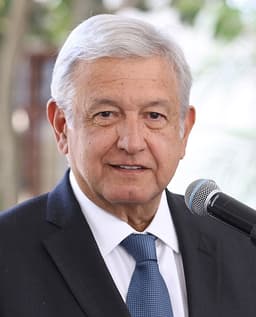
Andres Manuel Lopez Obrador
Politician · Modern
55.6Total

Juan Peron
Politician · Modern
61.0Total
Basic Information
Born
1953
1895
Died
—
1974
Era
Modern
Modern
Nationality
Mexico
Argentina
Occupation
Politician
Politician
Civilization
Western
Western
Score Comparison
Military (10%)
49.8
36.6
Political (20%)
68.0
72.0
Influence (20%)
56.4
72.0
Legacy (20%)
45.8
52.0
Leadership (15%)
72.0
68.0
Strategy (15%)
40.8
53.0
TOTAL
55.6
61.0
Andres Manuel Lopez Obrador — Complete Timeline
2018 AD
Elected President of MexicoPolitical Action◆ Major
López Obrador won the 2018 Mexican general election with 53% of the vote, representing the MORENA party. His victory ended decades of dominance by the PRI and PAN parties, marking a shift to leftist governance in Mexico.
ElectionPolitical Change
Impact: nationalconstructive
Cancelled the Mexico City Texcoco AirportPolitical Action◆ Major
After a public consultation, AMLO cancelled the partially built $13 billion Mexico City Texcoco airport project, citing corruption and cost overruns. He replaced it with the expansion of the Santa Luc
InfrastructureCorruption
Impact: nationaldestructive
2019 AD
Launched the 'Fourth Transformation' reformsReform◆ Major
AMLO initiated a series of constitutional and policy changes under the 'Fourth Transformation' agenda, including anti-corruption measures, austerity for high-level officials, and increased social spending. These reforms aimed to reduce inequality and state corruption.
ReformSocial Policy
Impact: nationalconstructive
Implemented the 'Sembrando Vida' reforestation programReform
AMLO launched Sembrando Vida, a large-scale reforestation and rural employment program providing payments to farmers for planting trees. The program aimed to combat deforestation and poverty in rural Mexico, covering over 1 million hectares.
EnvironmentSocial Program
Impact: nationalconstructive
2020 AD
Faced the COVID-19 pandemic responsePolitical Action◆ Major
AMLO's government implemented a limited lockdown and promoted the 'Healthy Distance' campaign. His administration faced criticism for downplaying the pandemic and for a high death toll, but also expanded hospital capacity and vaccination rollout.
PandemicPublic Health
Impact: national
2022 AD
Nationalized lithium reservesReform
AMLO signed a decree nationalizing lithium reserves in Mexico, declaring the mineral a strategic resource for the state. This move aimed to control the supply chain for electric vehicle batteries, but raised concerns among foreign investors about property rights.
NationalizationEnergy
Impact: nationalconstructive
Juan Peron — Complete Timeline
1943 AD
1943 Argentine coup d'étatPolitical Action◆ Major
Perón, as a colonel, participated in the military coup that overthrew President Ramón Castillo. He was appointed Secretary of Labor and Social Welfare, where he began building his political base among workers.
CoupMilitaryLabor
Impact: national
1946 AD
Election as President of ArgentinaPolitical Action
Perón won the presidential election with 56% of the vote, running on a platform of social justice, economic independence, and political sovereignty. His victory marked the beginning of Peronism as a dominant political force.
ElectionPeronismDemocracy
Impact: nationalconstructive
1947 AD
Nationalization of foreign-owned industriesReform◆ Major
Perón nationalized the British-owned railways and other key industries, including telephones and utilities. This was part of his Five-Year Plan to achieve economic independence and strengthen state control over the economy.
NationalizationEconomic PolicyIndustrialization
Impact: nationalconstructive
1955 AD
Overthrow and exilePolitical Action◆ Major
A military coup named the Revoluci
CoupExileAuthoritarianism
Impact: nationaldestructive
1973 AD
Return to Argentina and third presidencyPolitical Action◆ Major
Perón returned to Argentina after 18 years in exile and was elected president for a third term with 62% of the vote. His return was marked by political violence and factionalism within the Peronist movement.
ReturnElectionPeronism
Impact: national
Expert Analysis
Origins
Andrés Manuel López Obrador (AMLO) was born in 1953 in Tepetitán, Tabasco, Mexico. His family was middle-class; his father was a storekeeper. He studied political science and public administration at UNAM. His early political career was in the Institutional Revolutionary Party (PRI), but he left to join the Party of the Democratic Revolution (PRD). He served as mayor of Mexico City from 2000 to 2005. Juan Domingo Perón was born in 1895 in Lobos, Argentina. He entered the military academy at 16 and rose through the ranks. He served as a military attaché in Italy during the 1930s, where he observed fascist methods. Perón was part of the GOU (United Officers Group) that staged a coup in 1943. His early political influence came as Secretary of Labor under the military regime.
Rise to Power
AMLO rose to national prominence after nearly winning the 2006 presidential election, which he lost by 0.56% to Felipe Calderón. He claimed fraud and led massive protests. In 2012, he lost again to Enrique Peña Nieto. In 2018, he won the presidency with 53% of the vote, ending the PRI-PAN duopoly. Perón rose through the 1943 coup, where he became Secretary of Labor. He built a base among trade unions and descamisados (shirtless ones). In 1946, he won the presidency with 56% of the vote. His wife Eva Perón was crucial to his popularity.
Leadership & Governance
AMLO's leadership style is highly personalist and he holds daily press conferences (mañaneras). He launched the 'Fourth Transformation' (4T) with anti-corruption, austerity, and welfare programs. He canceled the $13 billion Texcoco airport after a public consultation. He increased social spending on pensions and youth apprenticeships. Perón created a corporatist state, integrating unions and business under government control. He nationalized the British-owned railways and Central Bank. He implemented the first Five-Year Plan focused on industrialization. Perón's leadership was charismatic and authoritarian; he imprisoned opponents and controlled the media.
Triumph & Tragedy
AMLO's greatest triumph was winning the presidency on a third attempt, breaking the old party system. He implemented Sembrando Vida, a reforestation program that provides payments to farmers, covering 1 million hectares. His austerity reduced government salaries and perks. However, his response to COVID-19 was criticized for downplaying the pandemic and limited testing. The murder rate remained high, with over 30,000 homicides annually. Perón's triumphs include transforming Argentina's economy and social structure, creating labor rights and social security. He achieved women's suffrage in 1947. His tragedies include economic mismanagement leading to inflation and debt. His overthrow in 1955 after the Revolución Libertadora, which banned Peronism. His return in 1973 was marked by political violence and his death in 1974 left a divided nation.
Character & Destiny
AMLO is known for his frugal lifestyle, sleeping in a modest house, and refusing to live in the presidential palace. He is resilient, having lost twice before winning. His character is that of a crusader against corruption, but critics say he centralizes power and attacks independent institutions. Perón was a pragmatic and charismatic leader who adapted his ideology. He was a skilled orator and manipulator. His destiny was to be overthrown and exiled, only to return and die in power. Perón's legacy is deeply polarizing in Argentina.
Legacy
AMLO's legacy includes the Fourth Transformation, which has shifted Mexican politics leftward. His welfare programs have reduced poverty but critics argue they are unsustainable. His cancellation of major infrastructure projects has been controversial. Perón's legacy is Peronism, a major political force in Argentina for over 70 years. His policies of nationalization and social welfare shaped Argentina's political culture. However, his economic policies contributed to long-term instability. In terms of scores, Perón leads with a total of 61.0 against AMLO's 55.6. Perón's influence (72.0) and political (72.0) scores are higher, while AMLO's leadership (72.0) and strategy (40.8) show a different profile.
Conclusion
While both are populist leaders, Juan Perón had a greater impact on Argentina's political structure, creating a movement that endured for decades. AMLO's transformation is still unfolding and faces significant challenges. Perón's legacy, though mixed, fundamentally changed Argentina's political landscape. AMLO's score of 55.6 reflects a more limited impact. Therefore, Perón is the more influential figure.
Rankings
🥇
Juan PeronLeader
Mil: 36.6Pol: 72.0Inf: 72.0
61.0
🥈
Andres Manuel Lopez Obrador
Mil: 49.8Pol: 68.0Inf: 56.4
55.6
+5.4 behind
How This Comparison Works
Algorithm
Each figure is scored on 6 dimensions (0—100 scale) based on structured historical data: Military (10%), Political (20%), Influence (20%), Legacy (20%), Leadership (15%), Strategy (15%). The weighted total produces the final ranking.
Data Sources
Scores are computed from structured sub-indicators in the database. Scale factors adjust for era (Ancient ×0.85, Modern ×1.0) and civilization size (Eastern ×1.05, Other ×0.80) to account for differences in population and military scale.
Maximum 3 Figures
Comparisons are limited to 2—3 figures to ensure readability and statistical meaningfulness.
Error Margins
±5 points per dimension — Sub-scores are derived from historical records with inherent uncertainty. Two figures within 5 points on a dimension should be considered roughly equivalent in that area.
Total Score Accuracy
±3 points overall — The weighted combination of 6 dimensions produces a total score with approximately ±3 points of uncertainty. Differences of less than 3 points are not statistically significant— the figures are effectively tied.
Known Limitations
- Historical records are incomplete and uneven across civilizations
- Figures from oral-tradition societies may be underrepresented
- Occupation labels can misclassify multi-role figures
- Scores measure capability and impact, not moral character
- Quantitative scoring is a comparison tool, not absolute truth
Capability Radar
Military (10%) — Battles & Warfare
Battles
28
5
Win Rate
34
5
Expansion
33
5
Political (20%) — Governance & Reform
Reform
60
70
Diplomacy
55
60
Economy
50
55
Influence (20%) — Cultural & Global Reach
Cultural
40
65
Global
40
60
Legacy (20%) — Historical Impact
Historical
45
70
Longevity
30
65
Leadership (15%) — Power & Stability
Tenure
65
65
Stability
45
40
Strategy (15%) — Tactics & Innovation
Strategy
36
5
Tactics
38
5
Reform
43
10
Similar Comparisons
Comments & Discussion
No comments yet. Be the first to share your thoughts!