Loading...
Alp Tigin vs Julius Caesar
Julius Caesar leads by 32.3 pts · 2 figures compared
…
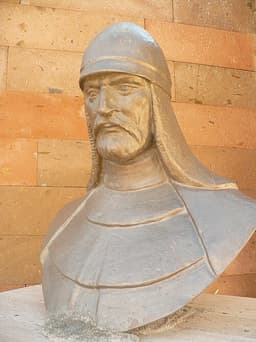
Alp Tigin
Emperor · Medieval
50.5Total

Julius Caesar
General · Ancient
82.8Total
Basic Information
Born
911
-100
Died
963
-44
Era
Medieval
Ancient
Nationality
Ghaznavid Empire
Roman Republic
Occupation
Emperor
General
Civilization
Middle Eastern
Western
Score Comparison
Military (10%)
55.0
88.0
Political (20%)
33.6
78.0
Influence (20%)
56.4
85.0
Legacy (20%)
49.2
82.0
Leadership (15%)
50.7
80.0
Strategy (15%)
60.0
85.0
TOTAL
50.5
82.8
Alp Tigin — Complete Timeline
961 AD
Rebellion against the SamanidsPolitical Action◆ Major
Alp Tigin rebelled against the Samanid ruler Mansur I after being passed over for a governorship. He marched from Nishapur to Ghazni, defeating Samanid forces along the way, and established his own rule in eastern Afghanistan.
Impact: regional
963 AD
Consolidation of GhazniPolitical Action
Alp Tigin fortified Ghazni and organized a military state based on slave soldiers (ghilman). He established a stable administration that attracted scholars and merchants, turning Ghazni into a major regional power center.
Impact: regionalconstructive
Julius Caesar — Complete Timeline
58 BC
Gallic WarsWar◆ Major
Caesar, as proconsul of Gaul, launched a series of campaigns that conquered all of Gaul (modern France, Belgium, and parts of Switzerland). He fought numerous battles, including against the Helvetii, the Belgae, and the Gallic chieftain Vercingetorix. The wars brought immense wealth and a loyal army to Caesar.
Gallic WarsConquestRoman Expansion
Impact: regional
49 BC
Crossing the RubiconPolitical Action◆ Major
Caesar led Legio XIII across the Rubicon River into Italy, defying the Roman Senate's order to disband his army. This act triggered a civil war against Pompey and the Optimates, ultimately leading to Caesar's dictatorship and the end of the Roman Republic.
Roman Civil WarEnd of RepublicPower Struggle
Impact: global
48 BC
Battle of PharsalusWar◆ Major
Caesar's outnumbered army defeated the larger forces of Pompey the Great at Pharsalus in Greece. Caesar's tactical use of a reserve line to counter Pompey's cavalry charge proved decisive. Pompey fled to Egypt, where he was assassinated, leaving Caesar as the undisputed master of the Roman world.
Roman Civil WarBattleDecisive Victory
Impact: regional
44 BC
Appointment as Dictator for LifePolitical Action◆ Major
The Roman Senate appointed Caesar dictator perpetuo (dictator for life), granting him unprecedented personal power. This move concentrated military, legislative, and judicial authority in one person, effectively ending the Roman Republic's traditional system of checks and balances and alarming many senators.
DictatorshipEnd of RepublicPower Consolidation
Impact: regionaldestructive
Assassination on the Ides of MarchPolitical Action◆ Major
A group of Roman senators, led by Marcus Junius Brutus and Gaius Cassius Longinus, stabbed Caesar to death at a meeting of the Senate in the Theatre of Pompey. The assassination was intended to restore the Republic, but instead triggered another civil war that led to the rise of the Roman Empire.
AssassinationRoman PoliticsEnd of Republic
Impact: globaldestructive
Expert Analysis
Julius Caesar vs Alp Tigin
The General and the Slave: Two Paths to Power
In the winter of 962, two men sat at the edge of worlds. One, a Roman patrician in his fifties, stood beside a small river in northern Italy, the Rubicon, and weighed the fate of a republic. The other, a Turkic former slave in his forties, looked out from the rocky fortress of Ghazni, in what is now eastern Afghanistan, and pondered how to turn a rebellion into a kingdom. Both were generals. Both would reshape history. But the differences between them tell a story not just of two men, but of two civilizations, two eras, and two definitions of ambition itself.
Origins
Julius Caesar was born into a world of marble and law. The year was 100 BCE, and Rome was a republic in name, though its nobles had long treated it as a private hunting ground. The Julian clan was ancient but not wealthy, and Caesar’s childhood was shaped by the violent politics of the late Republic—civil wars, proscriptions, and the rise of strongmen like Sulla. He learned early that survival meant playing a long game of alliances, debts, and calculated risk.
Alp Tigin was born in 911, somewhere in the steppes of Central Asia, into a world of horse and sword. His origins are obscure, but his destiny was clear: he was a slave. In the Islamic world of the 10th century, Turkic slaves were prized as soldiers for their loyalty and martial skill. Alp Tigin was purchased by the Samanid Empire, which ruled over Persia and Central Asia, and rose through the ranks of the *ghilman*—military slaves who often became generals. His world was not one of senatorial debates but of barracks, campaigns, and the harsh logic of the sword.
Rise to Power
Caesar’s path to power was a masterpiece of political engineering. He climbed the Roman *cursus honorum*—quaestor, aedile, praetor—each step funded by borrowed money and backed by the popular support he cultivated through lavish games and land reforms. His military breakthrough came in Gaul, where from 58 to 50 BCE he conquered a vast territory, built a loyal army, and amassed enormous wealth. But the Senate, fearing his ambition, ordered him to disband his legions. Caesar refused. In 49 BCE, he crossed the Rubicon River with a single legion, uttering the famous *“Alea iacta est”*—“The die is cast.” It was an act of treason that sparked a civil war.
Alp Tigin’s rise was more direct, and more desperate. In 961, the Samanid ruler Mansur I died, and his successor passed over Alp Tigin for the governorship of Khorasan. The slight was not just an insult; it was a death sentence for a slave general whose power depended on patronage. Alp Tigin rebelled, marching from Nishapur with a force of loyal *ghilman*. Defeated in open battle, he retreated eastward to the remote city of Ghazni, in present-day Afghanistan. There, in 963, he fortified the citadel, organized a military state based on his slave soldiers, and declared himself independent. He did not conquer an empire; he carved out a refuge.
Leadership & Governance
Caesar governed like a Roman—which is to say, like a man who believed that power flowed from law, even as he broke it. As dictator, he reformed the calendar, granted citizenship to provincials, launched public works, and planned campaigns against Parthia. His style was personal and charismatic: he pardoned enemies, promoted talent regardless of birth, and wrote his own propaganda in elegant Latin. Yet his governance was also autocratic. He centralized authority, packed the Senate with his supporters, and accepted the title “dictator for life.” His military genius lay in speed and logistics—he once said, “I came, I saw, I conquered” (*Veni, vidi, vici*)—but his political wisdom was brittle. He trusted too much in his own charm.
Alp Tigin governed like a Turkic warlord in an Islamic world. His state was a military machine: the *ghilman* system gave him a disciplined core of soldiers who owed everything to him. He minted coins, collected taxes, and maintained order in a region of fractious tribes and rival dynasties. But his horizon was narrow. He did not reform a republic or inspire a civilization; he built a fortress and held it. His military scores are modest—48.6—reflecting a commander who was competent but not brilliant. His political score of 50.7 suggests a ruler who survived but did not transform.
Triumph & Tragedy
Caesar’s greatest triumph was also his tragedy. In 45 BCE, he returned to Rome as master of the world. He was made dictator for life, and the Senate showered him with honors. But on the Ides of March—March 15, 44 BCE—a group of senators stabbed him to death in the Theatre of Pompey. He fell at the feet of a statue of his rival. His assassination plunged Rome into another civil war, but it also cleared the path for his adopted heir, Octavian, to become Augustus, the first emperor. Caesar’s death, in a sense, made the empire possible.
Alp Tigin’s triumph was survival itself. He died in 963, likely of natural causes, after only a few years as master of Ghazni. He never fought a great battle or conquered a great city. His tragedy was obscurity: he founded a dynasty, the Ghaznavids, but it was his slave-son, Sabuktigin, and his grandson, Mahmud of Ghazni, who would turn his fortress into an empire that stretched from the Caspian to the Indus. Alp Tigin was a seed, not a tree.
Character & Destiny
Caesar’s character was a paradox: he was ruthless yet magnanimous, calculating yet impulsive, a man who could weep at the death of a friend and order the massacre of a tribe. His decisions were driven by an insatiable hunger for glory—what the Romans called *gloria*—and a belief that his destiny was to rule. This hubris blinded him to the danger of the Ides of March.
Alp Tigin’s character was shaped by his origins as a slave. He was cautious, pragmatic, and loyal to his men but suspicious of the world. He did not dream of Rome; he dreamed of a safe place to rule. His decision to retreat to Ghazni was not cowardice but realism. He knew that in the world of Turkic slave generals, the man who reaches too high is the first to fall.
Legacy
Caesar’s legacy is monumental. His name became a title—*Kaiser*, *Tsar*—and his writings, especially the *Commentaries on the Gallic War*, are still read as literature. He transformed the Roman Republic into an empire, and the Western world has never been the same. His scores reflect this: Military 88, Political 78, Influence 85, Legacy 82. He is remembered as a genius, a tyrant, and a martyr.
Alp Tigin’s legacy is more modest. His scores—Military 48.6, Political 50.7, Influence 71.6, Legacy 62.1—tell the story of a man who laid a foundation but did not build the house. He is remembered by historians of the Islamic world as the founder of the Ghaznavid dynasty, but his name is little known outside that field. Yet his story matters, because it shows another path to power: not through the Senate and the Rubicon, but through the barracks and the mountain fortress.
Conclusion
Standing on opposite sides of the Rubicon and the Hindu Kush, Caesar and Alp Tigin both answered the same question: how does a man seize power in a world that denies it? Caesar answered with audacity, eloquence, and a legion at his back. Alp Tigin answered with patience, survival, and a fortress in the mountains. One changed the world; the other endured. Both, in their own ways, understood that the die is always cast—but not everyone gets to choose where it lands.
Rankings
🥇
Julius CaesarLeader
Mil: 88.0Pol: 78.0Inf: 85.0
82.8
🥈
Alp Tigin
Mil: 55.0Pol: 33.6Inf: 56.4
50.5
+32.3 behind
How This Comparison Works
Algorithm
Each figure is scored on 6 dimensions (0—100 scale) based on structured historical data: Military (10%), Political (20%), Influence (20%), Legacy (20%), Leadership (15%), Strategy (15%). The weighted total produces the final ranking.
Data Sources
Scores are computed from structured sub-indicators in the database. Scale factors adjust for era (Ancient ×0.85, Modern ×1.0) and civilization size (Eastern ×1.05, Other ×0.80) to account for differences in population and military scale.
Maximum 3 Figures
Comparisons are limited to 2—3 figures to ensure readability and statistical meaningfulness.
Error Margins
±5 points per dimension — Sub-scores are derived from historical records with inherent uncertainty. Two figures within 5 points on a dimension should be considered roughly equivalent in that area.
Total Score Accuracy
±3 points overall — The weighted combination of 6 dimensions produces a total score with approximately ±3 points of uncertainty. Differences of less than 3 points are not statistically significant— the figures are effectively tied.
Known Limitations
- Historical records are incomplete and uneven across civilizations
- Figures from oral-tradition societies may be underrepresented
- Occupation labels can misclassify multi-role figures
- Scores measure capability and impact, not moral character
- Quantitative scoring is a comparison tool, not absolute truth
Capability Radar
Military (10%) — Battles & Warfare
Battles
45
95
Win Rate
50
92
Expansion
50
97
Political (20%) — Governance & Reform
Reform
20
90
Diplomacy
30
85
Economy
20
82
Influence (20%) — Cultural & Global Reach
Cultural
30
88
Global
30
94
Legacy (20%) — Historical Impact
Historical
45
95
Longevity
40
96
Leadership (15%) — Power & Stability
Tenure
25
75
Stability
25
60
Strategy (15%) — Tactics & Innovation
Strategy
45
94
Tactics
40
96
Reform
30
88
Similar Comparisons
Comments & Discussion
XENOPHON'S GHOST6/16/2026
Caesar would have laughed at Alp Tigin's slave-to-king story then called it a tragedy. The Gallic Wars alone show Caesar's legitimacy came from Roman law and senatorial privilege, not pure martial skill. Alp Tigin's Ghaznavid rise proves his genius, but it rested on Turkic warrior culture that valued mobility over roots. Give me Caesar's aristocratic cunning over a slave's desperate climb any day—one built an empire with legal finesse, the other just conquered with blood.
法老之眼6/16/2026
你们都被表面光环骗了。恺撒的《高卢战记》里吹嘘杀了百万高卢人,却对奴隶制闭口不谈。阿尔普·特勤才是真英雄——从突厥奴隶到加兹尼之主,他用马刀和智慧在伊斯兰世界杀出血路。恺撒的罗马传统不过是贵族圈子里的互吹互擂,阿尔普·特勤的崛起证明了纯粹的意志能击碎任何出身枷锁。
MILITARY REALIST6/16/2026
Let's cut the romanticism. Caesar's crossing the Rubicon was a calculated coup by a patrician who'd bribed his way to command. Alp Tigin's rebellion was survival—he'd been exiled from Samanid court after losing a power struggle. Tactically, Caesar conquered Gaul with siege engineering; Alp Tigin took Ghazni with horse archers and gold. Different tools, same ambition, but Alp Tigin's path from slave to sultan is a harder narrative than Caesar's inherited privilege.
长安铁骑6/16/2026
恺撒算什么?他不过是罗马内战的赢家,靠的是军团和债务。阿尔普·特勤才配叫将军——他用突厥骑兵的机动性打垮了萨曼王朝的波斯重甲,在加兹尼建立了一个横跨印度河的新帝国。恺撒的罗马最终分崩离析,而阿尔普·特勤的加兹尼王朝却延续了百年。从奴隶到君王,这才是真正的白手起家传奇。
CLASSICAL MATTERS6/16/2026
Caesar's genius was institutional. He didn't just win battles—he reformed the calendar, extended citizenship, and mastered Roman rhetoric. Alp Tigin's Ghaznavid rule relied on slave soldiers (mamluks) and tribal loyalties, a fragile structure. Caesar's legacy outlasted his assassination; Alp Tigin died in relative obscurity, his son Sabuktigin having to rebuild the kingdom. The Roman's cultural impact dwarfs a Turkic warlord's brief moment in the Hindu Kush.