Loading...
This comparison has not been analyzed yet.
One-time AI generation (~1 minute). Scores and timeline are already available below.
Ali Mahdi Muhammad vs Milton Obote
Milton Obote leads by 6.5 pts · 2 figures compared
…

Ali Mahdi Muhammad
Politician · Modern
43.9Total
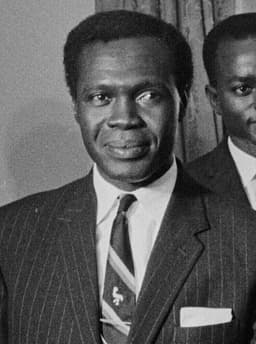
Milton Obote
Politician · Modern
50.4Total
Basic Information
Born
1939
1925
Died
—
—
Era
Modern
Modern
Nationality
Somalia
Uganda
Occupation
Politician
Politician
Civilization
Other
Other
Score Comparison
Military (10%)
36.6
41.6
Political (20%)
30.8
46.6
Influence (20%)
48.6
51.8
Legacy (20%)
39.2
43.3
Leadership (15%)
55.3
67.0
Strategy (15%)
53.5
53.8
TOTAL
43.9
50.4
Ali Mahdi Muhammad — Complete Timeline
1991 AD
Rivalry with Mohamed Farrah AididWar◆ Major
Ali Mahdi Muhammad's declaration of presidency sparked a violent rivalry with General Mohamed Farrah Aidid. Their forces clashed repeatedly in Mogadishu, causing thousands of civilian casualties and deepening the civil war.
Civil WarMogadishuFactional Fighting
Impact: nationaldestructive
Declared Interim President of SomaliaPolitical Action◆ Major
After the fall of Siad Barre's government, Ali Mahdi Muhammad declared himself interim president of Somalia. This was contested by other faction leaders, most notably Mohamed Farrah Aidid, leading to the fragmentation of the country into clan-based fiefdoms.
Civil WarSomaliaInterim President
Impact: nationaldestructive
1993 AD
Signed the Addis Ababa AgreementPolitical Action
Ali Mahdi Muhammad was a signatory to the Addis Ababa Agreement, a peace accord aimed at ending the Somali Civil War. The agreement failed to hold due to continued factional fighting and lack of enforcement mechanisms.
Peace AgreementCivil WarSomalia
Impact: nationalconstructive
Milton Obote — Complete Timeline
1962 AD
Became first Prime Minister of independent UgandaPolitical Action◆ Major
Milton Obote became the first Prime Minister of Uganda upon independence from Britain. He led a coalition government with the Kabaka Yekka party, marking the beginning of his political dominance.
IndependencePrime MinisterUganda
Impact: nationalconstructive
1966 AD
Suspended the constitution and assumed executive powersPolitical Action◆ Major
Obote suspended the constitution, abolished the federal system, and assumed executive powers, effectively making himself President. He also ordered the arrest of several ministers and attacked the Lubiri Palace, forcing the Kabaka into exile.
Constitutional CrisisPower GrabKabaka Crisis
Impact: nationaldestructive
1971 AD
Overthrown by Idi AminPolitical Action◆ Major
While attending a Commonwealth summit in Singapore, Obote was overthrown in a military coup led by his army commander Idi Amin. Obote went into exile in Tanzania, beginning eight years of Amin's brutal rule.
CoupExileIdi Amin
Impact: nationaltragic
1980 AD
Returned to power after Tanzanian invasionWar◆ Major
Obote returned to Uganda after the Tanzanian army and Ugandan rebels overthrew Idi Amin. He won the 1980 general election, which was widely criticized as rigged, and became President again.
Return to PowerElectionTanzania
Impact: national
1985 AD
Second overthrow and exilePolitical Action◆ Major
Obote was overthrown for a second time by his own army commanders, led by Tito Okello and Bazilio Olara-Okello. He fled to Zambia, where he remained in exile until his death in 2005.
CoupExileEnd of Presidency
Impact: nationaltragic
This comparison has not been analyzed yet.
One-time AI generation (~1 minute). Scores and timeline are already available below.
Rankings
🥇
Milton OboteLeader
Mil: 41.6Pol: 46.6Inf: 51.8
50.4
🥈
Ali Mahdi Muhammad
Mil: 36.6Pol: 30.8Inf: 48.6
43.9
+6.5 behind
How This Comparison Works
Algorithm
Each figure is scored on 6 dimensions (0—100 scale) based on structured historical data: Military (10%), Political (20%), Influence (20%), Legacy (20%), Leadership (15%), Strategy (15%). The weighted total produces the final ranking.
Data Sources
Scores are computed from structured sub-indicators in the database. Scale factors adjust for era (Ancient ×0.85, Modern ×1.0) and civilization size (Eastern ×1.05, Other ×0.80) to account for differences in population and military scale.
Maximum 3 Figures
Comparisons are limited to 2—3 figures to ensure readability and statistical meaningfulness.
Error Margins
±5 points per dimension — Sub-scores are derived from historical records with inherent uncertainty. Two figures within 5 points on a dimension should be considered roughly equivalent in that area.
Total Score Accuracy
±3 points overall — The weighted combination of 6 dimensions produces a total score with approximately ±3 points of uncertainty. Differences of less than 3 points are not statistically significant— the figures are effectively tied.
Known Limitations
- Historical records are incomplete and uneven across civilizations
- Figures from oral-tradition societies may be underrepresented
- Occupation labels can misclassify multi-role figures
- Scores measure capability and impact, not moral character
- Quantitative scoring is a comparison tool, not absolute truth
Capability Radar
Military (10%) — Battles & Warfare
Battles
5
10
Win Rate
5
10
Expansion
5
10
Political (20%) — Governance & Reform
Reform
20
40
Diplomacy
25
30
Economy
15
30
Influence (20%) — Cultural & Global Reach
Cultural
15
20
Global
15
20
Legacy (20%) — Historical Impact
Historical
20
40
Longevity
15
20
Leadership (15%) — Power & Stability
Tenure
40
55
Stability
10
15
Strategy (15%) — Tactics & Innovation
Strategy
5
10
Tactics
5
10
Reform
5
15
Similar Comparisons
Comments & Discussion
No comments yet. Be the first to share your thoughts!