Loading...
Bola Ige vs Milton Obote
Milton Obote leads by 6.0 pts · 2 figures compared
…

Bola Ige
Politician · Modern
44.4Total
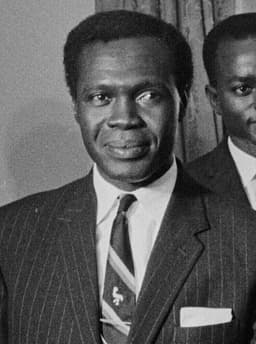
Milton Obote
Politician · Modern
50.4Total
Basic Information
Born
1930
1925
Died
—
—
Era
Modern
Modern
Nationality
Nigeria
Uganda
Occupation
Politician
Politician
Civilization
Other
Other
Score Comparison
Military (10%)
36.0
41.6
Political (20%)
40.8
46.6
Influence (20%)
51.0
51.8
Legacy (20%)
41.7
43.3
Leadership (15%)
51.9
67.0
Strategy (15%)
37.4
53.8
TOTAL
44.4
50.4
Bola Ige — Complete Timeline
1979 AD
Governor of Oyo StatePolitical Action◆ Major
Bola Ige was elected Governor of Oyo State under the Unity Party of Nigeria (UPN). He served from 1979 to 1983, focusing on education and rural development.
Nigerian PoliticsGovernorshipOyo State
Impact: regionalconstructive
2000 AD
Appointed Minister of JusticePolitical Action◆ Major
Ige was appointed Minister of Justice and Attorney General of the Federation by President Olusegun Obasanjo. He served until his assassination, working on legal reforms and anti-corruption efforts.
Nigerian PoliticsJustice MinistryObasanjo Administration
Impact: nationalconstructive
2001 AD
Assassinated at His HomePolitical Action
Bola Ige was assassinated at his home in Ibadan on December 23, 2001. The murder remains unsolved, with various political motives suspected. His death shocked Nigeria and highlighted political violence.
AssassinationPolitical ViolenceNigeriaUnsolved Murder
Impact: nationaltragic
Milton Obote — Complete Timeline
1962 AD
Became first Prime Minister of independent UgandaPolitical Action◆ Major
Milton Obote became the first Prime Minister of Uganda upon independence from Britain. He led a coalition government with the Kabaka Yekka party, marking the beginning of his political dominance.
IndependencePrime MinisterUganda
Impact: nationalconstructive
1966 AD
Suspended the constitution and assumed executive powersPolitical Action◆ Major
Obote suspended the constitution, abolished the federal system, and assumed executive powers, effectively making himself President. He also ordered the arrest of several ministers and attacked the Lubiri Palace, forcing the Kabaka into exile.
Constitutional CrisisPower GrabKabaka Crisis
Impact: nationaldestructive
1971 AD
Overthrown by Idi AminPolitical Action◆ Major
While attending a Commonwealth summit in Singapore, Obote was overthrown in a military coup led by his army commander Idi Amin. Obote went into exile in Tanzania, beginning eight years of Amin's brutal rule.
CoupExileIdi Amin
Impact: nationaltragic
1980 AD
Returned to power after Tanzanian invasionWar◆ Major
Obote returned to Uganda after the Tanzanian army and Ugandan rebels overthrew Idi Amin. He won the 1980 general election, which was widely criticized as rigged, and became President again.
Return to PowerElectionTanzania
Impact: national
1985 AD
Second overthrow and exilePolitical Action◆ Major
Obote was overthrown for a second time by his own army commanders, led by Tito Okello and Bazilio Olara-Okello. He fled to Zambia, where he remained in exile until his death in 2005.
CoupExileEnd of Presidency
Impact: nationaltragic
Expert Analysis
Origins
Bola Ige was born on September 13, 1930, in Esa Oke, Nigeria. He studied law at the University of London and was called to the bar at Lincoln's Inn. Ige returned to Nigeria and established a legal practice, becoming involved in politics through the Action Group party. His early career was marked by a commitment to democracy and federalism.
Milton Obote was born on December 28, 1925, in Akokoro, Uganda. He attended Makerere University but was expelled for political activism. Obote then worked in Kenya before returning to Uganda to enter politics. He founded the Uganda People's Congress (UPC) and became a leading figure in the independence movement.
Rise to Power
Ige rose to prominence as a lawyer and politician in the Western Region. He was elected to the Western Nigeria House of Assembly in 1964. After the Nigerian Civil War, he joined the Unity Party of Nigeria (UPN) and was elected Governor of Oyo State in 1979, serving until 1983. His tenure focused on education and rural development.
Obote became the first Prime Minister of independent Uganda on October 9, 1962. He led a coalition government with the Kabaka Yekka party. In 1966, he suspended the constitution, abolished the federal system, and assumed executive powers, making himself President. He ordered the attack on the Lubiri Palace, forcing the Kabaka into exile.
Leadership & Governance
Ige's leadership style was conciliatory and reform-oriented. As Governor of Oyo State, he implemented free primary education and invested in rural infrastructure. As Minister of Justice, he worked to reform the judiciary and combat corruption. His approach was consultative, seeking consensus among stakeholders.
Obote's governance was centralized and authoritarian. He implemented the "Move to the Left" policy, nationalizing industries and promoting state control. His regime was marked by political repression, including the detention of opponents. Obote's score of 67.0 in leadership reflects his ability to maintain power through force, but his political score of 46.6 indicates a lack of democratic legitimacy.
Triumph & Tragedy
Ige's greatest success was his role in advancing education in Oyo State, with primary school enrollment increasing by 40% during his governorship. His tragedy was his assassination on December 23, 2001, at his home in Ibadan, a murder that remains unsolved. The killing highlighted the dangers faced by reformist politicians in Nigeria.
Obote's triumphs include leading Uganda to independence and later returning to power after the overthrow of Idi Amin in 1980. However, his tragedy was his authoritarianism and the economic decline under his rule. His second overthrow in 1985 by his own army commanders ended his political career. Obote's military score of 41.6 reflects his reliance on force rather than popular support.
Character & Destiny
Ige was known for his integrity and intellectual rigor. He was a prolific writer and advocate for democracy. His character shaped his fate as a target for assassination by political rivals. His death remains a symbol of the challenges facing Nigerian democracy.
Obote was pragmatic and power-oriented. He was willing to use force to achieve his goals, which led to his initial rise but also his downfall. His character of centralizing power alienated allies, leading to the coups that removed him. Obote's total score of 50.4 is higher than Ige's 44.4, but his legacy is marred by authoritarianism.
Legacy
Ige's legacy is as a martyr for democracy and the rule of law in Nigeria. His work in education and judicial reform continues to influence policy. The Bola Ige Foundation promotes his ideals. However, his impact is limited to Nigeria's political history.
Obote's legacy is complex. He is remembered as a founding father of Uganda but also as an authoritarian leader whose policies contributed to instability. His influence on Ugandan politics is significant, but his reputation is overshadowed by the atrocities committed during his rule. Obote's influence score of 51.8 is slightly higher than Ige's 51.0.
Conclusion
Milton Obote had a greater impact on his country's history, as reflected in his higher total score of 50.4 compared to Bola Ige's 44.4. Obote shaped Uganda's post-independence trajectory, for better or worse, while Ige's influence was cut short by assassination. However, Obote's legacy is tainted by authoritarianism, whereas Ige's is one of democratic idealism. In terms of historical significance, Obote's actions had more far-reaching consequences, but Ige's moral example may endure longer.
Rankings
🥇
Milton OboteLeader
Mil: 41.6Pol: 46.6Inf: 51.8
50.4
🥈
Bola Ige
Mil: 36.0Pol: 40.8Inf: 51.0
44.4
+6.0 behind
How This Comparison Works
Algorithm
Each figure is scored on 6 dimensions (0—100 scale) based on structured historical data: Military (10%), Political (20%), Influence (20%), Legacy (20%), Leadership (15%), Strategy (15%). The weighted total produces the final ranking.
Data Sources
Scores are computed from structured sub-indicators in the database. Scale factors adjust for era (Ancient ×0.85, Modern ×1.0) and civilization size (Eastern ×1.05, Other ×0.80) to account for differences in population and military scale.
Maximum 3 Figures
Comparisons are limited to 2—3 figures to ensure readability and statistical meaningfulness.
Error Margins
±5 points per dimension — Sub-scores are derived from historical records with inherent uncertainty. Two figures within 5 points on a dimension should be considered roughly equivalent in that area.
Total Score Accuracy
±3 points overall — The weighted combination of 6 dimensions produces a total score with approximately ±3 points of uncertainty. Differences of less than 3 points are not statistically significant— the figures are effectively tied.
Known Limitations
- Historical records are incomplete and uneven across civilizations
- Figures from oral-tradition societies may be underrepresented
- Occupation labels can misclassify multi-role figures
- Scores measure capability and impact, not moral character
- Quantitative scoring is a comparison tool, not absolute truth
Capability Radar
Military (10%) — Battles & Warfare
Battles
20
10
Win Rate
23
10
Expansion
30
10
Political (20%) — Governance & Reform
Reform
40
40
Diplomacy
35
30
Economy
20
30
Influence (20%) — Cultural & Global Reach
Cultural
25
20
Global
20
20
Legacy (20%) — Historical Impact
Historical
30
40
Longevity
20
20
Leadership (15%) — Power & Stability
Tenure
30
55
Stability
15
15
Strategy (15%) — Tactics & Innovation
Strategy
33
10
Tactics
35
10
Reform
38
15
Similar Comparisons
Comments & Discussion
No comments yet. Be the first to share your thoughts!