Loading...
Ali Kafi vs Napoleon Bonaparte
Napoleon Bonaparte leads by 30.2 pts · 2 figures compared
…
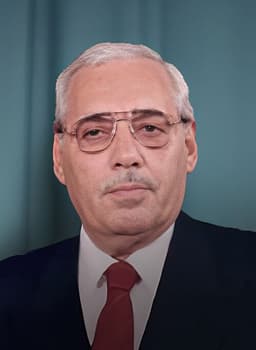
Ali Kafi
Politician · Modern
40.7Total

Napoleon Bonaparte
General · Modern
70.9Total
Basic Information
Born
1928
1769
Died
—
1821
Era
Modern
Modern
Nationality
Algeria
France
Occupation
Politician
General
Civilization
Middle Eastern
Western
Score Comparison
Military (10%)
35.5
94.0
Political (20%)
30.8
72.0
Influence (20%)
47.1
40.0
Legacy (20%)
37.5
80.0
Leadership (15%)
48.4
78.0
Strategy (15%)
41.1
90.0
TOTAL
40.7
70.9
Ali Kafi — Complete Timeline
1954 AD
Joined the National Liberation Front (FLN)Political Action◆ Major
Ali Kafi joined the FLN in 1954 at the start of the Algerian War of Independence. He became a militant and political organizer, working in the wilaya (military district) system and rising through the ranks of the revolutionary movement.
Algerian WarFLNIndependence
Impact: nationalconstructive
1962 AD
Served as ambassador to several countriesPolitical Action
After independence, Kafi served as Algeria's ambassador to several countries, including Syria, Lebanon, and Libya, from the 1960s to the 1980s. His diplomatic work focused on strengthening ties with Arab and African nations and supporting anti-colonial movements.
DiplomacyForeign PolicyAmbassador
Impact: regional
1992 AD
Appointed President of the High State Council (HCE)Political Action
Following the assassination of Mohamed Boudiaf, Kafi was appointed President of the High State Council (HCE) on July 2, 1992, becoming Algeria's de facto head of state. He led the collective presidency during the early years of the Algerian Civil War, overseeing the military's crackdown on Islamist insurgents.
PresidencyAlgerian Civil WarHCE
Impact: national
Oversaw the cancellation of the 1992 legislative electionsPolitical Action
As HCE president, Kafi supported the military's decision to cancel the second round of the 1991 legislative elections, which the Islamic Salvation Front (FIS) was poised to win. This action triggered the Algerian Civil War, leading to a decade of violence between the state and Islamist groups.
Election CancellationAlgerian Civil WarPolitical Crisis
Impact: nationaldestructive
1994 AD
Stepped down as HCE presidentPolitical Action◆ Major
Kafi stepped down as President of the HCE on January 30, 1994, as the council was dissolved and replaced by a single president, Liamine Z
ResignationGovernment ChangeAlgerian Civil War
Impact: national
Napoleon Bonaparte — Complete Timeline
1799 AD
Coup of 18 BrumaireOther◆ Major
Napoleon Bonaparte, with support from his brother Lucien and key political figures, overthrew the Directory in a bloodless coup. He established the Consulate with himself as First Consul, effectively becoming the ruler of France. This event ended the French Revolution's most unstable period.
French RevolutionCoupRise to Power
Impact: regional
1804 AD
Promulgation of the Napoleonic CodeOther◆ Major
Napoleon enacted the Civil Code of the French, known as the Napoleonic Code, a comprehensive set of laws that replaced the fragmented feudal legal systems. The code established legal equality, protected property rights, and secularized law. It became the basis for legal systems in many European and world countries.
Legal ReformNapoleonic CodeCivil Law
Impact: globalconstructive
1805 AD
Battle of AusterlitzWar◆ Major
Napoleon's Grande Arm
Napoleonic WarsBattleDecisive Victory
Impact: global
1812 AD
Invasion of RussiaWar◆ Major
Napoleon led the Grande Arm
Napoleonic WarsInvasionDisaster
Impact: globaldestructive
1815 AD
Battle of WaterlooWar◆ Major
Napoleon's French army was defeated by the combined forces of the Duke of Wellington's Anglo-Allied army and Gebhard Leberecht von Bl
Napoleonic WarsBattleFinal Defeat
Impact: globaldestructive
Expert Analysis
ali-kafi-vs-napoleon-bonaparte
# The Conqueror and the Caretaker
On a June morning in 1815, Napoleon Bonaparte stood on a muddy field near Waterloo, watching his Imperial Guard march toward their doom. He was a man who had remade Europe, only to see it slip through his fingers. One hundred and seventy-seven years later, on a July afternoon in Algiers, Ali Kafi took the oath of office as president of Algeria’s High Council of State, inheriting a nation torn apart by civil war. Two men, two eras, two vastly different scales of power. Yet both faced the same fundamental question: What does it mean to lead when history is collapsing around you?
Origins
Napoleon was born in 1769 on the Mediterranean island of Corsica, a place that had only recently become French. His family was minor nobility, struggling and proud. He grew up speaking Italian-accented French, an outsider among the elites he would one day command. The French Revolution, which erupted when he was twenty, shattered the old order and created a vacuum for ambitious men. Napoleon’s rise was not just a personal story—it was a product of an era that had torn down every ladder and then asked who was brave enough to climb the rubble.
Ali Kafi was born in 1928 in the village of El Harrouch, in eastern Algeria, then a colony of France. His Algeria was a place of deep humiliation: a land where Muslims were second-class citizens, where French settlers owned the best land, where independence was a dream whispered in coffeehouses and mosques. When Kafi joined the National Liberation Front in 1954, he was not seeking glory but dignity. His war was not for an empire but for a nation.
Rise to Power
Napoleon’s path was meteoric. At twenty-four, he drove the British out of Toulon and became a brigadier general. At twenty-six, he crushed a royalist uprising in Paris with a "whiff of grapeshot." At thirty, he conquered Italy. His rise was built on battlefield brilliance, but also on a genius for self-promotion. He understood that in the chaos of revolution, the man who acted decisively would be followed.
Kafi’s rise was slower, more patient. After Algeria won independence in 1962, he served as ambassador to Syria, Lebanon, and Libya—a diplomat, not a warrior. He climbed through bureaucracy, not blood. His turning point came in 1992, after the assassination of President Mohamed Boudiaf. The military needed a figurehead, someone who could lend legitimacy to their decision to cancel the 1991 legislative elections, which the Islamist Islamic Salvation Front had been poised to win. Kafi was chosen not for his brilliance but for his reliability.
Leadership & Governance
Napoleon governed as he fought: aggressively, creatively, and without restraint. He reformed French law through the Napoleonic Code, which standardized legal systems across Europe. He centralized education, established the Bank of France, and built roads and canals. His military strategy was revolutionary—using speed, artillery, and the division of forces to defeat larger armies. He won battles at Austerlitz and Jena that seemed impossible. But his political wisdom was shallow. He trusted no one, micromanaged everything, and believed his own legend.
Kafi governed in a nightmare. The Algerian Civil War was a slaughterhouse: Islamist insurgents versus a military regime, with civilians caught in between. As president of the High Council of State from 1992 to 1994, Kafi was a caretaker, not a ruler. He supported the military’s cancellation of the elections, a decision that plunged the country into a decade of bloodshed. He had no grand reforms, no sweeping vision. His leadership was about survival—his own, and the state’s.
Triumph & Tragedy
Napoleon’s greatest moment was Austerlitz in 1805, where he crushed the combined armies of Russia and Austria. It was a masterpiece of strategy, a victory so complete that it ended the Third Coalition. His tragedy was the invasion of Russia in 1812. He marched 600,000 men into the snow and returned with fewer than 100,000. The disaster broke his aura of invincibility and set the stage for his exile to Elba, his brief return, and finally Waterloo.
Kafi had no Austerlitz. His greatest moment was perhaps simply surviving—stepping down peacefully in 1994 when the council was dissolved. His tragedy was the war itself: the cancellation of elections that he endorsed, the massacres that followed, the thousands of dead. He was a man who tried to hold a country together while it was being torn apart, and failed.
Character & Destiny
Napoleon was driven by an insatiable hunger for glory. "I am not a man," he once said, "but a thing." He saw himself as an instrument of destiny, a force of nature. This made him fearless but also reckless. He could not stop, could not compromise, could not share power. His personality shaped his decisions: the decision to invade Russia, the refusal to accept a negotiated peace, the gamble at Waterloo. He was his own greatest asset and his own worst enemy.
Kafi was a different kind of man—cautious, dutiful, uncharismatic. He was a product of the FLN’s old guard, men who had fought for independence and then watched their revolution decay into authoritarianism. He did not seek power; it was thrust upon him. His personality was one of obedience and loyalty to the military establishment. He made decisions not out of ambition but out of fear—fear of chaos, fear of Islamism, fear of the unknown.
Legacy
Napoleon’s legacy is colossal. The Napoleonic Code influenced legal systems across Europe and the world. His military tactics are still studied. He reshaped the map of Europe, toppled old monarchies, and spread the ideals of the French Revolution—even as he betrayed them by crowning himself emperor. He is remembered as both a liberator and a tyrant, a genius and a madman.
Ali Kafi is barely remembered. His name appears in the footnotes of Algerian history, a brief caretaker in a bloody interregnum. He did not shape his nation’s destiny; he simply managed its collapse. His legacy is the civil war itself—a warning of what happens when democracy is sacrificed for stability.
Conclusion
Standing at the edge of their respective eras, Napoleon and Kafi faced the same truth: that history judges leaders not by their intentions but by their outcomes. Napoleon remade the world and was destroyed by his own ambition. Kafi tried to preserve a nation and was consumed by its violence. One was a comet, the other a shadow. Yet both reveal the same lesson: that leadership is not about the size of your stage but the weight of your choices. And that the quietest failures can be as devastating as the loudest defeats.
Rankings
🥇
Napoleon BonaparteLeader
Mil: 94.0Pol: 72.0Inf: 40.0
70.9
🥈
Ali Kafi
Mil: 35.5Pol: 30.8Inf: 47.1
40.7
+30.2 behind
How This Comparison Works
Algorithm
Each figure is scored on 6 dimensions (0—100 scale) based on structured historical data: Military (10%), Political (20%), Influence (20%), Legacy (20%), Leadership (15%), Strategy (15%). The weighted total produces the final ranking.
Data Sources
Scores are computed from structured sub-indicators in the database. Scale factors adjust for era (Ancient ×0.85, Modern ×1.0) and civilization size (Eastern ×1.05, Other ×0.80) to account for differences in population and military scale.
Maximum 3 Figures
Comparisons are limited to 2—3 figures to ensure readability and statistical meaningfulness.
Error Margins
±5 points per dimension — Sub-scores are derived from historical records with inherent uncertainty. Two figures within 5 points on a dimension should be considered roughly equivalent in that area.
Total Score Accuracy
±3 points overall — The weighted combination of 6 dimensions produces a total score with approximately ±3 points of uncertainty. Differences of less than 3 points are not statistically significant— the figures are effectively tied.
Known Limitations
- Historical records are incomplete and uneven across civilizations
- Figures from oral-tradition societies may be underrepresented
- Occupation labels can misclassify multi-role figures
- Scores measure capability and impact, not moral character
- Quantitative scoring is a comparison tool, not absolute truth
Capability Radar
Military (10%) — Battles & Warfare
Battles
22
95
Win Rate
25
90
Expansion
25
95
Political (20%) — Governance & Reform
Reform
20
95
Diplomacy
25
80
Economy
15
85
Influence (20%) — Cultural & Global Reach
Cultural
10
85
Global
10
90
Legacy (20%) — Historical Impact
Historical
15
95
Longevity
10
90
Leadership (15%) — Power & Stability
Tenure
30
85
Stability
10
70
Strategy (15%) — Tactics & Innovation
Strategy
31
95
Tactics
33
98
Reform
39
92
Similar Comparisons
Comments & Discussion
No comments yet. Be the first to share your thoughts!