Loading...
Alfonso XIII vs Elizabeth of Russia
Elizabeth of Russia leads by 12.2 pts · 2 figures compared
…
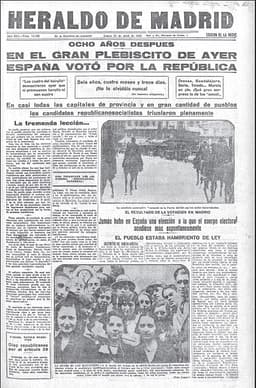
Alfonso XIII
Emperor · Modern
47.1Total

Elizabeth of Russia
Emperor · Modern
59.3Total
Basic Information
Born
1886
1709
Died
1941
1762
Era
Modern
Modern
Nationality
Spain
Russia
Occupation
Emperor
Emperor
Civilization
Western
Western
Score Comparison
Military (10%)
10.2
70.0
Political (20%)
61.3
60.0
Influence (20%)
54.9
55.0
Legacy (20%)
45.0
54.0
Leadership (15%)
53.2
72.0
Strategy (15%)
39.6
52.5
TOTAL
47.1
59.3
Alfonso XIII — Complete Timeline
1886 AD
Accession to the thronePolitical Action◆ Major
Alfonso XIII became King of Spain at birth, as his father Alfonso XII had died. His mother Maria Cristina served as regent until he came of age in 1902.
SuccessionRegencyMonarchy
Impact: national
1898 AD
Spanish-American WarWar
During Alfonso XIII's minority, Spain lost the Spanish-American War, ceding Cuba, Puerto Rico, and the Philippines to the United States. This disaster led to the Generation of '98 and a crisis of national identity.
WarColonial LossCrisis
Impact: globaltragic
1921 AD
Rif War and the Disaster of AnnualWar◆ Major
Spanish forces suffered a catastrophic defeat at Annual in Morocco, with thousands killed by Rifian rebels. The disaster severely damaged the monarchy's prestige and led to political crisis.
Colonial WarDefeatMorocco
Impact: regionaltragic
1923 AD
Dictatorship of Primo de RiveraPolitical Action◆ Major
Alfonso XIII supported General Miguel Primo de Rivera's coup, which established a military dictatorship. The king's association with the dictatorship further eroded support for the monarchy.
DictatorshipCoupMonarchy
Impact: nationaldestructive
1931 AD
Exile after the Second RepublicPolitical Action
After the Republican victory in municipal elections, Alfonso XIII left Spain without abdicating. The Second Spanish Republic was proclaimed, and he lived in exile until his death in 1941.
ExileRepublicEnd of Monarchy
Impact: nationaltragic
Elizabeth of Russia — Complete Timeline
1741 AD
Accession as Empress of RussiaPolitical Action◆ Major
Elizabeth seized the throne in a bloodless coup, overthrowing the infant Ivan VI and his regent. She was supported by the Preobrazhensky Regiment and popular sentiment against German dominance. Her accession restored the line of Peter the Great and was celebrated as a national revival.
CoupSuccessionNational Revival
Impact: nationalconstructive
1752 AD
Construction of the Catherine PalaceCultural
Elizabeth commissioned the reconstruction of the Catherine Palace in Tsarskoye Selo, designed by Francesco Bartolomeo Rastrelli. The palace, with its elaborate Baroque style, became a symbol of imperial opulence and a center of court life. It is a UNESCO World Heritage site.
ArchitectureBaroqueTsarskoye Selo
Impact: nationalconstructive
1753 AD
Abolition of Internal Customs TariffsReform◆ Major
Elizabeth abolished internal customs tariffs and tolls within Russia, which had hindered trade and economic development. This reform simplified taxation, promoted internal commerce, and increased state revenue through higher import duties. It was a significant step toward economic modernization.
Economic ReformTradeTaxation
Impact: nationalconstructive
1755 AD
Founding of Moscow UniversityCultural◆ Major
Elizabeth signed the decree establishing Moscow University, the first university in Russia, on the initiative of Mikhail Lomonosov. The university became a center of learning and science, promoting education and reducing reliance on foreign scholars. It remains a leading institution today.
EducationUniversityLomonosov
Impact: nationalconstructive
1756 AD
Participation in the Seven Years' WarWar◆ Major
Elizabeth led Russia into the Seven Years' War against Prussia, allying with Austria and France. Russian forces achieved major victories, including the occupation of Berlin in 1760. The war drained Russian resources but demonstrated its military power. Elizabeth's death in 1762 led to a reversal of policy.
Seven Years' WarPrussiaBerlin
Impact: global
Expert Analysis
Origins
Alfonso XIII was born on May 17, 1886, in Madrid, posthumous son of King Alfonso XII. His mother, Maria Christina of Austria, served as regent until he came of age. Raised in a court steeped in tradition, he was educated by military tutors and instilled with a sense of royal duty, but his upbringing lacked exposure to the political realities of a changing Spain.
Elizabeth of Russia was born on December 29, 1709, in Kolomenskoye, daughter of Peter the Great and Catherine I. She grew up in the vibrant but tumultuous Petrine court, receiving a modern education that included languages, dancing, and history. Her father's reforms and her mother's rise from peasant to empress shaped her ambition and understanding of power.
Rise to Power
Alfonso XIII became king at birth, but his effective rule began in 1902 when he was declared of age at 16. His early years were marked by the aftermath of the Spanish-American War (1898), which had stripped Spain of its colonies. The loss of Cuba, Puerto Rico, and the Philippines was a national trauma that defined his reign. He faced a fractured political system of turnismo, where two parties alternated power, and growing regionalism and labor unrest.
Elizabeth seized the throne on December 6, 1741, through a bloodless coup. She overthrew the infant Ivan VI and his regent, Anna Leopoldovna, with the support of the Preobrazhensky Regiment. Her claim was based on being Peter the Great's daughter, and she capitalized on popular discontent with the German-dominated court. She was crowned in 1742 and quickly consolidated power by exiling opponents and rewarding supporters.
Leadership & Governance
Alfonso XIII's leadership was characterized by interventionism and inconsistency. He frequently used his constitutional powers to dismiss governments and appoint ministers, undermining parliamentary stability. His support for the dictatorship of Primo de Rivera in 1923 was a turning point: he endorsed a military coup, hoping to restore order, but instead tied the monarchy to an unpopular regime. His political score of 61.3 reflects his active but often counterproductive role.
Elizabeth governed with a blend of autocracy and pragmatism. She relied on capable ministers like Chancellor Bestuzhev-Ryumin and the Shuvalovs. She abolished internal customs tariffs in 1753, simplifying taxation and boosting internal trade. She also founded Moscow University in 1755, promoting education. Her leadership score of 72.0 reflects her ability to maintain stability and pursue reforms, though she was prone to favoritism and lavish spending.
Triumph & Tragedy
Alfonso XIII's greatest success was his role in modernizing Spain's infrastructure, including the expansion of railways and public works. However, his reign was marred by the Disaster of Annual in 1921, where Spanish forces suffered a catastrophic defeat in Morocco, with up to 10,000 soldiers killed. The scandal eroded his legitimacy. His association with the dictatorship led to his exile in 1931 after Republican victories in municipal elections. He died in Rome in 1941, never returning to Spain.
Elizabeth's triumphs include Russia's military successes in the Seven Years' War, particularly the victory at Kunersdorf in 1759, where Russian forces under Saltykov defeated Frederick the Great. She also oversaw cultural flourishing, exemplified by the construction of the Catherine Palace. Her tragedy was her failure to secure a lasting peace; her death in 1762 led to her successor Peter III withdrawing from the war, nullifying her gains. She also faced palace intrigues and a costly court.
Character & Destiny
Alfonso XIII was intelligent and energetic but impulsive and indecisive. He believed in the monarchy's divine right yet was unable to adapt to democratic pressures. His personal involvement in politics alienated both left and right. His support for Primo de Rivera was a miscalculation that sealed the monarchy's fate. He scored 53.2 in leadership, reflecting his inability to steer Spain through crisis.
Elizabeth was known for her love of luxury and entertainment, but she was also shrewd and politically astute. She avoided war with Sweden and maintained a balance of power. Her character combined a forceful will with a reluctance to make hard decisions, often delaying responses. Her military score of 70.0 reflects her strategic acumen, but her personal extravagance strained the treasury.
Legacy
Alfonso XIII's legacy is mixed. He is remembered as the king who lost the monarchy, paving the way for the Second Republic and eventually Franco. His influence score of 54.9 is modest; his reign demonstrated the failure of constitutional monarchy in Spain. However, his exile did not end the monarchy; his grandson Juan Carlos I restored it in 1975, but Alfonso's mistakes served as lessons.
Elizabeth's legacy is more positive. She strengthened the Russian state, expanded its territory, and fostered culture and education. Moscow University remains a leading institution. Her reign is seen as a golden age of the Russian Empire, bridging Peter the Great and Catherine the Great. Her legacy score of 54.0 is solid, but her impact was overshadowed by her successor's achievements.
Conclusion
Elizabeth of Russia had a greater impact than Alfonso XIII. Her total score of 59.3 versus his 47.1 reflects her more effective governance and military success. While Alfonso faced structural challenges, his political missteps accelerated Spain's decline. Elizabeth, despite her flaws, left a lasting mark on Russian institutions and power. Alfonso's reign was a cautionary tale; Elizabeth's was a period of consolidation and expansion. The data supports Elizabeth as the more consequential ruler.
Rankings
🥇
Elizabeth of RussiaLeader
Mil: 70.0Pol: 60.0Inf: 55.0
59.3
🥈
Alfonso XIII
Mil: 10.2Pol: 61.3Inf: 54.9
47.1
+12.2 behind
How This Comparison Works
Algorithm
Each figure is scored on 6 dimensions (0—100 scale) based on structured historical data: Military (10%), Political (20%), Influence (20%), Legacy (20%), Leadership (15%), Strategy (15%). The weighted total produces the final ranking.
Data Sources
Scores are computed from structured sub-indicators in the database. Scale factors adjust for era (Ancient ×0.85, Modern ×1.0) and civilization size (Eastern ×1.05, Other ×0.80) to account for differences in population and military scale.
Maximum 3 Figures
Comparisons are limited to 2—3 figures to ensure readability and statistical meaningfulness.
Error Margins
±5 points per dimension — Sub-scores are derived from historical records with inherent uncertainty. Two figures within 5 points on a dimension should be considered roughly equivalent in that area.
Total Score Accuracy
±3 points overall — The weighted combination of 6 dimensions produces a total score with approximately ±3 points of uncertainty. Differences of less than 3 points are not statistically significant— the figures are effectively tied.
Known Limitations
- Historical records are incomplete and uneven across civilizations
- Figures from oral-tradition societies may be underrepresented
- Occupation labels can misclassify multi-role figures
- Scores measure capability and impact, not moral character
- Quantitative scoring is a comparison tool, not absolute truth
Capability Radar
Military (10%) — Battles & Warfare
Battles
10
60
Win Rate
10
55
Expansion
5
60
Political (20%) — Governance & Reform
Reform
30
55
Diplomacy
40
65
Economy
30
60
Influence (20%) — Cultural & Global Reach
Cultural
30
65
Global
30
55
Legacy (20%) — Historical Impact
Historical
40
60
Longevity
30
55
Leadership (15%) — Power & Stability
Tenure
60
70
Stability
20
50
Strategy (15%) — Tactics & Innovation
Strategy
10
65
Tactics
10
40
Reform
20
50
Similar Comparisons
Comments & Discussion
No comments yet. Be the first to share your thoughts!