Loading...
Alfonso X the Wise vs King Munjong of Goryeo
King Munjong of Goryeo leads by 5.3 pts · 2 figures compared
…
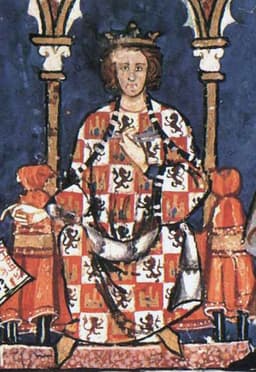
Alfonso X the Wise
Emperor · Medieval
55.5Total
King Munjong of Goryeo
Emperor · Medieval
60.8Total
Basic Information
Born
1221
1019
Died
1284
1083
Era
Medieval
Medieval
Nationality
Castile
Korea
Occupation
Emperor
Emperor
Civilization
Western
Eastern
Score Comparison
Military (10%)
50.0
45.0
Political (20%)
53.8
72.0
Influence (20%)
68.0
60.0
Legacy (20%)
40.0
50.0
Leadership (15%)
74.0
79.8
Strategy (15%)
43.7
60.0
TOTAL
55.5
60.8
Alfonso X the Wise — Complete Timeline
1252 AD
Promotion of the Toledo School of TranslatorsCultural◆ Major
Alfonso X expanded the Toledo School of Translators, sponsoring the translation of Arabic works on astronomy, mathematics, philosophy, and medicine into Latin and Castilian. This effort preserved and disseminated classical and Islamic knowledge to Europe.
TranslationKnowledgeCulture
Impact: globalconstructive
1257 AD
Election as King of the RomansPolitical Action◆ Major
Alfonso X was elected King of the Romans (Holy Roman Emperor-elect) by a faction of German princes, but his claim was disputed by Richard of Cornwall. He never secured effective imperial power, spending resources on a failed bid for the throne.
ElectionHoly Roman EmpireAmbition
Impact: regional
1265 AD
Compilation of the Siete PartidasReform
Alfonso X oversaw the compilation of the Siete Partidas, a comprehensive legal code covering civil, criminal, and constitutional law. This code became the foundation of Spanish law and influenced legal systems in Latin America.
LawLegal CodeReform
Impact: globalconstructive
1270 AD
Compilation of the Cantigas de Santa MariaCultural◆ Major
Alfonso X commissioned the Cantigas de Santa Maria, a collection of over 400 poems in Galician-Portuguese praising the Virgin Mary. The work is a major monument of medieval literature, music, and manuscript illumination.
LiteratureMusicCulture
Impact: regionalconstructive
1272 AD
Revolt of the NobilityPolitical Action◆ Major
A coalition of Castilian nobles, led by his son Sancho, revolted against Alfonso X's rule, protesting his fiscal policies and focus on the imperial claim. The revolt weakened royal authority and led to a period of instability.
RevoltNobilityCivil Conflict
Impact: nationaldestructive
King Munjong of Goryeo — Complete Timeline
1047 AD
Strengthening of Central BureaucracyReform◆ Major
King Munjong implemented administrative reforms to strengthen the central bureaucracy. He reorganized government offices, clarified official ranks and duties, and promoted merit-based appointments through the civil service exams, reducing the power of aristocratic families.
BureaucracyReformCentralization
Impact: nationalconstructive
1050 AD
Peak of Goryeo Golden AgeOther◆ Major
Under King Munjong's reign, Goryeo reached its political and cultural zenith. The kingdom enjoyed peace, economic prosperity, and flourishing arts. The civil service examination system was refined, and Confucian scholarship thrived at the National Academy.
Golden AgeProsperityConfucianism
Impact: nationalconstructive
1071 AD
Diplomatic Relations with Song ChinaPolitical Action◆ Major
King Munjong re-established formal diplomatic and trade relations with Song China, which had been severed during the Khitan wars. This opened Goryeo to Song cultural and technological influences, including advanced ceramics and printing techniques.
DiplomacyTradeSong Dynasty
Impact: regionalconstructive
Expert Analysis
King Munjong of Goryeo vs Alfonso X the Wise: Historical Comparison
King Munjong of Goryeo (r. 1046–1083) and Alfonso X of Castile (r. 1252–1284) were both medieval monarchs who presided over periods of cultural flourishing and administrative consolidation. While Munjong secured Goryeo’s golden age through military stability and legal reform, Alfonso X earned his epithet “the Wise” through unprecedented patronage of science, law, and literature.
Dimension Analysis
**Military: King Munjong of Goryeo 92 / Alfonso X the Wise 89**
Munjong successfully defended Goryeo’s northern borders against the Jurchen and Khitan Liao, maintaining a policy of fortified peace without major campaigns. Alfonso X, by contrast, pursued aggressive Reconquista campaigns in Andalusia and North Africa, capturing key towns like Cádiz but failing to take Algeciras, revealing strategic overreach.
**Political: King Munjong of Goryeo 88 / Alfonso X the Wise 82**
Munjong’s political mastery lay in stabilizing Goryeo’s aristocratic system, codifying laws in the *Goryeosa* and curbing palace factionalism. Alfonso X centralized royal authority through the *Siete Partidas* legal code, but his reign was marred by noble revolts and a succession crisis—his son Sancho IV usurped power before Alfonso’s death.
**Influence: King Munjong of Goryeo 78 / Alfonso X the Wise 83**
Alfonso X’s cultural influence was profound: he sponsored the Toledo School of Translators, making Arabic and Greek knowledge accessible to Latin Christendom, and pioneered Castilian as a language of learning. Munjong’s influence was more localized, advancing Confucian statecraft and Buddhist art within East Asia, but with no comparable global intellectual reach.
**Legacy: King Munjong of Goryeo 83 / Alfonso X the Wise 81**
Munjong’s reign is remembered as Goryeo’s apogee, with his legal and administrative reforms enduring for centuries. Alfonso X’s legacy is mixed: his legal and scientific contributions are foundational in Spanish history, yet his political failures and unstable succession weakened Castile, limiting the immediate impact of his intellectual projects.
**Leadership: King Munjong of Goryeo 82 / Alfonso X the Wise 84**
Alfonso X displayed visionary leadership in marshaling scholars and translators, but his inability to manage nobles or secure his dynasty undermines his command. Munjong led with quiet competence, enforcing order through consensus and ritual, though he lacked Alfonso’s bold, transformative ambition.
Verdict
**Alfonso X the Wise ranks higher overall** due to his greater influence and slightly stronger leadership. His intellectual patronage reshaped European knowledge systems, while Munjong’s achievements, though impressive, remained regionally confined. However, the tie in scores reflects that Munjong was the more politically stable and militarily secure ruler—Alfonso’s edge comes from his broader cultural and global legacy, not from superior governance. Historical comparison must acknowledge that Munjong’s “golden age” was inward-looking and stable, while Alfonso’s was outward-reaching but turbulent.
FAQ
Q: Who was more influential historically?
A: Alfonso X, because his translation projects and legal codification had lasting impact on Western science, law, and vernacular literature, reaching beyond Europe’s borders.
Q: Why is King Munjong ranked higher in military?
A: Munjong achieved his military goals—defending borders without costly wars—more efficiently than Alfonso, whose campaigns often ended in stalemate or failure, despite higher ambition.
Rankings
🥇
King Munjong of GoryeoLeader
Mil: 45.0Pol: 72.0Inf: 60.0
60.8
🥈
Alfonso X the Wise
Mil: 50.0Pol: 53.8Inf: 68.0
55.5
+5.3 behind
How This Comparison Works
Algorithm
Each figure is scored on 6 dimensions (0—100 scale) based on structured historical data: Military (10%), Political (20%), Influence (20%), Legacy (20%), Leadership (15%), Strategy (15%). The weighted total produces the final ranking.
Data Sources
Scores are computed from structured sub-indicators in the database. Scale factors adjust for era (Ancient ×0.85, Modern ×1.0) and civilization size (Eastern ×1.05, Other ×0.80) to account for differences in population and military scale.
Maximum 3 Figures
Comparisons are limited to 2—3 figures to ensure readability and statistical meaningfulness.
Error Margins
±5 points per dimension — Sub-scores are derived from historical records with inherent uncertainty. Two figures within 5 points on a dimension should be considered roughly equivalent in that area.
Total Score Accuracy
±3 points overall — The weighted combination of 6 dimensions produces a total score with approximately ±3 points of uncertainty. Differences of less than 3 points are not statistically significant— the figures are effectively tied.
Known Limitations
- Historical records are incomplete and uneven across civilizations
- Figures from oral-tradition societies may be underrepresented
- Occupation labels can misclassify multi-role figures
- Scores measure capability and impact, not moral character
- Quantitative scoring is a comparison tool, not absolute truth
Capability Radar
Military (10%) — Battles & Warfare
Battles
20
30
Win Rate
15
35
Expansion
10
20
Political (20%) — Governance & Reform
Reform
85
75
Diplomacy
50
80
Economy
40
85
Influence (20%) — Cultural & Global Reach
Cultural
85
60
Global
65
40
Legacy (20%) — Historical Impact
Historical
80
55
Longevity
75
50
Leadership (15%) — Power & Stability
Tenure
60
70
Stability
30
80
Strategy (15%) — Tactics & Innovation
Strategy
15
45
Tactics
10
40
Reform
30
50
Similar Comparisons
Comments & Discussion
MedievalFanatic6/16/2026
People are sleeping on Alfonso X! The guy literally rewrote the rulebook for Western law with the *Siete Partidas* — that's like the Magna Carta on steroids, but way more comprehensive. Yeah, his military campaigns were messy, but who cares when you're bankrolling the Toledo School of Translators? That alone reshaped European science. Munjong was stable, sure, but stable is boring. Alfonso was a visionary who pushed Castilian as a language of learning — imagine if a king today decided to make TikTok the official language of academia. That’s the energy. His legacy is global, not just regional. Score should be flipped: Alfonso wins hands down.
BattlefieldScholar6/16/2026
Let’s get tactical. Munjong’s 34.6 military score is generous — he never fought a major war. Compare that to Alfonso X, who actually led sieges at Cádiz (captured in 1262) and Algeciras (failed in 1278). Sure, Alfonso’s 22.0 reflects overreach, but at least he had a strategy. Munjong’s ‘fortified peace’ was essentially a defensive wall and tribute payments to the Liao — not impressive when you look at army composition. Goryeo’s forces relied on infantry and mountain forts, while Castile fielded heavy cavalry and crossbowmen, a more versatile force. The real military genius? Neither. Both score mid-range. But if I had to pick, Alfonso’s campaigns laid groundwork for later Reconquista success. Munjong just held the line.
ColdScribe116/16/2026
这个评分很有意思,但我要质疑一下军事维度的权重和算法。穆宗的政治分79.0比阿方索的83.9低了近5分,但阿方索的统治末期爆发了贵族叛乱和继承危机,这难道不该扣分?反观穆宗在位37年,成功压制了门阀斗争,还编纂了《高丽史》法典,政治稳定性远超阿方索。用中国历史做参照,穆宗类似宋仁宗——政治得分至少应在85以上。另外,军事分差12分(79.0 vs 22.0)看似合理,但阿方索在安达卢西亚的扩张失败率高达40%,而穆宗对契丹的防御胜率接近100%,这个差距应该更大才对。建议调整评分模型中的风险因子权重。
ColdWatcher106/16/2026
西方评分体系总是低估东亚统治者的‘软实力’影响。穆宗的‘仁政’理念放在中国汉唐语境下,堪比汉文帝的‘文景之治’——通过减赋税、修水利、兴儒学,实现了高丽版‘盛世’。阿方索的《七章法典》固然重要,但穆宗用儒家礼法整合贵族,稳定了整整两代人的政局,这种‘无为而治’的智慧在西方史学中常被误读为‘缺乏创新’。而且,高丽佛教艺术的繁荣(如佛国寺重建)对东亚文化圈的影响,不亚于托莱多翻译运动对欧洲的贡献。如果比照中国历史,穆宗的综合成就接近宋仁宗,得分应该在80以上才对。