Loading...
Alfonso V of Aragon vs Boleslaw III Wrymouth
Alfonso V of Aragon leads by 15.0 pts · 2 figures compared
…
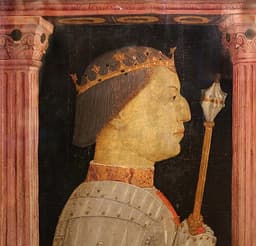
Alfonso V of Aragon
Emperor · Medieval
58.7Total

Boleslaw III Wrymouth
Emperor · Medieval
43.7Total
Basic Information
Born
1396
1086
Died
1458
1138
Era
Medieval
Medieval
Nationality
Aragon
Poland
Occupation
Emperor
Emperor
Civilization
Western
Western
Score Comparison
Military (10%)
67.5
20.0
Political (20%)
62.7
30.8
Influence (20%)
59.0
51.8
Legacy (20%)
49.2
47.5
Leadership (15%)
68.0
51.9
Strategy (15%)
52.5
45.0
TOTAL
58.7
43.7
Alfonso V of Aragon — Complete Timeline
1442 AD
Conquest of NaplesWar
Alfonso V of Aragon captured the city of Naples after a prolonged siege, defeating the Angevin claimant Ren
Italian conquestMediterranean empire
Impact: regional
1443 AD
Patronage of the arts in NaplesCultural◆ Major
Alfonso V established a humanist court in Naples, patronizing scholars, artists, and writers. He commissioned translations of classical works, supported the construction of the Castel Nuovo, and fostered a cultural renaissance in southern Italy, earning him the epithet 'the Magnanimous'.
Renaissance patronageHumanism
Impact: regionalconstructive
1454 AD
Peace of LodiPolitical Action◆ Major
Alfonso V was a signatory to the Peace of Lodi, a treaty that ended decades of warfare between the Italian states of Milan, Venice, Florence, and Naples. The agreement established a balance of power in Italy that lasted for forty years, with Alfonso's Kingdom of Naples as a key player.
Italian peaceBalance of power
Impact: regionalconstructive
Boleslaw III Wrymouth — Complete Timeline
1109 AD
Battle of NakłoWar◆ Major
Bolesław III defeated the Pomeranian forces at Nakło, securing Polish control over Pomerania. This victory expanded Polish territory and influence in the Baltic region.
PomeraniaMilitary CampaignExpansion
Impact: regionalconstructive
Conflict with Henry V of GermanyWar◆ Major
Bolesław III successfully defended Poland against an invasion by Holy Roman Emperor Henry V at the Battle of Głogów and the Battle of Hundsfeld. The Polish forces repelled the imperial army, preserving Polish independence.
Holy Roman EmpireDefenseIndependence
Impact: nationalconstructive
1121 AD
Conquest of PomeraniaWar◆ Major
Bolesław III completed the conquest of Pomerania, incorporating the region into the Polish state. He forced the Pomeranian duke Wartislaw I to become a vassal, extending Polish authority to the Baltic coast.
PomeraniaConquestBaltic
Impact: regionalconstructive
1138 AD
Testament of Bolesław III WrymouthPolitical Action
Bolesław III issued his testament dividing the Polish realm among his four sons, with the senior prince ruling Kraków. This act established the principle of seniorate and initiated the period of feudal fragmentation in Poland, which lasted nearly two centuries.
Feudal FragmentationSuccessionPoland
Impact: nationaldestructive
Expert Analysis
Origins
Alfonso V of Aragon was born in 1396 in Medina del Campo, Castile, the son of King Ferdinand I of Aragon and Eleanor of Alburquerque. He was educated in the chivalric and courtly traditions of the Crown of Aragon, which at that time comprised a maritime empire in the Mediterranean. His early exposure to administration came through governing the kingdom of Sicily. Bolesław III Wrymouth was born in 1086 in Kraków, Poland, the only son of Duke Władysław I Herman and Judith of Bohemia. His early life was marked by political intrigue and conflict with his half-brother Zbigniew, which shaped his ambitions and strategic thinking.
Rise to Power
Alfonso V ascended to the Aragonese throne in 1416 upon his father's death, inheriting a kingdom with strong Mediterranean interests. His major turning point came in 1442 when he conquered Naples after a prolonged siege, defeating the Angevin claimant René of Anjou. This victory established the Aragonese dynasty in southern Italy and made Alfonso the de facto ruler of a substantial Italian territory. Bolesław III's rise was more contested. He became Duke of Poland in 1102 after his father's death, but faced immediate opposition from his half-brother Zbigniew, who controlled parts of the realm. Through military campaigns and political maneuvering, Bolesław defeated Zbigniew in 1106, exiling him and unifying Poland under his sole rule. His most decisive military triumph was the Battle of Nakło in 1109, where he defeated the Pomeranian forces, securing Polish control over Pomerania.
Leadership & Governance
Alfonso V was a Renaissance prince who combined military ambition with cultural patronage. He established a humanist court in Naples, commissioning translations of classical works and supporting scholars. His governance style emphasized diplomacy and alliance-building, as seen in his role in the Peace of Lodi in 1454, which ended decades of warfare among Italian states. However, his focus on Italian affairs often left his Aragonese domains neglected. In contrast, Bolesław III was a warrior duke who prioritized territorial expansion and internal consolidation. He completed the conquest of Pomerania, forcing Duke Wartislaw I to become a Polish vassal. His governance was pragmatic, but his most fateful decision was his testament, which divided Poland among his four sons, establishing the principle of seniority that led to centuries of fragmentation. While Alfonso's political score is 62.7, Bolesław's is 30.8, reflecting the difference in their administrative sophistication.
Triumph & Tragedy
Alfonso's greatest triumph was the conquest of Naples, which fulfilled his ambition to create a Mediterranean empire. He also successfully defended his Italian possessions against the Angevins and other rivals. His patronage of the arts made Naples a center of Renaissance culture. However, his overextension in Italy strained Aragonese resources, and his death in 1458 left Naples to his illegitimate son Ferrante, leading to instability. Bolesław's triumphs include the Battle of Nakło and successful defense against Henry V of Germany at the Battles of Głogów (1109) and Hundsfeld (1109). He also expanded Polish territory westward. His tragedy is his testament of 1138, which divided Poland into duchies for his sons, causing the fragmentation that lasted until the 14th century. This decision, intended to prevent civil war, ironically triggered internal conflict. Bolesław's legacy score of 47.5 reflects this mixed outcome, while Alfonso's is 49.2.
Character & Destiny
Alfonso V was known as "the Magnanimous" for his generous patronage and clement treatment of enemies. He was a strategic thinker with a cosmopolitan outlook, comfortable in both Catalan and Italian cultures. His character led him to pursue grand ambitions, but his neglect of his Iberian realms created tensions. Bolesław III was nicknamed "Wrymouth" due to a facial deformity. He was tenacious and militarily adept, but his decision to partition his kingdom reveals a flawed understanding of dynastic stability. Historians note that his testament, while legally innovative, failed to maintain unity. Alfonso's leadership score is 68.0, Bolesław's 51.9, indicating Alfonso's more effective command.
Legacy
Alfonso V's legacy is primarily cultural: his patronage helped spark the Italian Renaissance in Naples, and his court served as a model for later rulers. Politically, the Aragonese kingdom of Naples survived until 1501. However, his impact on Spain was limited. Bolesław III's legacy is more ambiguous. He successfully expanded Poland and defended its independence, but his testament's fragmentation became a defining feature of Polish medieval history. The seniorate principle he established influenced Polish succession for centuries. His military achievements, with a score of 20.0 compared to Alfonso's 67.5, are less impressive, but his political legacy endured longer in Polish national memory.
Conclusion
Alfonso V of Aragon had greater immediate impact, as his conquest of Naples and cultural patronage shaped the Renaissance in Italy. His scores total 58.7 compared to Bolesław's 43.7. However, Bolesław's actions had longer-term consequences for Poland, both positive (unification) and negative (fragmentation). In terms of overall influence, Alfonso's Mediterranean empire and cultural contributions outweigh Bolesław's regional legacy. The data supports Alfonso as the more significant figure, though Bolesław's role in Polish history is undeniable.
Rankings
🥇
Alfonso V of AragonLeader
Mil: 67.5Pol: 62.7Inf: 59.0
58.7
🥈
Boleslaw III Wrymouth
Mil: 20.0Pol: 30.8Inf: 51.8
43.7
+15.0 behind
How This Comparison Works
Algorithm
Each figure is scored on 6 dimensions (0—100 scale) based on structured historical data: Military (10%), Political (20%), Influence (20%), Legacy (20%), Leadership (15%), Strategy (15%). The weighted total produces the final ranking.
Data Sources
Scores are computed from structured sub-indicators in the database. Scale factors adjust for era (Ancient ×0.85, Modern ×1.0) and civilization size (Eastern ×1.05, Other ×0.80) to account for differences in population and military scale.
Maximum 3 Figures
Comparisons are limited to 2—3 figures to ensure readability and statistical meaningfulness.
Error Margins
±5 points per dimension — Sub-scores are derived from historical records with inherent uncertainty. Two figures within 5 points on a dimension should be considered roughly equivalent in that area.
Total Score Accuracy
±3 points overall — The weighted combination of 6 dimensions produces a total score with approximately ±3 points of uncertainty. Differences of less than 3 points are not statistically significant— the figures are effectively tied.
Known Limitations
- Historical records are incomplete and uneven across civilizations
- Figures from oral-tradition societies may be underrepresented
- Occupation labels can misclassify multi-role figures
- Scores measure capability and impact, not moral character
- Quantitative scoring is a comparison tool, not absolute truth
Capability Radar
Military (10%) — Battles & Warfare
Battles
65
45
Win Rate
60
40
Expansion
65
40
Political (20%) — Governance & Reform
Reform
55
20
Diplomacy
70
30
Economy
60
25
Influence (20%) — Cultural & Global Reach
Cultural
55
30
Global
40
20
Legacy (20%) — Historical Impact
Historical
50
45
Longevity
45
40
Leadership (15%) — Power & Stability
Tenure
70
55
Stability
55
10
Strategy (15%) — Tactics & Innovation
Strategy
60
30
Tactics
55
35
Reform
40
20
Similar Comparisons
Comments & Discussion
No comments yet. Be the first to share your thoughts!