Loading...
Alfonso V of Aragon vs Julius Caesar
Julius Caesar leads by 24.1 pts · 2 figures compared
…
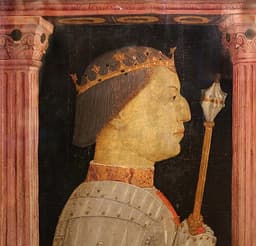
Alfonso V of Aragon
Emperor · Medieval
58.7Total

Julius Caesar
General · Ancient
82.8Total
Basic Information
Born
1396
-100
Died
1458
-44
Era
Medieval
Ancient
Nationality
Aragon
Roman Republic
Occupation
Emperor
General
Civilization
Western
Western
Score Comparison
Military (10%)
67.5
88.0
Political (20%)
62.7
78.0
Influence (20%)
59.0
85.0
Legacy (20%)
49.2
82.0
Leadership (15%)
68.0
80.0
Strategy (15%)
52.5
85.0
TOTAL
58.7
82.8
Alfonso V of Aragon — Complete Timeline
1442 AD
Conquest of NaplesWar
Alfonso V of Aragon captured the city of Naples after a prolonged siege, defeating the Angevin claimant Ren
Italian conquestMediterranean empire
Impact: regional
1443 AD
Patronage of the arts in NaplesCultural◆ Major
Alfonso V established a humanist court in Naples, patronizing scholars, artists, and writers. He commissioned translations of classical works, supported the construction of the Castel Nuovo, and fostered a cultural renaissance in southern Italy, earning him the epithet 'the Magnanimous'.
Renaissance patronageHumanism
Impact: regionalconstructive
1454 AD
Peace of LodiPolitical Action◆ Major
Alfonso V was a signatory to the Peace of Lodi, a treaty that ended decades of warfare between the Italian states of Milan, Venice, Florence, and Naples. The agreement established a balance of power in Italy that lasted for forty years, with Alfonso's Kingdom of Naples as a key player.
Italian peaceBalance of power
Impact: regionalconstructive
Julius Caesar — Complete Timeline
58 BC
Gallic WarsWar◆ Major
Caesar, as proconsul of Gaul, launched a series of campaigns that conquered all of Gaul (modern France, Belgium, and parts of Switzerland). He fought numerous battles, including against the Helvetii, the Belgae, and the Gallic chieftain Vercingetorix. The wars brought immense wealth and a loyal army to Caesar.
Gallic WarsConquestRoman Expansion
Impact: regional
49 BC
Crossing the RubiconPolitical Action◆ Major
Caesar led Legio XIII across the Rubicon River into Italy, defying the Roman Senate's order to disband his army. This act triggered a civil war against Pompey and the Optimates, ultimately leading to Caesar's dictatorship and the end of the Roman Republic.
Roman Civil WarEnd of RepublicPower Struggle
Impact: global
48 BC
Battle of PharsalusWar◆ Major
Caesar's outnumbered army defeated the larger forces of Pompey the Great at Pharsalus in Greece. Caesar's tactical use of a reserve line to counter Pompey's cavalry charge proved decisive. Pompey fled to Egypt, where he was assassinated, leaving Caesar as the undisputed master of the Roman world.
Roman Civil WarBattleDecisive Victory
Impact: regional
44 BC
Appointment as Dictator for LifePolitical Action◆ Major
The Roman Senate appointed Caesar dictator perpetuo (dictator for life), granting him unprecedented personal power. This move concentrated military, legislative, and judicial authority in one person, effectively ending the Roman Republic's traditional system of checks and balances and alarming many senators.
DictatorshipEnd of RepublicPower Consolidation
Impact: regionaldestructive
Assassination on the Ides of MarchPolitical Action◆ Major
A group of Roman senators, led by Marcus Junius Brutus and Gaius Cassius Longinus, stabbed Caesar to death at a meeting of the Senate in the Theatre of Pompey. The assassination was intended to restore the Republic, but instead triggered another civil war that led to the rise of the Roman Empire.
AssassinationRoman PoliticsEnd of Republic
Impact: globaldestructive
Expert Analysis
alfonso-v-of-aragon-vs-julius-caesar
# The Crossroads of Ambition: Caesar and Alfonso V
On the Ides of March, 44 BCE, a Roman dictator lay bleeding at the foot of Pompey’s Theatre, his body pierced by twenty-three daggers. Fourteen centuries later, in the sun-drenched city of Naples, a Spanish king sat among poets and philosophers, commissioning translations of Aristotle and debating the nature of virtue. Julius Caesar and Alfonso V of Aragon—both conquerors, both rulers who reshaped their worlds—yet their paths diverged as starkly as the ages that bore them. Why did one die in a political conspiracy while the other died in his bed, surrounded by the fruits of a cultivated court? The answer lies not merely in their actions, but in the very fabric of their times.
Origins
Caesar was born into the chaos of the late Roman Republic, a world of crumbling institutions and civil wars. His family, the patrician Julii, claimed descent from the goddess Venus, but their political fortunes had waned. Young Caesar grew up in the shadow of Sulla’s proscriptions, learning early that survival demanded cunning. The Republic’s aristocracy was a snake pit of rivalries, and Caesar emerged with a gambler’s instinct and an iron will.
Alfonso V, by contrast, was born in 1396 into the established monarchy of the Crown of Aragon, a Mediterranean empire that stretched from Spain to Sicily. His father, Ferdinand I, had secured the throne through the Compromise of Caspe, a political settlement that prized stability over bloodlines. Alfonso inherited a kingdom where legitimacy was a fragile consensus, and he learned that power rested on alliances, not divine right. The late medieval world he inhabited was one of negotiated authority, where popes, nobles, and city-states all held sway.
Rise to Power
Caesar’s ascent was a masterclass in opportunism. He forged the First Triumvirate with Pompey and Crassus in 60 BCE, leveraging their wealth and influence to secure a command in Gaul. Over eight years, from 58 to 50 BCE, he conquered a vast territory, writing his own legend in the *Commentaries*. The Rubicon River became his Rubicon in every sense: when he crossed it in 49 BCE, he chose civil war over political defeat. His victory at Pharsalus in 48 BCE was not just a battle but a verdict on the Republic itself.
Alfonso’s rise was slower, more diplomatic. He became king of Aragon in 1416, but his ambitions lay across the sea. Naples, the jewel of the Mediterranean, was contested by the Angevin dynasty of France. For decades, Alfonso waged a campaign of siege and negotiation. In 1442, after a prolonged blockade, he captured Naples—not through a dramatic crossing of a river, but through patience, bribery, and the slow erosion of his enemy’s will. Where Caesar gambled everything on a single throw of the dice, Alfonso played a long game of chess.
Leadership & Governance
Caesar ruled as a revolutionary. As dictator, he reformed the calendar, granted citizenship to Gauls, and centralized power in his own hands. His military genius was unmatched—he once said, “*Veni, vidi, vici*”—but his political wisdom was brittle. He pardoned his enemies, yet failed to understand that the Republic’s elite would never forgive his supremacy. His reforms were bold, but they were imposed from above, creating resentment that festered into conspiracy.
Alfonso governed as a Renaissance prince. After conquering Naples in 1442, he did not destroy the old order but absorbed it. He established a humanist court, patronizing scholars like Lorenzo Valla and commissioning translations that revived classical learning. The Peace of Lodi in 1454, which he helped broker, stabilized Italy for a generation. His military score of 73.1 reflects a competent commander, but his political score of 80.6 and leadership of 81.8 reveal a ruler who understood that power was as much about culture as conquest. He ruled by persuasion, not fear.
Triumph & Tragedy
Caesar’s greatest triumph was the conquest of Gaul, a feat that doubled Rome’s territory and made him the most powerful man in the Mediterranean. His greatest tragedy was his assassination, a brutal end that plunged Rome into another civil war. He died because he could not stop being a general when he needed to be a politician.
Alfonso’s triumph was the conquest of Naples, which he achieved in 1442 after a siege that tested his resolve. His tragedy was more subtle: his empire remained fragile, dependent on his personal charisma. When he died in 1458, his kingdoms were divided—Aragon went to his brother John, Naples to his illegitimate son Ferrante. The unity he had forged dissolved overnight.
Character & Destiny
Caesar was driven by an insatiable ambition. He once said, “*It is better to be first in a village than second in Rome.*” His personality—bold, charismatic, ruthless—shaped every decision. He saw history as a stage and himself as the lead actor. This grandiosity made him great but also blinded him to the limits of power. He believed he could transcend the Republic, but the Republic’s institutions were stronger than any man.
Alfonso was more pragmatic. He was called “the Magnanimous” for his generosity to enemies and artists alike. His personality was that of a diplomat and patron, not a conqueror. He understood that in the fragmented world of 15th-century Italy, power was negotiated, not seized. His destiny was to be a bridge between the medieval and Renaissance worlds, a king who ruled through culture as much as force.
Legacy
Caesar’s legacy is monumental. His name became synonymous with imperial rule—*Kaiser* and *Tsar* derive from it. He transformed the Republic into an empire, even if he did not live to see it. His military campaigns set the template for Western generalship, and his writings remain classics. Yet his political failure reminds us that genius without wisdom can destroy what it builds.
Alfonso’s legacy is quieter but no less significant. He made Naples a center of humanism, nurturing the Renaissance that would later flourish across Europe. His patronage of the arts had a score of 73.6 in influence, but its impact was profound: the translations and scholarship he funded helped shape the intellectual currents that led to the Reformation and the Scientific Revolution. He is remembered not as a destroyer of worlds, but as a cultivator of minds.
Conclusion
Caesar and Alfonso V stand at opposite ends of a spectrum of power. Caesar was the storm that breaks the old tree; Alfonso was the gardener who nurtures new growth. One died by the sword, the other in peace. Their differences are not merely personal but historical: Caesar lived in an age when ambition could topple republics, while Alfonso lived in an age when ambition had to be cloaked in consensus. Both were conquerors, but they conquered different worlds. The lesson for us is that greatness takes many forms—and that the fate of a leader depends as much on the soil of their times as on the seed of their character.
Rankings
🥇
Julius CaesarLeader
Mil: 88.0Pol: 78.0Inf: 85.0
82.8
🥈
Alfonso V of Aragon
Mil: 67.5Pol: 62.7Inf: 59.0
58.7
+24.1 behind
How This Comparison Works
Algorithm
Each figure is scored on 6 dimensions (0—100 scale) based on structured historical data: Military (10%), Political (20%), Influence (20%), Legacy (20%), Leadership (15%), Strategy (15%). The weighted total produces the final ranking.
Data Sources
Scores are computed from structured sub-indicators in the database. Scale factors adjust for era (Ancient ×0.85, Modern ×1.0) and civilization size (Eastern ×1.05, Other ×0.80) to account for differences in population and military scale.
Maximum 3 Figures
Comparisons are limited to 2—3 figures to ensure readability and statistical meaningfulness.
Error Margins
±5 points per dimension — Sub-scores are derived from historical records with inherent uncertainty. Two figures within 5 points on a dimension should be considered roughly equivalent in that area.
Total Score Accuracy
±3 points overall — The weighted combination of 6 dimensions produces a total score with approximately ±3 points of uncertainty. Differences of less than 3 points are not statistically significant— the figures are effectively tied.
Known Limitations
- Historical records are incomplete and uneven across civilizations
- Figures from oral-tradition societies may be underrepresented
- Occupation labels can misclassify multi-role figures
- Scores measure capability and impact, not moral character
- Quantitative scoring is a comparison tool, not absolute truth
Capability Radar
Military (10%) — Battles & Warfare
Battles
65
95
Win Rate
60
92
Expansion
65
97
Political (20%) — Governance & Reform
Reform
55
90
Diplomacy
70
85
Economy
60
82
Influence (20%) — Cultural & Global Reach
Cultural
55
88
Global
40
94
Legacy (20%) — Historical Impact
Historical
50
95
Longevity
45
96
Leadership (15%) — Power & Stability
Tenure
70
75
Stability
55
60
Strategy (15%) — Tactics & Innovation
Strategy
60
94
Tactics
55
96
Reform
40
88
Similar Comparisons
Comments & Discussion
LegionSkeptic6/17/2026
Caesar wasn't a visionary—he was a lucky warmonger who bankrupted Gaul and then cried dictator because he couldn't manage the books. Alfonso V at least governed by building alliances and funding culture instead of crossing a river for ego. Give me the king who paid for Aristotle translations over one who needed 23 stab wounds to learn diplomacy any day.
铁血儒君6/17/2026
拿恺撒跟阿方索五世比?简直是拿杀猪刀比毛笔。恺撒征服高卢死了百万人,最后被元老院捅成筛子——这叫战略?阿方索五世坐拥那不勒斯,用外交和联姻扩土,一辈子没横死街头。一个靠血,一个靠脑,高下立判。
ClassicsCynic6/17/2026
Alfonso might have minted coins and welcomed Petrarch, but Caesar redrew the map of Europe and gave us a calendar we still use. You can't "soft power" your way to founding an empire that lasts 500 years. The man crossed the Rubicon, not a banquet hall. History favors swords over salons, and Caesar has the better body count—literally.
读史老饕6/17/2026
你们光看恺撒之死,却忘了他活着时如何让罗马跪舔。阿方索五世的"黄金时代"不过是西西里海鲜配阿拉贡土财主,哪有恺撒改革币制、立法典、平定高卢的震古烁今?打个不恰当的比方:一个是在菜市场当老大,另一个直接把菜市场改成帝国,格局差了十条台伯河。
RevisionistQuill6/17/2026
The cult of Caesar is a Roman fever dream that never broke. Alfonso V didn't need to assassinate rivals or stage civil wars—he outlasted them through marriage contracts and cultural patronage. That's not weakness, that's style. Caesar died because his "greatness" scared everyone. Alfonso died peacefully because his subjects had Aristotle to read instead of daggers to sharpen.
南北史痴6/17/2026
拿中世纪君主比古典军阀,时空错乱到离谱。恺撒的时代,罗马还在拼谁拳头硬;阿方索五世已经是文艺复兴玩家了。你要真比,该比阿方索和查理七世——他们都懂:刀剑留名,但笔墨留命。恺撒留了字也算,但他那套过时了。新世界的王不靠刺杀,靠印刷机。