Loading...
This comparison has not been analyzed yet.
One-time AI generation (~1 minute). Scores and timeline are already available below.
Alexis I of Russia vs Rukidi I of Tooro
Alexis I of Russia leads by 10.5 pts · 2 figures compared
…
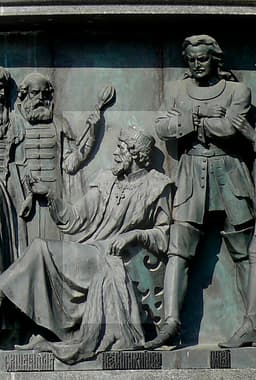
Alexis I of Russia
Emperor · Modern
59.5Total

Rukidi I of Tooro
Emperor · Modern
49.0Total
Basic Information
Born
1629
1830
Died
1676
1890
Era
Modern
Modern
Nationality
Russia
Uganda
Occupation
Emperor
Emperor
Civilization
Western
Other
Score Comparison
Military (10%)
55.0
50.0
Political (20%)
60.0
42.2
Influence (20%)
55.0
50.2
Legacy (20%)
58.0
44.2
Leadership (15%)
72.0
65.7
Strategy (15%)
60.0
42.3
TOTAL
59.5
49.0
Alexis I of Russia — Complete Timeline
1649 AD
Enacted the 1649 Sobornoye Ulozheniye (Code of Laws)Reform◆ Major
Alexis I enacted the Sobornoye Ulozheniye, a comprehensive legal code that consolidated Russian law and strengthened serfdom by making peasants permanently bound to the land. The code also centralized state authority and defined the rights of nobles, clergy, and townspeople.
Legal CodeSerfdomCentralization
Impact: national
1654 AD
Led the 1654-1667 Russo-Polish WarWar◆ Major
Alexis I launched a war against the Polish-Lithuanian Commonwealth, initially capturing Smolensk and much of eastern Poland. The war, which included the Khmelnytsky Uprising and Swedish intervention, ended with the Truce of Andrusovo, gaining Russia left-bank Ukraine and Kiev.
WarPolandUkraine
Impact: regional
1662 AD
Suppressed the 1662 Copper RiotPolitical Action◆ Major
Alexis I's government brutally suppressed the Copper Riot in Moscow, a protest against the devaluation of copper coins and economic hardship. Thousands of rioters were killed or executed, and the rebellion led to the withdrawal of copper currency, restoring silver coinage.
RiotCopperEconomic
Impact: nationaldestructive
1666 AD
Supported the 1666-1667 Church Council that condemned the Old BelieversCultural◆ Major
Alexis I supported the Great Moscow Synod, which condemned the Old Believers and their leader Avvakum for opposing Patriarch Nikon's liturgical reforms. The council excommunicated the dissenters, leading to a schism (Raskol) in the Russian Orthodox Church that persisted for centuries.
ChurchSchismOld Believers
Impact: nationaldestructive
Rukidi I of Tooro — Complete Timeline
1830 AD
Secession from BunyoroPolitical Action◆ Major
Rukidi I led a rebellion against the Bunyoro kingdom, establishing the independent Tooro kingdom. This event created a new political entity in the region, with Rukidi becoming the first Omukama of Tooro.
FoundingSecessionTooro Kingdom
Impact: regional
1840 AD
Consolidation of Tooro territoryWar◆ Major
Rukidi I fought defensive wars against Bunyoro attempts to reconquer Tooro. He secured the kingdom's borders and established its territorial integrity, though conflicts with Bunyoro continued intermittently.
Territorial DefenseBunyoro Conflict
Impact: regional
This comparison has not been analyzed yet.
One-time AI generation (~1 minute). Scores and timeline are already available below.
Rankings
🥇
Alexis I of RussiaLeader
Mil: 55.0Pol: 60.0Inf: 55.0
59.5
🥈
Rukidi I of Tooro
Mil: 50.0Pol: 42.2Inf: 50.2
49.0
+10.5 behind
How This Comparison Works
Algorithm
Each figure is scored on 6 dimensions (0—100 scale) based on structured historical data: Military (10%), Political (20%), Influence (20%), Legacy (20%), Leadership (15%), Strategy (15%). The weighted total produces the final ranking.
Data Sources
Scores are computed from structured sub-indicators in the database. Scale factors adjust for era (Ancient ×0.85, Modern ×1.0) and civilization size (Eastern ×1.05, Other ×0.80) to account for differences in population and military scale.
Maximum 3 Figures
Comparisons are limited to 2—3 figures to ensure readability and statistical meaningfulness.
Error Margins
±5 points per dimension — Sub-scores are derived from historical records with inherent uncertainty. Two figures within 5 points on a dimension should be considered roughly equivalent in that area.
Total Score Accuracy
±3 points overall — The weighted combination of 6 dimensions produces a total score with approximately ±3 points of uncertainty. Differences of less than 3 points are not statistically significant— the figures are effectively tied.
Known Limitations
- Historical records are incomplete and uneven across civilizations
- Figures from oral-tradition societies may be underrepresented
- Occupation labels can misclassify multi-role figures
- Scores measure capability and impact, not moral character
- Quantitative scoring is a comparison tool, not absolute truth
Capability Radar
Military (10%) — Battles & Warfare
Battles
45
15
Win Rate
50
20
Expansion
50
25
Political (20%) — Governance & Reform
Reform
65
30
Diplomacy
60
35
Economy
55
20
Influence (20%) — Cultural & Global Reach
Cultural
55
30
Global
50
10
Legacy (20%) — Historical Impact
Historical
65
35
Longevity
60
30
Leadership (15%) — Power & Stability
Tenure
70
40
Stability
50
25
Strategy (15%) — Tactics & Innovation
Strategy
55
15
Tactics
40
10
Reform
60
10
Similar Comparisons
Comments & Discussion
No comments yet. Be the first to share your thoughts!