Loading...
Alexis I of Russia vs William IV
Alexis I of Russia leads by 7.4 pts · 2 figures compared
…
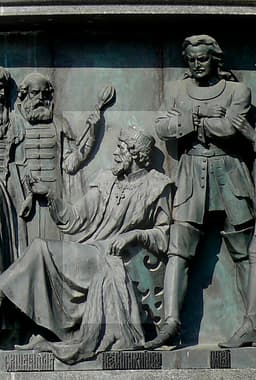
Alexis I of Russia
Emperor · Modern
59.5Total

William IV
Emperor · Modern
52.1Total
Basic Information
Born
1629
1765
Died
1676
1837
Era
Modern
Modern
Nationality
Russia
United Kingdom
Occupation
Emperor
Emperor
Civilization
Western
Western
Score Comparison
Military (10%)
55.0
22.6
Political (20%)
60.0
60.0
Influence (20%)
55.0
54.1
Legacy (20%)
58.0
47.5
Leadership (15%)
72.0
77.2
Strategy (15%)
60.0
38.6
TOTAL
59.5
52.1
Alexis I of Russia — Complete Timeline
1649 AD
Enacted the 1649 Sobornoye Ulozheniye (Code of Laws)Reform◆ Major
Alexis I enacted the Sobornoye Ulozheniye, a comprehensive legal code that consolidated Russian law and strengthened serfdom by making peasants permanently bound to the land. The code also centralized state authority and defined the rights of nobles, clergy, and townspeople.
Legal CodeSerfdomCentralization
Impact: national
1654 AD
Led the 1654-1667 Russo-Polish WarWar◆ Major
Alexis I launched a war against the Polish-Lithuanian Commonwealth, initially capturing Smolensk and much of eastern Poland. The war, which included the Khmelnytsky Uprising and Swedish intervention, ended with the Truce of Andrusovo, gaining Russia left-bank Ukraine and Kiev.
WarPolandUkraine
Impact: regional
1662 AD
Suppressed the 1662 Copper RiotPolitical Action◆ Major
Alexis I's government brutally suppressed the Copper Riot in Moscow, a protest against the devaluation of copper coins and economic hardship. Thousands of rioters were killed or executed, and the rebellion led to the withdrawal of copper currency, restoring silver coinage.
RiotCopperEconomic
Impact: nationaldestructive
1666 AD
Supported the 1666-1667 Church Council that condemned the Old BelieversCultural◆ Major
Alexis I supported the Great Moscow Synod, which condemned the Old Believers and their leader Avvakum for opposing Patriarch Nikon's liturgical reforms. The council excommunicated the dissenters, leading to a schism (Raskol) in the Russian Orthodox Church that persisted for centuries.
ChurchSchismOld Believers
Impact: nationaldestructive
William IV — Complete Timeline
1779 AD
Naval CareerOther
William IV served in the Royal Navy from age 13, rising to the rank of admiral. He saw action in the American Revolutionary War and later served as Lord High Admiral. His naval experience earned him the nickname 'Sailor King'.
NavyMilitary ServiceSailor King
Impact: nationalconstructive
1832 AD
Reform Act 1832Political Action
William IV gave royal assent to the Reform Act, which reformed the British electoral system. It abolished rotten boroughs, redistributed seats to industrial cities, and expanded the electorate. This act was a major step toward democratic representation.
Reform ActElectoral ReformDemocracy
Impact: nationalconstructive
1833 AD
Abolition of Slavery Act 1833Political Action
William IV gave royal assent to the Slavery Abolition Act, which abolished slavery throughout the British Empire. The act provided for the emancipation of slaves and compensation to slave owners. This was a landmark in human rights.
AbolitionSlaveryHuman Rights
Impact: globalprogressive
1837 AD
Death from Heart FailureOther◆ Major
William IV died of heart failure at Windsor Castle at age 71. He was buried in St George's Chapel. His death ended the personal union with Hanover, as Salic law prevented Queen Victoria from inheriting Hanover. His reign saw significant reform.
DeathSuccessionHanover
Impact: national
Expert Analysis
Origins
Alexis I of Russia was born in 1629, the son of Tsar Michael I, the first Romanov ruler. His education was traditional, emphasizing Orthodox piety and autocratic governance. He ascended the throne at age 16 in 1645, inheriting a realm recovering from the Time of Troubles. In contrast, William IV was born in 1765, the third son of George III, and never expected to reign. He pursued a naval career from age 13, serving in the American Revolutionary War and rising to admiral. His upbringing was less formal, shaped by maritime discipline and exposure to diverse colonial ports.
Rise to Power
Alexis I's early reign was dominated by his tutor Boris Morozov, who implemented unpopular tax policies that sparked the 1648 Salt Riot. Alexis asserted control by exiling Morozov and personally engaging with petitioners, establishing his authority. His 1654-1667 war against Poland-Lithuania initially captured Smolensk and much of eastern Poland, but the conflict drained resources and led to the 1662 Copper Riot. William IV became heir apparent at age 52 after the death of his niece Princess Charlotte in 1817. He ascended the throne in 1830 at age 64, succeeding his brother George IV. His long naval career gave him a reputation as a reform-minded, approachable figure, contrasting with his predecessors.
Leadership & Governance
Alexis I's leadership was autocratic and deeply intertwined with Orthodox Christianity. He enacted the 1649 Sobornoye Ulozheniye, a comprehensive legal code that consolidated the tsar's power and permanently bound peasants to the land, strengthening serfdom. He supported Patriarch Nikon's liturgical reforms, leading to the 1666-1667 Church Council that condemned the Old Believers, sparking a religious schism. His governance emphasized centralization and suppression of dissent. William IV, by contrast, was a constitutional monarch who navigated the turbulent era of parliamentary reform. He gave royal assent to the Reform Act 1832, which abolished rotten boroughs and expanded the electorate, and the Slavery Abolition Act 1833, ending slavery in the British Empire. His style was pragmatic, often mediating between Whigs and Tories, though he dismissed the Whig government in 1834, a controversial act.
Triumph & Tragedy
Alexis I's greatest triumph was the Sobornoye Ulozheniye, which provided a unified legal framework for Russia for nearly two centuries. His military campaigns expanded Russian territory, notably securing Smolensk and eastern Ukraine. However, his wars and reforms also deepened serfdom and religious repression, leading to the Copper Riot and the Old Believer persecution, which weakened social cohesion. William IV's triumphs include the Reform Act and Abolition Act, which modernized British politics and advanced human rights. His naval career also saw him serve in the Battle of Cape St. Vincent (1797). Yet, his reign was short (7 years) and his personal life marred by illegitimacy (10 children with actress Dorothea Jordan) and unpopularity due to his attempts to influence politics, such as the 1834 dismissal.
Character & Destiny
Alexis I was known as the "Quietest Tsar" for his pious demeanor, but he could be ruthless when challenged. His character combined religious devotion with a drive for centralization, leading to both legal consolidation and social fracture. His destiny was to lay the groundwork for his son Peter the Great's modernization, but his own reign was marked by stagnation and conflict. William IV, nicknamed the "Sailor King," was bluff, informal, and more accessible than his predecessors. His naval background gave him a practical outlook, but his political interventions were often clumsy. His destiny was to preside over peaceful reform, but his lack of direct heirs ended the personal union with Hanover.
Legacy
Alexis I's legacy is mixed: his legal code influenced Russian law until the 19th century, but his reinforcement of serfdom had long-term negative consequences. He scored 58.0 in legacy, reflecting his foundational role for the Romanov dynasty. William IV's legacy is more direct: the Reform Act set Britain on a path toward democracy, and the Slavery Abolition Act was a moral milestone. His legacy score of 47.5 is lower partly due to his short reign and limited personal influence. However, his political impact, scoring 60.0, ties with Alexis I's political score of 60.0.
Conclusion
While Alexis I scored higher overall (59.5 vs 52.1), William IV's reforms had a more direct and positive impact on human freedom. Alexis's codification of serfdom and religious persecution entrenched authoritarianism, whereas William's assent to the Reform and Abolition Acts advanced democratic and humanitarian principles. In terms of lasting global impact, William IV's legacy is more aligned with modern values, but Alexis I's foundational role in Russian autocracy was more influential in shaping a major world power. Taking a clear position: William IV had greater impact on progressive change, but Alexis I's influence on Russia's historical trajectory was more profound. Thus, while Alexis I's overall score is higher, William IV's specific achievements in reform are more significant for human rights.
Rankings
🥇
Alexis I of RussiaLeader
Mil: 55.0Pol: 60.0Inf: 55.0
59.5
🥈
William IV
Mil: 22.6Pol: 60.0Inf: 54.1
52.1
+7.4 behind
How This Comparison Works
Algorithm
Each figure is scored on 6 dimensions (0—100 scale) based on structured historical data: Military (10%), Political (20%), Influence (20%), Legacy (20%), Leadership (15%), Strategy (15%). The weighted total produces the final ranking.
Data Sources
Scores are computed from structured sub-indicators in the database. Scale factors adjust for era (Ancient ×0.85, Modern ×1.0) and civilization size (Eastern ×1.05, Other ×0.80) to account for differences in population and military scale.
Maximum 3 Figures
Comparisons are limited to 2—3 figures to ensure readability and statistical meaningfulness.
Error Margins
±5 points per dimension — Sub-scores are derived from historical records with inherent uncertainty. Two figures within 5 points on a dimension should be considered roughly equivalent in that area.
Total Score Accuracy
±3 points overall — The weighted combination of 6 dimensions produces a total score with approximately ±3 points of uncertainty. Differences of less than 3 points are not statistically significant— the figures are effectively tied.
Known Limitations
- Historical records are incomplete and uneven across civilizations
- Figures from oral-tradition societies may be underrepresented
- Occupation labels can misclassify multi-role figures
- Scores measure capability and impact, not moral character
- Quantitative scoring is a comparison tool, not absolute truth
Capability Radar
Military (10%) — Battles & Warfare
Battles
45
15
Win Rate
50
10
Expansion
50
10
Political (20%) — Governance & Reform
Reform
65
70
Diplomacy
60
50
Economy
55
45
Influence (20%) — Cultural & Global Reach
Cultural
55
30
Global
50
35
Legacy (20%) — Historical Impact
Historical
65
55
Longevity
60
40
Leadership (15%) — Power & Stability
Tenure
70
55
Stability
50
60
Strategy (15%) — Tactics & Innovation
Strategy
55
25
Tactics
40
20
Reform
60
30
Similar Comparisons
Comments & Discussion
No comments yet. Be the first to share your thoughts!