Loading...
Alexis I of Russia vs Gustaf V
Alexis I of Russia leads by 2.2 pts · 2 figures compared
…
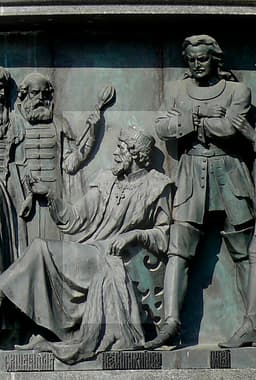
Alexis I of Russia
Emperor · Modern
59.5Total

Gustaf V
Emperor · Modern
57.3Total
Basic Information
Born
1629
1858
Died
1676
1950
Era
Modern
Modern
Nationality
Russia
Sweden
Occupation
Emperor
Emperor
Civilization
Western
Western
Score Comparison
Military (10%)
55.0
45.0
Political (20%)
60.0
68.0
Influence (20%)
55.0
51.8
Legacy (20%)
58.0
46.7
Leadership (15%)
72.0
80.0
Strategy (15%)
60.0
60.0
TOTAL
59.5
57.3
Alexis I of Russia — Complete Timeline
1649 AD
Enacted the 1649 Sobornoye Ulozheniye (Code of Laws)Reform◆ Major
Alexis I enacted the Sobornoye Ulozheniye, a comprehensive legal code that consolidated Russian law and strengthened serfdom by making peasants permanently bound to the land. The code also centralized state authority and defined the rights of nobles, clergy, and townspeople.
Legal CodeSerfdomCentralization
Impact: national
1654 AD
Led the 1654-1667 Russo-Polish WarWar◆ Major
Alexis I launched a war against the Polish-Lithuanian Commonwealth, initially capturing Smolensk and much of eastern Poland. The war, which included the Khmelnytsky Uprising and Swedish intervention, ended with the Truce of Andrusovo, gaining Russia left-bank Ukraine and Kiev.
WarPolandUkraine
Impact: regional
1662 AD
Suppressed the 1662 Copper RiotPolitical Action◆ Major
Alexis I's government brutally suppressed the Copper Riot in Moscow, a protest against the devaluation of copper coins and economic hardship. Thousands of rioters were killed or executed, and the rebellion led to the withdrawal of copper currency, restoring silver coinage.
RiotCopperEconomic
Impact: nationaldestructive
1666 AD
Supported the 1666-1667 Church Council that condemned the Old BelieversCultural◆ Major
Alexis I supported the Great Moscow Synod, which condemned the Old Believers and their leader Avvakum for opposing Patriarch Nikon's liturgical reforms. The council excommunicated the dissenters, leading to a schism (Raskol) in the Russian Orthodox Church that persisted for centuries.
ChurchSchismOld Believers
Impact: nationaldestructive
Gustaf V — Complete Timeline
1907 AD
Accession to the thronePolitical Action◆ Major
Gustaf V became King of Sweden upon the death of his father, Oscar II. His reign spanned both World Wars and the Great Depression, during which he maintained Sweden's neutrality.
SuccessionMonarchy
Impact: national
1914 AD
World War I neutralityPolitical Action◆ Major
Gustaf V presided over Sweden's policy of neutrality during World War I. He convened a meeting of Scandinavian kings to coordinate neutrality policies, helping Sweden avoid involvement in the conflict.
NeutralityWorld War IScandinavia
Impact: regional
1939 AD
World War II neutralityPolitical Action◆ Major
Gustaf V maintained Sweden's neutrality throughout World War II. He faced pressure from Nazi Germany and the Allies but kept Sweden non-belligerent, though he made concessions such as allowing German troop transit.
NeutralityWorld War IIConcessions
Impact: regional
1950 AD
Longest reign in modern SwedenOther
Gustaf V died after a reign of 43 years, the longest of any Swedish monarch in the modern era. His reign saw the transition from a constitutional monarchy with some royal influence to a purely ceremonial role.
ReignMonarchyLongevity
Impact: national
Expert Analysis
Origins
Alexis I of Russia (born 1629) was the second Romanov tsar, son of Michael I. His upbringing was steeped in Orthodox piety and autocratic tradition. He received a traditional education focused on religious texts and statecraft, but lacked exposure to Western ideas. His father’s death in 1645 left the 16-year-old Alexis on the throne, guided by his tutor Boris Morozov. The early years were marked by Morozov’s corrupt administration, which sowed the seeds of future unrest.
Gustaf V (born 1858) was the eldest son of King Oscar II of Sweden and Sophia of Nassau. He was educated privately, including military training, and studied at Uppsala University. His early life was shaped by the gradual democratization of Sweden; he ascended the throne in 1907 as a constitutional monarch with limited powers. Unlike Alexis, Gustaf grew up in a stable, industrializing nation with a parliamentary system.
Rise to Power
Alexis I became tsar at 16, but his early reign was dominated by Morozov. The 1648 Salt Riot forced Alexis to dismiss Morozov, marking his first independent act. He then enacted the Sobornoye Ulozheniye (1649), a legal code that centralized law but also bound serfs permanently to the land. This code was a turning point, cementing his authority and the feudal system. His military ambitions led to the Russo-Polish War (1654-1667), where he initially captured Smolensk and Vilnius, but the war dragged on with mixed results.
Gustaf V became king in 1907 after his father’s death. His rise was smooth, as constitutional monarchy was already established. He quickly asserted his role in foreign policy, particularly during World War I, when he convened the Three Kings' Meeting in 1914 with the kings of Denmark and Norway to coordinate neutrality. His influence was largely symbolic, but he used his position to maintain Sweden’s non-alignment.
Leadership & Governance
Alexis I ruled as an autocrat, relying on the Boyar Duma and his own decrees. He strengthened the state’s control over the church by supporting Patriarch Nikon’s reforms, which aimed to align Russian Orthodox practices with Greek ones. This led to the schism with the Old Believers, whom he suppressed harshly. His governance was marked by centralization and the expansion of serfdom, which stifled social mobility. Economically, his government debased the currency by minting copper coins, causing the Copper Riot of 1662, which was brutally crushed.
Gustaf V, in contrast, was a constitutional monarch who largely stayed above party politics. He appointed prime ministers and opened parliament annually, but his influence was subtle. During World War II, he personally intervened to prevent a German invasion by allowing troop transit through Sweden, a controversial decision that preserved neutrality. His leadership style was diplomatic and cautious, earning him the nickname "the king of peace." However, his reluctance to criticize Nazi Germany tarnished his legacy.
Triumph & Tragedy
Alexis I’s greatest triumph was the Sobornoye Ulozheniye, which remained the basis of Russian law until 1832. It provided legal stability but at the cost of enshrining serfdom. His military campaigns expanded Russian territory, gaining Smolensk and left-bank Ukraine. However, his failures included the prolonged Russo-Polish War that drained resources and the Copper Riot, which revealed economic mismanagement. The church schism created lasting religious divisions.
Gustaf V’s triumph was maintaining Sweden’s neutrality through both world wars, sparing the country from devastation. His reign saw social reforms like universal suffrage (1919). Yet his failure was the perceived appeasement of Nazi Germany, including allowing German troops to transit Sweden and refusing to condemn the Holocaust. His legacy is mixed: a symbol of stability but also of moral compromise.
Character & Destiny
Alexis I was devout, pious, but also firm and sometimes cruel. His support for religious reform shows a desire for order, but his suppression of dissent was ruthless. He was a transitional figure between medieval Muscovy and the Westernizing reforms of his son, Peter the Great. His character shaped a Russia that was more centralized but also more rigidly stratified.
Gustaf V was reserved, dignified, and pragmatic. He prioritized national survival over moral stands. His personal intervention in 1941 to allow German troop transit was a calculated risk that kept Sweden out of war. His character—cautious and diplomatic—defined Sweden’s neutral path, but also exposed his lack of moral leadership.
Legacy
Alexis I’s legacy is profound: his legal code shaped Russian society for centuries, reinforcing serfdom until 1861. He expanded Russia’s borders and laid the groundwork for absolutism. His scores: Military 55.0, Political 60.0, Influence 55.0, Legacy 58.0, Leadership 72.0, Strategy 60.0, Total 59.5.
Gustaf V’s legacy is more circumscribed: he presided over Sweden’s peaceful transition to full democracy and maintained neutrality. However, his reign is often overshadowed by his grandson’s more progressive rule. His scores: Military 45.0, Political 68.0, Influence 51.8, Legacy 46.7, Leadership 80.0, Strategy 60.0, Total 57.3.
Conclusion
Alexis I of Russia had a greater impact on history than Gustaf V. Despite a total score only 2.2 points higher, Alexis’s policies directly shaped the social and legal structure of a major empire for centuries. Gustaf V’s influence was largely reactive and confined to a small neutral state. Alexis’s leadership score (72.0) reflects his decisive actions, while Gustaf’s higher leadership score (80.0) stems from his steady hand, but his legacy score (46.7) lags. Alexis’s codification of serfdom and territorial expansion had lasting consequences, whereas Gustaf’s neutrality, while successful, did not fundamentally alter Sweden’s trajectory. Therefore, Alexis I is the more historically significant figure.
Rankings
🥇
Alexis I of RussiaLeader
Mil: 55.0Pol: 60.0Inf: 55.0
59.5
🥈
Gustaf V
Mil: 45.0Pol: 68.0Inf: 51.8
57.3
+2.2 behind
How This Comparison Works
Algorithm
Each figure is scored on 6 dimensions (0—100 scale) based on structured historical data: Military (10%), Political (20%), Influence (20%), Legacy (20%), Leadership (15%), Strategy (15%). The weighted total produces the final ranking.
Data Sources
Scores are computed from structured sub-indicators in the database. Scale factors adjust for era (Ancient ×0.85, Modern ×1.0) and civilization size (Eastern ×1.05, Other ×0.80) to account for differences in population and military scale.
Maximum 3 Figures
Comparisons are limited to 2—3 figures to ensure readability and statistical meaningfulness.
Error Margins
±5 points per dimension — Sub-scores are derived from historical records with inherent uncertainty. Two figures within 5 points on a dimension should be considered roughly equivalent in that area.
Total Score Accuracy
±3 points overall — The weighted combination of 6 dimensions produces a total score with approximately ±3 points of uncertainty. Differences of less than 3 points are not statistically significant— the figures are effectively tied.
Known Limitations
- Historical records are incomplete and uneven across civilizations
- Figures from oral-tradition societies may be underrepresented
- Occupation labels can misclassify multi-role figures
- Scores measure capability and impact, not moral character
- Quantitative scoring is a comparison tool, not absolute truth
Capability Radar
Military (10%) — Battles & Warfare
Battles
45
0
Win Rate
50
0
Expansion
50
0
Political (20%) — Governance & Reform
Reform
65
40
Diplomacy
60
60
Economy
55
30
Influence (20%) — Cultural & Global Reach
Cultural
55
30
Global
50
20
Legacy (20%) — Historical Impact
Historical
65
40
Longevity
60
50
Leadership (15%) — Power & Stability
Tenure
70
85
Stability
50
70
Strategy (15%) — Tactics & Innovation
Strategy
55
0
Tactics
40
0
Reform
60
10
Similar Comparisons
Comments & Discussion
No comments yet. Be the first to share your thoughts!