Loading...
Alexis I of Russia vs Hamad bin Khalifa Al Thani
Hamad bin Khalifa Al Thani leads by 5.8 pts · 2 figures compared
…
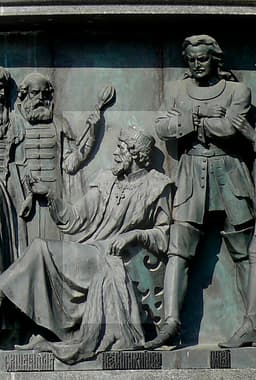
Alexis I of Russia
Emperor · Modern
59.5Total

Hamad bin Khalifa Al Thani
Emperor · Modern
65.3Total
Basic Information
Born
1629
1952
Died
1676
—
Era
Modern
Modern
Nationality
Russia
Qatar
Occupation
Emperor
Emperor
Civilization
Western
Middle Eastern
Score Comparison
Military (10%)
55.0
45.0
Political (20%)
60.0
84.0
Influence (20%)
55.0
65.0
Legacy (20%)
58.0
56.0
Leadership (15%)
72.0
80.0
Strategy (15%)
60.0
60.0
TOTAL
59.5
65.3
Alexis I of Russia — Complete Timeline
1649 AD
Enacted the 1649 Sobornoye Ulozheniye (Code of Laws)Reform◆ Major
Alexis I enacted the Sobornoye Ulozheniye, a comprehensive legal code that consolidated Russian law and strengthened serfdom by making peasants permanently bound to the land. The code also centralized state authority and defined the rights of nobles, clergy, and townspeople.
Legal CodeSerfdomCentralization
Impact: national
1654 AD
Led the 1654-1667 Russo-Polish WarWar◆ Major
Alexis I launched a war against the Polish-Lithuanian Commonwealth, initially capturing Smolensk and much of eastern Poland. The war, which included the Khmelnytsky Uprising and Swedish intervention, ended with the Truce of Andrusovo, gaining Russia left-bank Ukraine and Kiev.
WarPolandUkraine
Impact: regional
1662 AD
Suppressed the 1662 Copper RiotPolitical Action◆ Major
Alexis I's government brutally suppressed the Copper Riot in Moscow, a protest against the devaluation of copper coins and economic hardship. Thousands of rioters were killed or executed, and the rebellion led to the withdrawal of copper currency, restoring silver coinage.
RiotCopperEconomic
Impact: nationaldestructive
1666 AD
Supported the 1666-1667 Church Council that condemned the Old BelieversCultural◆ Major
Alexis I supported the Great Moscow Synod, which condemned the Old Believers and their leader Avvakum for opposing Patriarch Nikon's liturgical reforms. The council excommunicated the dissenters, leading to a schism (Raskol) in the Russian Orthodox Church that persisted for centuries.
ChurchSchismOld Believers
Impact: nationaldestructive
Hamad bin Khalifa Al Thani — Complete Timeline
1995 AD
Accession as Emir of QatarPolitical Action◆ Major
Hamad bin Khalifa Al Thani became Emir after deposing his father, Khalifa bin Hamad Al Thani, in a bloodless coup while his father was abroad. This marked the beginning of a transformative era for Qatar.
CoupSuccessionQatar
Impact: national
1996 AD
Launch of Al JazeeraCultural◆ Major
Hamad bin Khalifa founded Al Jazeera, the first independent news network in the Arab world. The channel revolutionized media in the Middle East, providing uncensored news and commentary, and became a major global influence.
MediaAl JazeeraFree Press
Impact: globalconstructive
2005 AD
Establishment of Qatar's Sovereign Wealth FundReform◆ Major
Hamad bin Khalifa oversaw the creation of the Qatar Investment Authority, a sovereign wealth fund that invested heavily in global assets. This strategy diversified Qatar's economy beyond hydrocarbons and increased its international financial influence.
EconomyInvestmentSovereign Wealth Fund
Impact: globalconstructive
2010 AD
Qatar's Successful Bid for 2022 FIFA World CupCultural◆ Major
Under Hamad bin Khalifa's leadership, Qatar won the bid to host the 2022 FIFA World Cup, the first Middle Eastern country to do so. This decision brought international attention and massive infrastructure investment to Qatar.
SportsWorld CupInfrastructure
Impact: globalconstructive
2013 AD
Abdication in Favor of Son TamimPolitical Action◆ Major
Hamad bin Khalifa voluntarily abdicated the throne, handing power to his son, Tamim bin Hamad Al Thani. This was a rare peaceful transfer of power in the region, ensuring continuity of his policies.
AbdicationSuccessionQatar
Impact: nationalconstructive
Expert Analysis
Origins
Alexis I of Russia (born 1629) was the second Romanov tsar, son of Michael I. His education was limited to traditional Orthodox teachings, and he grew up in a court dominated by boyars and clergy. His father's death in 1645 thrust him onto the throne at age 16, unprepared for governance. In contrast, Hamad bin Khalifa Al Thani (born 1952) was the son of Qatar's Emir Khalifa bin Hamad. He was educated in the UK at the Royal Military Academy Sandhurst, then served as commander of Qatar's armed forces. His exposure to Western military and political thought shaped his modernizing vision.
Rise to Power
Alexis I ascended peacefully in 1645 but quickly faced challenges. In 1648, the Salt Riot erupted in Moscow due to high taxes, forcing him to convene the Zemsky Sobor and enact the 1649 Sobornoye Ulozheniye. This code consolidated serfdom and centralized law, but also sparked long-term resistance. Hamad bin Khalifa seized power in a bloodless coup on June 27, 1995, while his father was abroad. As crown prince, he had already modernized the military and attracted foreign investment. His deposition was swift, with immediate support from the royal family and Western allies. Both leaders gained power through dynastic mechanisms, but Hamad's act was a deliberate break from tradition.
Leadership & Governance
Alexis I ruled as an autocrat but relied on advisors like Boris Morozov and later Patriarch Nikon. His governance was reactive: he suppressed the 1662 Copper Riot with force, executing thousands. He supported the 1666-1667 Church Council that condemned Old Believers, deepening religious schism. His style was conservative, preserving the boyar system. Hamad bin Khalifa, by contrast, was a reformer. He launched Al Jazeera in 1996, breaking the state media monopoly. He established the Qatar Investment Authority in 2005, turning oil wealth into global assets like Harrods and the Shard. He expanded women's rights and education. His leadership score of 80.0 reflects his proactive vision, while Alexis's 72.0 indicates competent but reactive rule.
Triumph & Tragedy
Alexis I's greatest success was the 1654-1667 Russo-Polish War, where he captured Smolensk and eastern Poland, expanding Russia's western border. However, the war drained resources and led to economic crisis. His 1649 legal code stabilized law but permanently enshrined serfdom, a tragedy for peasants. The Copper Riot and later Razin Rebellion (1670-1671) showed his failure to address inequality. Hamad bin Khalifa's triumphs include the 2022 FIFA World Cup bid, which put Qatar on the global stage, and his sovereign wealth fund, which grew to over $300 billion. His tragedy was the human cost of rapid development: migrant worker abuses and criticism of Al Jazeera's editorial independence. He also faced regional tension, notably the 2017-2021 blockade by Saudi Arabia and allies, which began after his abdication.
Character & Destiny
Alexis I was pious and cautious, often torn between reform and tradition. His support for Nikon's reforms alienated many, and his suppression of dissent showed a harsh streak. He died in 1676, leaving a divided realm to his son Fyodor. His character shaped Russia's path toward autocracy and serfdom. Hamad bin Khalifa was pragmatic and ambitious, willing to challenge norms. His abdication in 2013 was a calculated move to ensure succession. He scored 84.0 in political skill, reflecting his ability to navigate tribal and global politics. Alexis's political score of 60.0 indicates less strategic finesse.
Legacy
Alexis I is remembered as the father of Peter the Great, but his own legacy is mixed. The Sobornoye Ulozheniye lasted until 1832, and his wars expanded territory. However, he entrenched serfdom and religious division. His total score is 59.5. Hamad bin Khalifa transformed Qatar from a sleepy Gulf state into a global hub. Al Jazeera remains influential, and the sovereign wealth fund ensures long-term prosperity. His legacy is modernization and soft power, albeit with controversies. His total score of 65.3 reflects broader impact.
Conclusion
Hamad bin Khalifa Al Thani had greater impact, scoring 65.3 vs Alexis's 59.5. Alexis's reforms were backward-looking, consolidating autocracy and serfdom. Hamad's changes were forward-looking, creating institutions that endure. While both ruled as autocrats, Hamad's modernization of Qatar's economy, media, and global standing outweighed Alexis's territorial gains. The 5.8-point gap reflects Hamad's higher political and leadership scores. In the modern era, Hamad's model of using wealth for influence proved more transformative than Alexis's military expansion.
Rankings
🥇
Hamad bin Khalifa Al ThaniLeader
Mil: 45.0Pol: 84.0Inf: 65.0
65.3
🥈
Alexis I of Russia
Mil: 55.0Pol: 60.0Inf: 55.0
59.5
+5.8 behind
How This Comparison Works
Algorithm
Each figure is scored on 6 dimensions (0—100 scale) based on structured historical data: Military (10%), Political (20%), Influence (20%), Legacy (20%), Leadership (15%), Strategy (15%). The weighted total produces the final ranking.
Data Sources
Scores are computed from structured sub-indicators in the database. Scale factors adjust for era (Ancient ×0.85, Modern ×1.0) and civilization size (Eastern ×1.05, Other ×0.80) to account for differences in population and military scale.
Maximum 3 Figures
Comparisons are limited to 2—3 figures to ensure readability and statistical meaningfulness.
Error Margins
±5 points per dimension — Sub-scores are derived from historical records with inherent uncertainty. Two figures within 5 points on a dimension should be considered roughly equivalent in that area.
Total Score Accuracy
±3 points overall — The weighted combination of 6 dimensions produces a total score with approximately ±3 points of uncertainty. Differences of less than 3 points are not statistically significant— the figures are effectively tied.
Known Limitations
- Historical records are incomplete and uneven across civilizations
- Figures from oral-tradition societies may be underrepresented
- Occupation labels can misclassify multi-role figures
- Scores measure capability and impact, not moral character
- Quantitative scoring is a comparison tool, not absolute truth
Capability Radar
Military (10%) — Battles & Warfare
Battles
45
0
Win Rate
50
0
Expansion
50
0
Political (20%) — Governance & Reform
Reform
65
85
Diplomacy
60
90
Economy
55
95
Influence (20%) — Cultural & Global Reach
Cultural
55
60
Global
50
80
Legacy (20%) — Historical Impact
Historical
65
70
Longevity
60
50
Leadership (15%) — Power & Stability
Tenure
70
75
Stability
50
80
Strategy (15%) — Tactics & Innovation
Strategy
55
0
Tactics
40
0
Reform
60
10
Similar Comparisons
Comments & Discussion
No comments yet. Be the first to share your thoughts!