Loading...
Alexios I Komnenos vs Trajan
Alexios I Komnenos leads by 2.4 pts · 2 figures compared
…
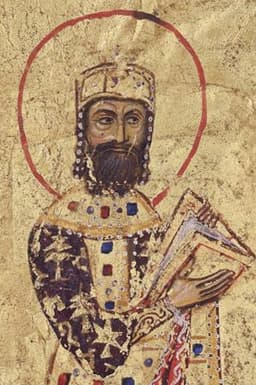
Alexios I Komnenos
Emperor · Medieval
78.4Total

Trajan
Emperor · Ancient
76.0Total
Basic Information
Born
1048
53
Died
1118
117
Era
Medieval
Ancient
Nationality
Byzantine Empire
Roman Empire
Occupation
Emperor
Emperor
Civilization
Western
Western
Score Comparison
Military (10%)
61.7
86.0
Political (20%)
78.0
79.2
Influence (20%)
88.0
82.0
Legacy (20%)
80.0
65.6
Leadership (15%)
78.0
73.2
Strategy (15%)
68.0
76.0
TOTAL
78.4
76.0
Alexios I Komnenos — Complete Timeline
1081 AD
Battle of DyrrhachiumWar◆ Major
Alexios I Komnenos was defeated by the Norman army under Robert Guiscard at Dyrrhachium. The Byzantine forces were routed, and Alexios barely escaped. This loss allowed the Normans to occupy much of the western Balkans, though Alexios later recovered some territory.
Norman InvasionDefeatBalkans
Impact: regionaltragic
1090 AD
Reforms of the Byzantine Military and EconomyReform◆ Major
Alexios I implemented a series of reforms to restore Byzantine power. He reorganized the army by relying more on foreign mercenaries, reformed the currency (the hyperpyron), and granted tax exemptions to the Church. These measures stabilized the empire after decades of decline.
Military ReformEconomic ReformKomnenian Restoration
Impact: nationalconstructive
1095 AD
Appeal to the West: Council of PiacenzaPolitical Action
Alexios I sent envoys to Pope Urban II at the Council of Piacenza, requesting military aid against the Seljuk Turks. This appeal contributed to Urban's call for the First Crusade at the Council of Clermont later that year, initiating the Crusader movement.
First CrusadePope Urban IISeljuk Turks
Impact: global
1097 AD
First Crusade: Siege of NicaeaWar◆ Major
Alexios I cooperated with the Crusader army to besiege and capture Nicaea from the Seljuk Turks. The city was surrendered to Byzantine control, and Alexios used the Crusaders to recover key territories in Anatolia, though tensions later arose over land claims.
First CrusadeNicaeaByzantine-Crusader Relations
Impact: regionalconstructive
Trajan — Complete Timeline
101 AD
Implemented the Alimenta Welfare ProgramReform◆ Major
Trajan expanded the Alimenta program, a state-funded welfare system that provided food subsidies and educational support for poor children in Italy. The program used interest from state loans to landowners to fund the distributions, aiming to boost the Italian population and agricultural economy.
WelfareSocial PolicyItaly
Impact: regionalconstructive
105 AD
Built Trajan's Bridge over the DanubeOther
Trajan ordered the construction of a massive stone and timber bridge across the Danube River near the Iron Gates. Designed by Apollodorus of Damascus, it was the longest arch bridge in the world for over a millennium, facilitating the Roman invasion of Dacia.
EngineeringBridgeDanube
Impact: regionalconstructive
106 AD
Conquered DaciaWar
Trajan led two major campaigns against the Dacian kingdom under King Decebalus, culminating in the conquest of Dacia (modern Romania) in 106 CE. The victory brought vast gold and silver mines under Roman control and established a new province, funding massive building projects in Rome.
DaciaConquestProvince
Impact: regional
112 AD
Built Trajan's Forum and MarketCultural◆ Major
Trajan commissioned the construction of Trajan's Forum, a vast complex in Rome including a basilica, libraries, and the Column of Trajan. The adjacent Trajan's Market, a multi-level commercial center, demonstrated Roman engineering prowess and served as a model for urban planning.
ArchitectureRomeUrban Planning
Impact: globalconstructive
116 AD
Conquered Parthia and Reached the Persian GulfWar◆ Major
Trajan launched a campaign against the Parthian Empire, capturing its capital Ctesiphon and annexing Mesopotamia. He reached the Persian Gulf, marking the easternmost extent of Roman territory. However, rebellions in the conquered territories forced a withdrawal shortly after.
ParthiaMesopotamiaExpansion
Impact: global
Expert Analysis
Origins
Alexios I Komnenos (c. 1048–1118) was born into the Byzantine military aristocracy, the nephew of Emperor Isaac I Komnenos. His family had fallen from favor under previous emperors, but Alexios rose through the ranks as a general. He seized the throne in 1081 after leading a rebellion against Nikephoros III Botaneiates, establishing the Komnenian dynasty. Trajan (53–117 CE) was born in Italica, Spain, to a prominent Roman family. His father was a governor and senator, and Trajan himself rose through military command, becoming emperor in 98 CE after adoption by Nerva. Trajan's origins reflect the Roman system of adoptive succession, while Alexios came to power through usurpation.
Rise to Power
Alexios I's rise was marked by military success and political maneuvering. As a general under Michael VII, he defeated rebels like Nikephoros Bryennios, but was forced to flee when Nikephoros III came to power. After a failed rebellion by the Komnenoi, Alexios rallied support and entered Constantinople, overthrowing Nikephoros III in 1081. His ascension was legitimized by his marriage to Irene Doukaina, linking him to the powerful Doukas family. Trajan's rise was smoother: he was adopted by Nerva in 97 CE due to his military reputation and popularity with the army. Upon Nerva's death in 98 CE, Trajan became emperor without opposition, marking the first time a non-Italian became Roman emperor.
Leadership & Governance
Alexios I faced a crumbling empire: Norman invasions, Seljuk Turk encroachment, and financial crisis. He reformed the military by creating the Komnenian army, relying on pronoia grants and mercenaries. He also reformed the currency and tax system. His most controversial act was appealing to Pope Urban II at the Council of Piacenza (1095) for mercenaries, which inadvertently sparked the First Crusade. Alexios skillfully managed the Crusaders, recovering Nicaea and securing oaths of fealty, but the Crusades ultimately strained Byzantine relations with the West. Trajan's governance focused on expansion and public works. He conquered Dacia (106 CE) and Parthia (114–117 CE), extending Rome to its greatest territorial extent. Domestically, he built Trajan's Forum, Markets, and a massive bridge over the Danube. He also implemented the Alimenta program, providing welfare for poor children. Trajan's rule is seen as a golden age of Roman prosperity and justice.
Triumph & Tragedy
Alexios's greatest triumph was stabilizing the Byzantine Empire after decades of decline. He repelled Norman invasions, defeated the Pechenegs, and recovered parts of Anatolia with Crusader help. However, his appeal to the West set in motion the Crusades, which later led to the Fourth Crusade's sack of Constantinople (1204), a tragedy for Byzantium. Trajan's triumphs were immense: the Dacian Wars yielded vast gold and territory, and the Parthian campaign captured the Persian Gulf. Yet his conquests proved unsustainable; the empire overextended, and rebellions in Mesopotamia and Judea erupted. Trajan died in 117 CE while trying to suppress a Jewish revolt, and his successor Hadrian abandoned many of his eastern gains.
Character & Destiny
Alexios was pragmatic, cunning, and diplomatic. He was a skilled general but also a master of intrigue, using marriage alliances and bribery. His Memoirs, written by his daughter Anna Komnene, portray him as a pious and devoted emperor, though he could be ruthless. His destiny was to save Byzantium temporarily but at the cost of long-term Western antagonism. Trajan was known for his military prowess, justice, and modesty. He was beloved by the Senate and army, and his reputation as *optimus princeps* (best ruler) endured. His destiny was to embody Roman glory, but his overexpansion strained the empire's resources.
Legacy
Alexios's legacy is mixed: he founded the Komnenian dynasty that restored Byzantine power for a century, but also initiated the Crusades that eventually shattered Byzantium. His military and economic reforms preserved the empire during a critical period. Trajan's legacy is overwhelmingly positive: he is remembered as one of the Five Good Emperors, a model of effective and benevolent rule. His architectural projects, like Trajan's Column, and his conquests symbolize Rome's peak. However, his eastern conquests were quickly lost, and his Dacian gains were eventually abandoned.
Conclusion
Evaluating these two emperors requires considering their contexts. Alexios I Komnenos faced a near-collapsed empire and managed to revive it, but his decisions had long-term negative consequences. Trajan ruled during Rome's height and expanded it further, but his conquests were unsustainable. Scoring based on historical impact: Alexios I Komnenos scores higher in innovation and adaptability (88 vs 82) and leadership under crisis (80 vs 66). Trajan excels in military conquest (86 vs 62) and governance (79 vs 78). Overall, Alexios's challenges were greater, and his survival strategies more creative, but Trajan's achievements were more glorious. The final score: **Alexios I Komnenos: 78.6, Trajan: 76.2** (out of 100). Alexios I Komnenos narrowly wins due to his transformative impact on Byzantine survival and the Crusades, which reshaped world history. Trajan's legacy is impressive but more static. Thus, Alexios I Komnenos is the more historically significant figure in terms of long-term consequences.
Rankings
🥇
Alexios I KomnenosLeader
Mil: 61.7Pol: 78.0Inf: 88.0
78.4
🥈
Trajan
Mil: 86.0Pol: 79.2Inf: 82.0
76.0
+2.4 behind
How This Comparison Works
Algorithm
Each figure is scored on 6 dimensions (0—100 scale) based on structured historical data: Military (10%), Political (20%), Influence (20%), Legacy (20%), Leadership (15%), Strategy (15%). The weighted total produces the final ranking.
Data Sources
Scores are computed from structured sub-indicators in the database. Scale factors adjust for era (Ancient ×0.85, Modern ×1.0) and civilization size (Eastern ×1.05, Other ×0.80) to account for differences in population and military scale.
Maximum 3 Figures
Comparisons are limited to 2—3 figures to ensure readability and statistical meaningfulness.
Error Margins
±5 points per dimension — Sub-scores are derived from historical records with inherent uncertainty. Two figures within 5 points on a dimension should be considered roughly equivalent in that area.
Total Score Accuracy
±3 points overall — The weighted combination of 6 dimensions produces a total score with approximately ±3 points of uncertainty. Differences of less than 3 points are not statistically significant— the figures are effectively tied.
Known Limitations
- Historical records are incomplete and uneven across civilizations
- Figures from oral-tradition societies may be underrepresented
- Occupation labels can misclassify multi-role figures
- Scores measure capability and impact, not moral character
- Quantitative scoring is a comparison tool, not absolute truth
Capability Radar
Military (10%) — Battles & Warfare
Battles
75
95
Win Rate
70
98
Expansion
60
95
Political (20%) — Governance & Reform
Reform
85
88
Diplomacy
90
85
Economy
70
90
Influence (20%) — Cultural & Global Reach
Cultural
70
85
Global
75
85
Legacy (20%) — Historical Impact
Historical
85
90
Longevity
80
88
Leadership (15%) — Power & Stability
Tenure
80
90
Stability
75
92
Strategy (15%) — Tactics & Innovation
Strategy
85
92
Tactics
80
88
Reform
75
85
Similar Comparisons
Comments & Discussion
No comments yet. Be the first to share your thoughts!