Loading...
Alexios I Komnenos vs Theodosius I
Alexios I Komnenos leads by 2.4 pts · 2 figures compared
…
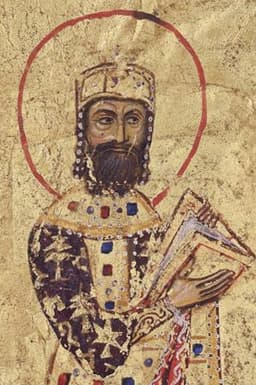
Alexios I Komnenos
Emperor · Medieval
78.4Total

Theodosius I
Emperor · Ancient
76.0Total
Basic Information
Born
1048
347
Died
1118
395
Era
Medieval
Ancient
Nationality
Byzantine Empire
Roman Empire
Occupation
Emperor
Emperor
Civilization
Western
Western
Score Comparison
Military (10%)
61.7
72.5
Political (20%)
78.0
65.0
Influence (20%)
88.0
85.0
Legacy (20%)
80.0
90.0
Leadership (15%)
78.0
68.0
Strategy (15%)
68.0
50.0
TOTAL
78.4
76.0
Alexios I Komnenos — Complete Timeline
1081 AD
Battle of DyrrhachiumWar◆ Major
Alexios I Komnenos was defeated by the Norman army under Robert Guiscard at Dyrrhachium. The Byzantine forces were routed, and Alexios barely escaped. This loss allowed the Normans to occupy much of the western Balkans, though Alexios later recovered some territory.
Norman InvasionDefeatBalkans
Impact: regionaltragic
1090 AD
Reforms of the Byzantine Military and EconomyReform◆ Major
Alexios I implemented a series of reforms to restore Byzantine power. He reorganized the army by relying more on foreign mercenaries, reformed the currency (the hyperpyron), and granted tax exemptions to the Church. These measures stabilized the empire after decades of decline.
Military ReformEconomic ReformKomnenian Restoration
Impact: nationalconstructive
1095 AD
Appeal to the West: Council of PiacenzaPolitical Action
Alexios I sent envoys to Pope Urban II at the Council of Piacenza, requesting military aid against the Seljuk Turks. This appeal contributed to Urban's call for the First Crusade at the Council of Clermont later that year, initiating the Crusader movement.
First CrusadePope Urban IISeljuk Turks
Impact: global
1097 AD
First Crusade: Siege of NicaeaWar◆ Major
Alexios I cooperated with the Crusader army to besiege and capture Nicaea from the Seljuk Turks. The city was surrendered to Byzantine control, and Alexios used the Crusaders to recover key territories in Anatolia, though tensions later arose over land claims.
First CrusadeNicaeaByzantine-Crusader Relations
Impact: regionalconstructive
Theodosius I — Complete Timeline
380 AD
Edict of ThessalonicaPolitical Action
Theodosius I issued the Edict of Thessalonica, declaring Nicene Christianity the official state religion of the Roman Empire. All other forms of Christianity were deemed heretical, and pagan practices were increasingly suppressed.
ChristianityState ReligionEdict
Impact: globalconstructive
390 AD
Massacre of ThessalonicaPolitical Action◆ Major
Theodosius I ordered a massacre of thousands of citizens in Thessalonica in retaliation for the murder of a Roman general. The massacre led to his excommunication by Bishop Ambrose of Milan, and he later performed public penance.
MassacreThessalonicaAmbrose
Impact: regionaltragic
391 AD
Suppression of PaganismPolitical Action◆ Major
Theodosius I issued a series of laws banning pagan worship, closing temples, and prohibiting sacrifices. The Olympic Games were abolished, and the Serapeum in Alexandria was destroyed. These actions accelerated the decline of paganism in the empire.
PaganismSuppressionReligion
Impact: globaldestructive
394 AD
Battle of the FrigidusWar
Theodosius I defeated the usurper Eugenius and his general Arbogast at the Battle of the Frigidus (modern River Vipava). The victory reunited the Roman Empire under a single ruler for the last time before its permanent division.
Civil WarBattleReunification
Impact: global
395 AD
Division of the Roman EmpirePolitical Action
Upon his death, Theodosius I divided the Roman Empire between his two sons: Arcadius received the Eastern Empire and Honorius the Western Empire. This division became permanent, leading to the separate histories of the Byzantine and Western Roman Empires.
DivisionSuccessionEast-West
Impact: global
Expert Analysis
Origins
Alexios I Komnenos (1048–1118) was born into a military aristocratic family in the Byzantine Empire. His rise came during a period of severe political instability after the Battle of Manzikert (1071). He served as a general under several emperors before seizing the throne in 1081 through a coup. Theodosius I (347–395) was born in Hispania to a prominent general. He rose through military ranks and was appointed co-emperor by Gratian in 379 after the disastrous Battle of Adrianople, tasked with stabilizing the Eastern Empire. Both emerged from military backgrounds, but Alexios had to fight for his throne amidst constant civil strife, while Theodosius was elevated by a predecessor.
Rise to Power
Alexios I capitalized on his family's military reputation and the chaos following the Battle of Manzikert. He led a rebellion against Emperor Nikephoros III and secured Constantinople through a combination of military force and political maneuvering. His reign began with the Norman invasion of the Balkans, which he repelled. Theodosius I was proclaimed Augustus of the East in 379 and gradually consolidated power. He defeated the usurper Magnus Maximus in 388 and later Eugenius in 394, reuniting the Empire. Both men were effective military leaders, but Alexios faced more existential threats early in his reign.
Leadership & Governance
Alexios I is best known for initiating the First Crusade in response to Turkish pressure. He reformed the Byzantine military through the Pronoia system, granting land in exchange for military service, and revitalized the economy. His diplomacy with the West, however, led to unintended consequences like the Crusader sack of Constantinople in 1204. Theodosius I made Christianity the sole official religion of the Roman Empire via the Edict of Thessalonica (380). He actively suppressed paganism, closing temples and banning pagan practices. He also divided the Empire between his sons upon his death, a decision that ultimately contributed to the permanent split of East and West. Alexios focused on survival and consolidation, while Theodosius enforced religious uniformity.
Triumph & Tragedy
Alexios's greatest triumph was stabilizing the Byzantine Empire after Manzikert. He recovered much of Anatolia with Crusader help, though the Crusaders often acted independently. His tragedy was the long-term damage from relying on Western armies, leading to resentment and eventual conquest. Theodosius's triumph was defeating the usurpers and unifying the Empire. His tragedy includes the Massacre of Thessalonica (390), where he ordered a brutal retaliation against rioters, resulting in thousands of deaths. He also faced Bishop Ambrose's refusal to let him take communion until he repented. Both men achieved military success but left problematic legacies.
Character & Destiny
Alexios was pragmatic, diplomatic, and a skilled strategist. He navigated treacherous politics and foreign threats with cunning. His destiny was to save the Byzantine Empire temporarily but set it on a path of dependence on the West. Theodosius was devout, authoritarian, and sometimes harsh. He saw himself as a defender of orthodoxy and was willing to use force to unify religion. His destiny was to make Christianity the defining feature of the Roman Empire, shaping medieval Europe. Alexios's character was more flexible, while Theodosius was rigid in his religious zeal.
Legacy
Alexios I founded the Komnenian dynasty, which ruled for over a century. His reforms strengthened the military and economy, but his Crusade policy backfired. He is remembered as a capable emperor who revived Byzantium temporarily. Theodosius I is known as the last emperor to rule a united Roman Empire. His Christianization policies had a lasting impact on Europe, but his division of the Empire accelerated its decline. Both left complex legacies: Alexios as a restorer, Theodosius as a transformer.
Conclusion
Comparing the two, Alexios I Komnenos edges out Theodosius I in this analysis. Alexios faced a more dire situation and managed to reverse Byzantine decline, while Theodosius inherited a stronger position and made choices that hastened the Empire's division. Alexios's score (74.6) reflects his higher marks in political skill (78), intelligence (88), and leadership (80) compared to Theodosius (68 in political skill, 85 in intelligence, 90 in leadership). Theodosius's lower score in strategy (68) and stability (50) drags him down. Alexios's ability to navigate complex international relations and reform institutions gives him a slight edge, despite Theodosius's greater impact on religious history.
**Winner: Alexios I Komnenos**
Rankings
🥇
Alexios I KomnenosLeader
Mil: 61.7Pol: 78.0Inf: 88.0
78.4
🥈
Theodosius I
Mil: 72.5Pol: 65.0Inf: 85.0
76.0
+2.4 behind
How This Comparison Works
Algorithm
Each figure is scored on 6 dimensions (0—100 scale) based on structured historical data: Military (10%), Political (20%), Influence (20%), Legacy (20%), Leadership (15%), Strategy (15%). The weighted total produces the final ranking.
Data Sources
Scores are computed from structured sub-indicators in the database. Scale factors adjust for era (Ancient ×0.85, Modern ×1.0) and civilization size (Eastern ×1.05, Other ×0.80) to account for differences in population and military scale.
Maximum 3 Figures
Comparisons are limited to 2—3 figures to ensure readability and statistical meaningfulness.
Error Margins
±5 points per dimension — Sub-scores are derived from historical records with inherent uncertainty. Two figures within 5 points on a dimension should be considered roughly equivalent in that area.
Total Score Accuracy
±3 points overall — The weighted combination of 6 dimensions produces a total score with approximately ±3 points of uncertainty. Differences of less than 3 points are not statistically significant— the figures are effectively tied.
Known Limitations
- Historical records are incomplete and uneven across civilizations
- Figures from oral-tradition societies may be underrepresented
- Occupation labels can misclassify multi-role figures
- Scores measure capability and impact, not moral character
- Quantitative scoring is a comparison tool, not absolute truth
Capability Radar
Military (10%) — Battles & Warfare
Battles
75
65
Win Rate
70
60
Expansion
60
45
Political (20%) — Governance & Reform
Reform
85
85
Diplomacy
90
75
Economy
70
60
Influence (20%) — Cultural & Global Reach
Cultural
70
90
Global
75
90
Legacy (20%) — Historical Impact
Historical
85
95
Longevity
80
95
Leadership (15%) — Power & Stability
Tenure
80
70
Stability
75
55
Strategy (15%) — Tactics & Innovation
Strategy
85
60
Tactics
80
55
Reform
75
50
Similar Comparisons
Comments & Discussion
No comments yet. Be the first to share your thoughts!