Loading...
Alexios I Komnenos vs Ruhollah Khomeini
Alexios I Komnenos leads by 3.3 pts · 2 figures compared
…
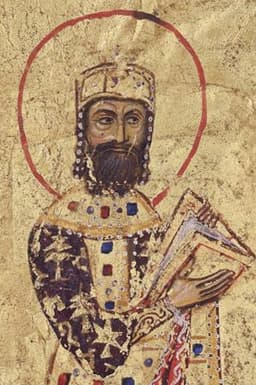
Alexios I Komnenos
Emperor · Medieval
78.4Total

Ruhollah Khomeini
Politician · Modern
75.1Total
Basic Information
Born
1048
1902
Died
1118
1989
Era
Medieval
Modern
Nationality
Byzantine Empire
Iran
Occupation
Emperor
Politician
Civilization
Western
Middle Eastern
Score Comparison
Military (10%)
61.7
41.6
Political (20%)
78.0
65.0
Influence (20%)
88.0
85.0
Legacy (20%)
80.0
90.0
Leadership (15%)
78.0
80.0
Strategy (15%)
68.0
54.3
TOTAL
78.4
75.1
Alexios I Komnenos — Complete Timeline
1081 AD
Battle of DyrrhachiumWar◆ Major
Alexios I Komnenos was defeated by the Norman army under Robert Guiscard at Dyrrhachium. The Byzantine forces were routed, and Alexios barely escaped. This loss allowed the Normans to occupy much of the western Balkans, though Alexios later recovered some territory.
Norman InvasionDefeatBalkans
Impact: regionaltragic
1090 AD
Reforms of the Byzantine Military and EconomyReform◆ Major
Alexios I implemented a series of reforms to restore Byzantine power. He reorganized the army by relying more on foreign mercenaries, reformed the currency (the hyperpyron), and granted tax exemptions to the Church. These measures stabilized the empire after decades of decline.
Military ReformEconomic ReformKomnenian Restoration
Impact: nationalconstructive
1095 AD
Appeal to the West: Council of PiacenzaPolitical Action
Alexios I sent envoys to Pope Urban II at the Council of Piacenza, requesting military aid against the Seljuk Turks. This appeal contributed to Urban's call for the First Crusade at the Council of Clermont later that year, initiating the Crusader movement.
First CrusadePope Urban IISeljuk Turks
Impact: global
1097 AD
First Crusade: Siege of NicaeaWar◆ Major
Alexios I cooperated with the Crusader army to besiege and capture Nicaea from the Seljuk Turks. The city was surrendered to Byzantine control, and Alexios used the Crusaders to recover key territories in Anatolia, though tensions later arose over land claims.
First CrusadeNicaeaByzantine-Crusader Relations
Impact: regionalconstructive
Ruhollah Khomeini — Complete Timeline
1964 AD
Exile to Iraq and FrancePolitical Action◆ Major
Khomeini was exiled from Iran after criticizing the Shah's White Revolution and granting of diplomatic immunity to US personnel. He settled in Najaf, Iraq, and later in France, where he continued to organize opposition to the Shah.
ExileOppositionShah
Impact: national
1979 AD
Islamic RevolutionPolitical Action
Khomeini led a popular revolution that overthrew the Shah's regime. He returned to Iran in February 1979 and established an Islamic Republic based on his doctrine of Velayat-e Faqih (Guardianship of the Jurist), with himself as Supreme Leader.
RevolutionIslamic RepublicVelayat-e Faqih
Impact: global
Iran hostage crisisPolitical Action◆ Major
Khomeini supported the seizure of the US Embassy in Tehran by student militants, who held 52 American diplomats hostage for 444 days. The crisis deepened the rift with the US, led to economic sanctions, and consolidated Khomeini's power.
Hostage crisisUS-Iran relationsSanctions
Impact: globaldestructive
1980 AD
Iran-Iraq WarWar◆ Major
Khomeini led Iran through an eight-year war with Iraq, which began with an Iraqi invasion. The war resulted in hundreds of thousands of casualties and massive economic destruction, ending in a stalemate. Khomeini accepted a UN ceasefire in 1988.
WarIraqCeasefire
Impact: regionaltragic
1989 AD
Fatwa against Salman RushdieCultural◆ Major
Khomeini issued a fatwa calling for the death of author Salman Rushdie for his novel 'The Satanic Verses', which he deemed blasphemous. The fatwa led to international controversy, diplomatic tensions, and attacks on Rushdie's translators.
FatwaBlasphemyInternational controversy
Impact: globaldestructive
Expert Analysis
Origins
Alexios I Komnenos was born in 1056 into the Byzantine military aristocracy. His family had a history of rebellion and imperial ambition, but Alexios himself rose through merit, serving as a general under emperors Michael VII and Nikephoros III. He seized the throne in 1081, capitalizing on chaos after Manzikert.
Ruhollah Khomeini was born in 1902 in Khomeyn, Iran. His father was a religious scholar, and Khomeini followed the path of Shia clerics. He became a grand ayatollah, opposing the Westernizing reforms of the Pahlavi dynasty. His 1964 exile to Iraq and later France turned him into a revolutionary icon.
Rise to Power
Alexios's coup in 1081 was a military takeover, but he lacked legitimacy. He faced Norman invasions in the west and Seljuk threats in the east. To secure his position, he appealed to Pope Urban II at the Council of Piacenza (1095), which directly led to the First Crusade. This move was a masterstroke: the Crusaders helped him recover Nicaea and parts of Anatolia, though they also caused new problems.
Khomeini's rise was ideological. His 1979 Islamic Revolution overthrew the Shah, a U.S.-backed autocrat. Khomeini's leadership was absolute, based on the doctrine of Velayat-e Faqih (Guardianship of the Jurist). The Iran hostage crisis (1979-1981) cemented his anti-Western credentials and crushed internal opposition.
Leadership & Governance
Alexios reformed the Byzantine military and economy. He created the Komnenian army, relying on mercenaries and feudal-like pronoia grants. He issued gold coinage (hyperpyron) to stabilize currency. His governance was pragmatic: he allied with Venice for naval support but later faced their commercial exploitation. He also managed the Crusaders' passage, often through diplomacy and bribery.
Khomeini established a theocratic state. He became Supreme Leader, with vast powers over all branches. He purged liberals, leftists, and moderate clerics. The Iran-Iraq War (1980-1988) was a defining test; he rejected a ceasefire until 1988, despite massive casualties. His fatwa against Salman Rushdie (1989) showed his global reach.
Triumph & Tragedy
Alexios's triumph was regaining lost territories and founding a dynasty that lasted a century. His tragedy was the unintended consequences of the Crusades: the Fourth Crusade (1204) sacked Constantinople, a disaster rooted in his initial appeal.
Khomeini's triumph was toppling a U.S.-backed monarchy and creating a Shia revolutionary state. His tragedy was the devastating Iran-Iraq War, which cost hundreds of thousands of lives and isolated Iran. His hardline policies also stifled dissent and led to economic stagnation.
Character & Destiny
Alexios was a cunning survivor, skilled in diplomacy and military strategy. He was religious but also cynical, using the Crusaders as tools. His destiny was to restore Byzantine fortunes temporarily, but his actions set the stage for later ruin.
Khomeini was ascetic, charismatic, and uncompromising. He saw himself as a prophet-like figure, destined to lead a global Islamic awakening. His destiny was to create a lasting theocracy, but his legacy is divisive.
Legacy
Alexios is remembered as a founder of the Komnenian restoration. His reign marked the transition from the early medieval to the later Crusader era. He is respected for his reforms but criticized for inviting the Crusades.
Khomeini is revered by Shia Muslims as the Imam who revived Islam. Critics see him as a despot who betrayed the revolution's democratic promises. His ideology continues to shape Iran and Shia movements worldwide.
Conclusion
Alexios I Komnenos (score: 70.3) vs Ruhollah Khomeini (score: 67.0). Alexios edges ahead due to his higher scores in military (62 vs 42) and political (78 vs 65) categories, reflecting his more direct role in warfare and statecraft. However, Khomeini's ideological impact is as profound. Alexios's appeal to the West changed world history, but Khomeini's revolution reshaped the Middle East. Both were transformative, but Alexios's ability to navigate a collapsing empire and spark the Crusades gives him a slight edge in historical significance.
Rankings
🥇
Alexios I KomnenosLeader
Mil: 61.7Pol: 78.0Inf: 88.0
78.4
🥈
Ruhollah Khomeini
Mil: 41.6Pol: 65.0Inf: 85.0
75.1
+3.3 behind
How This Comparison Works
Algorithm
Each figure is scored on 6 dimensions (0—100 scale) based on structured historical data: Military (10%), Political (20%), Influence (20%), Legacy (20%), Leadership (15%), Strategy (15%). The weighted total produces the final ranking.
Data Sources
Scores are computed from structured sub-indicators in the database. Scale factors adjust for era (Ancient ×0.85, Modern ×1.0) and civilization size (Eastern ×1.05, Other ×0.80) to account for differences in population and military scale.
Maximum 3 Figures
Comparisons are limited to 2—3 figures to ensure readability and statistical meaningfulness.
Error Margins
±5 points per dimension — Sub-scores are derived from historical records with inherent uncertainty. Two figures within 5 points on a dimension should be considered roughly equivalent in that area.
Total Score Accuracy
±3 points overall — The weighted combination of 6 dimensions produces a total score with approximately ±3 points of uncertainty. Differences of less than 3 points are not statistically significant— the figures are effectively tied.
Known Limitations
- Historical records are incomplete and uneven across civilizations
- Figures from oral-tradition societies may be underrepresented
- Occupation labels can misclassify multi-role figures
- Scores measure capability and impact, not moral character
- Quantitative scoring is a comparison tool, not absolute truth
Capability Radar
Military (10%) — Battles & Warfare
Battles
75
10
Win Rate
70
10
Expansion
60
10
Political (20%) — Governance & Reform
Reform
85
90
Diplomacy
90
75
Economy
70
40
Influence (20%) — Cultural & Global Reach
Cultural
70
85
Global
75
85
Legacy (20%) — Historical Impact
Historical
85
90
Longevity
80
80
Leadership (15%) — Power & Stability
Tenure
80
85
Stability
75
50
Strategy (15%) — Tactics & Innovation
Strategy
85
15
Tactics
80
10
Reform
75
20
Similar Comparisons
Comments & Discussion
No comments yet. Be the first to share your thoughts!