Loading...
Alexios I Komnenos vs Oduduwa
Alexios I Komnenos leads by 18.7 pts · 2 figures compared
…
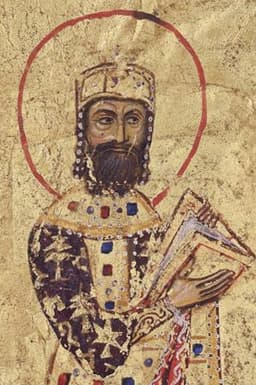
Alexios I Komnenos
Emperor · Medieval
78.4Total
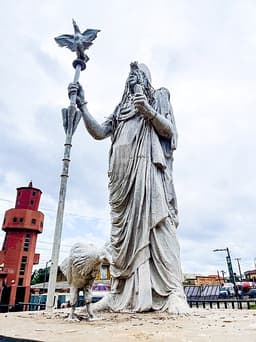
Oduduwa
Emperor · Medieval
59.7Total
Basic Information
Born
1048
950
Died
1118
1020
Era
Medieval
Medieval
Nationality
Byzantine Empire
Ife
Occupation
Emperor
Emperor
Civilization
Western
Other
Score Comparison
Military (10%)
61.7
50.0
Political (20%)
78.0
46.6
Influence (20%)
88.0
68.0
Legacy (20%)
80.0
68.0
Leadership (15%)
78.0
67.0
Strategy (15%)
68.0
36.8
TOTAL
78.4
59.7
Alexios I Komnenos — Complete Timeline
1081 AD
Battle of DyrrhachiumWar◆ Major
Alexios I Komnenos was defeated by the Norman army under Robert Guiscard at Dyrrhachium. The Byzantine forces were routed, and Alexios barely escaped. This loss allowed the Normans to occupy much of the western Balkans, though Alexios later recovered some territory.
Norman InvasionDefeatBalkans
Impact: regionaltragic
1090 AD
Reforms of the Byzantine Military and EconomyReform◆ Major
Alexios I implemented a series of reforms to restore Byzantine power. He reorganized the army by relying more on foreign mercenaries, reformed the currency (the hyperpyron), and granted tax exemptions to the Church. These measures stabilized the empire after decades of decline.
Military ReformEconomic ReformKomnenian Restoration
Impact: nationalconstructive
1095 AD
Appeal to the West: Council of PiacenzaPolitical Action
Alexios I sent envoys to Pope Urban II at the Council of Piacenza, requesting military aid against the Seljuk Turks. This appeal contributed to Urban's call for the First Crusade at the Council of Clermont later that year, initiating the Crusader movement.
First CrusadePope Urban IISeljuk Turks
Impact: global
1097 AD
First Crusade: Siege of NicaeaWar◆ Major
Alexios I cooperated with the Crusader army to besiege and capture Nicaea from the Seljuk Turks. The city was surrendered to Byzantine control, and Alexios used the Crusaders to recover key territories in Anatolia, though tensions later arose over land claims.
First CrusadeNicaeaByzantine-Crusader Relations
Impact: regionalconstructive
Oduduwa — Complete Timeline
1000 AD
Foundation of the Yoruba civilization at Ile-IfeCultural
According to Yoruba oral tradition, Oduduwa descended from heaven at Ile-Ife and founded the Yoruba civilization. He is credited with establishing the first Yoruba kingdom and the sacred city of Ile-Ife, which became the spiritual and cultural heartland of the Yoruba people.
Impact: regionalconstructive
1010 AD
Establishment of the Yoruba royal dynastiesPolitical Action◆ Major
Oduduwa is said to have sent his sons and grandsons to found the various Yoruba kingdoms, including Oyo, Benin, and Ketu. This act established the royal lineages that ruled these states for centuries, creating a network of related kingdoms under the spiritual authority of the Ooni of Ife.
Impact: regionalconstructive
Expert Analysis
Alexios I Komnenos vs Oduduwa
### The Emperor and the Progenitor
History rarely offers a more stark contrast than the meeting of two men who never met: Alexios I Komnenos, the desperate Byzantine emperor who summoned the West to save his empire, and Oduduwa, the legendary founder of the Yoruba civilization who descended from the sky to create a world. One ruled from the ancient throne of Constantinople, a city of marble and gold that had stood for a thousand years. The other stepped onto the red earth of Ile-Ife, a place where the world itself was said to be new. One fought for survival, the other for genesis. Their stories, separated by oceans and centuries, ask the same question: what does it mean to build a legacy when everything is at stake?
### Origins
Alexios was born in 1048 into a world of decay. The Byzantine Empire, once the Roman Empire’s eastern heir, had been bleeding territory for decades. The Seljuk Turks had shattered its army at Manzikert in 1071, and the Norman adventurer Robert Guiscard was carving out a kingdom in Italy. Alexios grew up in the shadow of collapse, a scion of the Komnenos family, a military clan that had seen its fortunes rise and fall with the empire’s pulse. He was a product of a civilization that remembered greatness but could no longer afford it.
Oduduwa, by contrast, emerged from myth. Yoruba oral tradition places his arrival at Ile-Ife around 1000, during a time when the rainforests of West Africa were home to scattered villages, not empires. He is said to have descended from the sky, carrying a handful of earth and a chicken that spread the soil to create the world. Whether he was a historical figure or a divine symbol, his origin story tells us everything: he was not a reformer of an old order but a founder of a new one. The world he entered was a blank canvas, and he painted it with kings.
### Rise to Power
Alexios rose through the ranks of a failing state. In 1081, he seized the throne in a coup, but his first year was a disaster. At the Battle of Dyrrhachium, he led his army against Robert Guiscard’s Normans. The Byzantine forces were routed; Alexios barely escaped with his life. It was a humiliating defeat, but it taught him a hard lesson: the old Roman army was dead. To survive, he would need to reinvent his empire.
Oduduwa’s rise was not a coup but a creation. According to tradition, he did not conquer Ife; he founded it. He established the first royal dynasty, and then sent his sons and grandsons to found the kingdoms of Oyo, Benin, and Ketu. Where Alexios fought for a throne, Oduduwa built the throne itself. His power was not political cunning but spiritual authority—he was the father of kings, and his bloodline became the source of legitimacy for an entire civilization.
### Leadership & Governance
Alexios ruled with the grim pragmatism of a man who had seen his empire’s guts spilled on a battlefield. In 1090, he implemented sweeping reforms: he reorganized the army by relying on foreign mercenaries—Varangians, Normans, even Turks—because he could no longer trust his own subjects to fight. He devalued the currency, seized church treasures, and granted land to nobles in exchange for military service, creating the *pronoia* system that would define Byzantine feudalism. He was a master of survival, not glory.
Oduduwa governed through myth and lineage. He did not need a treasury or a standing army; he needed a story. By establishing the Yoruba royal dynasties around 1010, he created a political order that would last for centuries. The Ooni of Ife, the ruler of the spiritual heartland, still traces his descent to Oduduwa. His governance was not about reforming institutions but about creating them—and, crucially, making them sacred.
### Triumph & Tragedy
Alexios’s greatest triumph was also his greatest tragedy. In 1095, he sent envoys to Pope Urban II at the Council of Piacenza, begging for mercenaries to fight the Turks. Urban saw an opportunity. The result was the First Crusade—a wave of Frankish knights and peasants that Alexios could barely control. In 1097, he cooperated with the Crusaders to besiege Nicaea, and the city was surrendered to him. It was a victory, but it came at a price. The Crusaders, who had sworn oaths to return conquered lands to the empire, broke their promises. Alexios died in 1118, having restored some of Byzantium’s power but having also opened the door to a century of Crusader betrayal.
Oduduwa’s triumph was the civilization itself. He did not fight a single recorded battle; his military score of 11.4 reflects a reign of peace, not war. His tragedy, if it can be called one, is that he left no written records. He exists only in oral tradition, his deeds passed down through generations of praise singers. He is remembered, but he is not known.
### Character & Destiny
Alexios was a survivor, and survival shaped his character. He was cunning, patient, and ruthless—he blinded a rival general, he imprisoned his own mother-in-law. He trusted no one, because no one in Byzantium was trustworthy. His destiny was to hold together a crumbling empire with his bare hands, and he succeeded, but at the cost of his humanity.
Oduduwa was a progenitor, and creation shaped his character. He did not need to be cunning because he did not face enemies; he faced emptiness. His destiny was to fill that emptiness with kings, rituals, and a sense of divine order. He was not a man of strategy but of symbolism. Where Alexios fought for the future, Oduduwa created it.
### Legacy
Alexios I Komnenos left behind a dynasty that would rule for a century, but his legacy is ambiguous. He began the Crusades, an event that reshaped the world but also destroyed the very empire he tried to save. He is remembered as a restorer, but also as a man who sold his soul to the West.
Oduduwa left behind a civilization. The Yoruba people, numbering over 40 million today, trace their identity to his descent from the sky. His legacy is not a dynasty but a culture—a language, a pantheon of gods, a system of kingship that still exists. He is not remembered as a historical figure but as a living ancestor, a bridge between heaven and earth.
### Conclusion
In the end, Alexios and Oduduwa represent two poles of leadership. One was a firefighter, rushing to put out flames in a burning house. The other was an architect, building a house from the ground up. Alexios’s story is one of desperation, cunning, and fragile survival. Oduduwa’s is one of creation, myth, and enduring power. We remember the emperor because he almost lost everything. We remember the progenitor because he made everything. Both are fathers—one of a dynasty, the other of a world.
Rankings
🥇
Alexios I KomnenosLeader
Mil: 61.7Pol: 78.0Inf: 88.0
78.4
🥈
Oduduwa
Mil: 50.0Pol: 46.6Inf: 68.0
59.7
+18.7 behind
How This Comparison Works
Algorithm
Each figure is scored on 6 dimensions (0—100 scale) based on structured historical data: Military (10%), Political (20%), Influence (20%), Legacy (20%), Leadership (15%), Strategy (15%). The weighted total produces the final ranking.
Data Sources
Scores are computed from structured sub-indicators in the database. Scale factors adjust for era (Ancient ×0.85, Modern ×1.0) and civilization size (Eastern ×1.05, Other ×0.80) to account for differences in population and military scale.
Maximum 3 Figures
Comparisons are limited to 2—3 figures to ensure readability and statistical meaningfulness.
Error Margins
±5 points per dimension — Sub-scores are derived from historical records with inherent uncertainty. Two figures within 5 points on a dimension should be considered roughly equivalent in that area.
Total Score Accuracy
±3 points overall — The weighted combination of 6 dimensions produces a total score with approximately ±3 points of uncertainty. Differences of less than 3 points are not statistically significant— the figures are effectively tied.
Known Limitations
- Historical records are incomplete and uneven across civilizations
- Figures from oral-tradition societies may be underrepresented
- Occupation labels can misclassify multi-role figures
- Scores measure capability and impact, not moral character
- Quantitative scoring is a comparison tool, not absolute truth
Capability Radar
Military (10%) — Battles & Warfare
Battles
75
10
Win Rate
70
10
Expansion
60
30
Political (20%) — Governance & Reform
Reform
85
50
Diplomacy
90
40
Economy
70
40
Influence (20%) — Cultural & Global Reach
Cultural
70
80
Global
75
70
Legacy (20%) — Historical Impact
Historical
85
80
Longevity
80
80
Leadership (15%) — Power & Stability
Tenure
80
40
Stability
75
50
Strategy (15%) — Tactics & Innovation
Strategy
85
10
Tactics
80
10
Reform
75
10
Similar Comparisons
Comments & Discussion
The Emperor's Lance6/16/2026
Alexios I was a desperate survivor, not a visionary. He begged the West for help and got the Crusades—a disaster that gutted Byzantium. Oduduwa built a civilization from scratch, while Alexios just propped up a rotting throne. Give me the founder over the firefighter any day.
神话破译者6/16/2026
拿亚历克修斯跟奥杜杜瓦比?纯属关公战秦琼。拜占庭那点破事有记载有数字,约鲁巴传说全靠一张嘴。说难听点,亚历克修斯好歹是个真实人物,奥杜杜瓦大概跟女娲一样——文化需要个祖宗罢了。
The Contrarian Count6/16/2026
Everyone romanticizes Oduduwa's "genesis," but Alexios's legacy actually shaped the modern world. The Crusades he inadvertently sparked reshaped Europe and the Middle East. What did Oduduwa's descendents build? A regional kingdom that got swallowed by colonialism. Impact matters more than mythology.
历史唯物者6/16/2026
军事上亚历克修斯完胜——他用拉丁雇佣兵撑住了帝国,还跟诺曼人周旋。奥杜杜瓦那套"从天而降"的鬼话,连个像样的武器都没留下。要我说,能打仗的皇帝比会编故事的祖宗实用得多。
The Crossroads Critic6/16/2026
Both are overhyped. Alexios was a competent bureaucrat who couldn't stop the decline, and Oduduwa is a folklore figure with zero verifiable history. The real geniuses were the unrecorded farmers who kept both civilizations fed while these "great men" played politics.