Loading...
Alexios I Komnenos vs Nyatsimba Mutota
Alexios I Komnenos leads by 21.9 pts · 2 figures compared
…
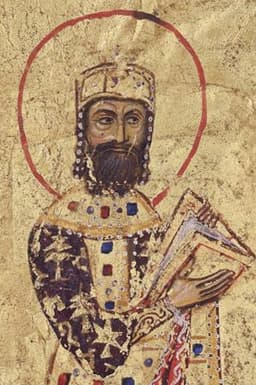
Alexios I Komnenos
Emperor · Medieval
78.4Total

Nyatsimba Mutota
Emperor · Medieval
56.5Total
Basic Information
Born
1048
1400
Died
1118
1450
Era
Medieval
Medieval
Nationality
Byzantine Empire
Mozambique
Occupation
Emperor
Emperor
Civilization
Western
Other
Score Comparison
Military (10%)
61.7
72.5
Political (20%)
78.0
68.0
Influence (20%)
88.0
59.0
Legacy (20%)
80.0
50.0
Leadership (15%)
78.0
40.0
Strategy (15%)
68.0
57.5
TOTAL
78.4
56.5
Alexios I Komnenos — Complete Timeline
1081 AD
Battle of DyrrhachiumWar◆ Major
Alexios I Komnenos was defeated by the Norman army under Robert Guiscard at Dyrrhachium. The Byzantine forces were routed, and Alexios barely escaped. This loss allowed the Normans to occupy much of the western Balkans, though Alexios later recovered some territory.
Norman InvasionDefeatBalkans
Impact: regionaltragic
1090 AD
Reforms of the Byzantine Military and EconomyReform◆ Major
Alexios I implemented a series of reforms to restore Byzantine power. He reorganized the army by relying more on foreign mercenaries, reformed the currency (the hyperpyron), and granted tax exemptions to the Church. These measures stabilized the empire after decades of decline.
Military ReformEconomic ReformKomnenian Restoration
Impact: nationalconstructive
1095 AD
Appeal to the West: Council of PiacenzaPolitical Action
Alexios I sent envoys to Pope Urban II at the Council of Piacenza, requesting military aid against the Seljuk Turks. This appeal contributed to Urban's call for the First Crusade at the Council of Clermont later that year, initiating the Crusader movement.
First CrusadePope Urban IISeljuk Turks
Impact: global
1097 AD
First Crusade: Siege of NicaeaWar◆ Major
Alexios I cooperated with the Crusader army to besiege and capture Nicaea from the Seljuk Turks. The city was surrendered to Byzantine control, and Alexios used the Crusaders to recover key territories in Anatolia, though tensions later arose over land claims.
First CrusadeNicaeaByzantine-Crusader Relations
Impact: regionalconstructive
Nyatsimba Mutota — Complete Timeline
1430 AD
Founding of the Mutapa EmpirePolitical Action
Nyatsimba Mutota led a migration north from Great Zimbabwe and founded the Mutapa Empire in the Zambezi valley. He established a new capital at Zvongombe and began territorial expansion.
Impact: regionalconstructive
1440 AD
Conquest of the TavaraWar◆ Major
Nyatsimba Mutota conquered the Tavara people in the Zambezi valley, incorporating their territory into the Mutapa Empire. This victory secured control over fertile agricultural lands and trade routes.
Impact: regional
1445 AD
Establishment of the Mwenemutapa TitlePolitical Action◆ Major
Nyatsimba Mutota adopted the title Mwenemutapa, meaning 'lord of the conquered lands,' formalizing the imperial structure. This title became hereditary and defined the ruler's authority over conquered peoples.
Impact: regionalconstructive
Expert Analysis
Alexios I Komnenos vs Nyatsimba Mutota
The Emperor and the Migrant King
On a rain-soaked battlefield in 1081, Alexios I Komnenos watched his elite Varangian Guard cut down by Norman cavalry. His empire, Byzantium, was bleeding from every frontier—Normans in the west, Pechenegs in the north, Seljuk Turks in the east. Three centuries later, in the Zambezi valley, a different kind of ruler was leading his people north from the crumbling walls of Great Zimbabwe. Nyatsimba Mutota, a man whose name would become synonymous with conquest, was about to found an empire where no Byzantine would ever set foot. Two medieval emperors, separated by oceans and centuries, yet both faced the same fundamental question: how do you build power when the old world is collapsing around you?
Origins
Alexios Komnenos was born into the Byzantine aristocracy in 1048, a world of silk robes, Greek fire, and endless court intrigue. His family had produced emperors before, and he had learned from childhood that survival meant mastering the delicate dance of alliance and betrayal. The Byzantine Empire he inherited was a shadow of its Roman glory—its treasury empty, its army reduced to mercenaries, its Anatolian heartland lost to the Turks. Alexios was not a visionary; he was a fixer, a man who understood that empire was a machine that needed constant repair.
Nyatsimba Mutota, born around 1400, emerged from a very different tradition. Great Zimbabwe, the stone city of his ancestors, had dominated southern Africa for centuries through gold trade and cattle wealth. But by Mutota's time, the city was in decline—overgrazed lands, exhausted mines, and shifting trade routes. Mutota did not inherit a throne; he seized a possibility. He was a migrant king, leading his followers north into the unknown Zambezi valley, where new gold deposits and fertile lands awaited. His world had no parchment, no bureaucrats, no standing army—only loyalty, cattle, and the memory of Zimbabwe's glory.
Rise to Power
Alexios rose through the Byzantine court's bloodstained corridors. In 1081, at age 33, he staged a military coup against the unpopular Emperor Nikephoros III, marching his troops into Constantinople with the support of powerful noble families. But his first major test came months later at Dyrrhachium, where Robert Guiscard's Normans crushed his hastily assembled army. Alexios fled the battlefield, his reputation in tatters. Yet he learned from defeat: he began rebuilding not by seeking revenge, but by playing a longer game.
Mutota's rise was simpler and more brutal. Around 1430, he simply left Great Zimbabwe with a band of followers, heading north. There was no coup, no coronation—just a migration. The Tavara people he encountered in the Zambezi valley were farmers, not warriors. Mutota conquered them with iron weapons and superior organization, absorbing their villages into his growing domain. By 1440, he had established a new capital at Zvongombe, and by 1445, he adopted the title *Mwenemutapa*—"lord of the conquered lands." His power was not inherited but earned, spear in hand.
Leadership & Governance
Alexios governed through improvisation and cunning. His military reforms shifted the Byzantine army away from expensive native troops toward cheaper foreign mercenaries—a pragmatic but risky choice. He debased the currency to pay his bills, alienating merchants but buying time. His greatest political achievement came in 1095, when he sent envoys to Pope Urban II at the Council of Piacenza, requesting western knights to fight the Turks. This appeal would trigger the First Crusade—a decision that reshaped the medieval world. Alexios saw the Crusaders as hired swords; he did not foresee they would carve out their own kingdoms.
Mutota ruled through presence and lineage. The Mutapa Empire had no bureaucracy, no written laws, no tax collectors. Instead, the Mwenemutapa controlled gold mines and trade routes, distributing cattle and wives to loyal chieftains. His authority was personal: men followed him because he won battles and distributed wealth. He did not reform an empire—he created one from scratch, building a network of tributary chiefs who acknowledged his supremacy. The state he founded would last nearly four centuries, outliving Byzantium by three hundred years.
Triumph & Tragedy
Alexios's triumph was the First Crusade's siege of Nicaea in 1097. Working with Crusader armies, he recaptured the city from the Seljuks, a victory that restored Byzantine prestige. But his tragedy was that he could not control the forces he unleashed. The Crusaders marched on to Jerusalem without him, establishing Latin states that would become Byzantium's enemies. Alexios died in 1118, having stabilized his empire but leaving it vulnerable to the very west he had summoned.
Mutota's triumph was the creation of the Mutapa Empire itself. By his death around 1450, he controlled the gold-rich plateau between the Zambezi and Limpopo rivers, and his name had become legend. His tragedy was more subtle: his conquests were never fully consolidated. The Tavara and other conquered peoples maintained their own identities, and succession struggles would later tear his empire apart. He built a house on sand, but it stood for generations.
Character & Destiny
Alexios was a survivor, not a hero. He lied to Crusaders, betrayed allies when necessary, and spent his life patching holes in a leaking ship. His autobiography, written by his daughter Anna Komnene, portrays him as a reluctant emperor burdened by duty. The truth is more complex: he was a pragmatist who understood that in Byzantium, the only sin was failure. His destiny was to hold the line, not to conquer.
Mutota was a founder, a man who left the known world behind. He had no Anna Komnene to record his thoughts, but his title—Mwenemutapa, lord of the conquered—reveals his worldview. He did not inherit power; he took it. His destiny was to create something new, not to preserve something old. Where Alexios looked backward to Rome, Mutota looked forward to gold and cattle.
Legacy
Alexios I Komnenos is remembered as the founder of the Komnenian dynasty, the man who bought Byzantium another century of life. His appeal to the West changed the course of history, for better and worse. Today, historians give him a leadership score of 79.6, recognizing his political skill even as they note his military limitations. He is a cautionary tale about the price of survival.
Nyatsimba Mutota is remembered as the father of the Mutapa Empire, a state that dominated southeast Africa until the Portuguese arrived in the 1500s. His legacy score of 64.2 reflects how little the world knows of him—no chronicles, no palaces, only oral traditions and scattered ruins. But his empire outlasted Byzantium, and his name still echoes in Zimbabwean history. He is a testament to what one man can build with a spear and a dream.
Conclusion
Two emperors, two empires, two fates. Alexios fought to preserve a civilization that had already passed its peak, while Mutota built one that was just beginning. One called for help from strangers who became conquerors; the other conquered strangers who became subjects. In the end, both were human—ambitious, flawed, desperate. Their stories remind us that history is not a march of progress but a series of choices, made in the dark, with incomplete information and impossible odds. Alexios saved his empire for a time; Mutota founded one that endured. Which is the greater achievement? Perhaps the answer lies not in their scores but in the question itself: what does it mean to leave the world different from how you found it?
Rankings
🥇
Alexios I KomnenosLeader
Mil: 61.7Pol: 78.0Inf: 88.0
78.4
🥈
Nyatsimba Mutota
Mil: 72.5Pol: 68.0Inf: 59.0
56.5
+21.9 behind
How This Comparison Works
Algorithm
Each figure is scored on 6 dimensions (0—100 scale) based on structured historical data: Military (10%), Political (20%), Influence (20%), Legacy (20%), Leadership (15%), Strategy (15%). The weighted total produces the final ranking.
Data Sources
Scores are computed from structured sub-indicators in the database. Scale factors adjust for era (Ancient ×0.85, Modern ×1.0) and civilization size (Eastern ×1.05, Other ×0.80) to account for differences in population and military scale.
Maximum 3 Figures
Comparisons are limited to 2—3 figures to ensure readability and statistical meaningfulness.
Error Margins
±5 points per dimension — Sub-scores are derived from historical records with inherent uncertainty. Two figures within 5 points on a dimension should be considered roughly equivalent in that area.
Total Score Accuracy
±3 points overall — The weighted combination of 6 dimensions produces a total score with approximately ±3 points of uncertainty. Differences of less than 3 points are not statistically significant— the figures are effectively tied.
Known Limitations
- Historical records are incomplete and uneven across civilizations
- Figures from oral-tradition societies may be underrepresented
- Occupation labels can misclassify multi-role figures
- Scores measure capability and impact, not moral character
- Quantitative scoring is a comparison tool, not absolute truth
Capability Radar
Military (10%) — Battles & Warfare
Battles
75
55
Win Rate
70
60
Expansion
60
65
Political (20%) — Governance & Reform
Reform
85
50
Diplomacy
90
55
Economy
70
50
Influence (20%) — Cultural & Global Reach
Cultural
70
45
Global
75
40
Legacy (20%) — Historical Impact
Historical
85
55
Longevity
80
50
Leadership (15%) — Power & Stability
Tenure
80
60
Stability
75
55
Strategy (15%) — Tactics & Innovation
Strategy
85
55
Tactics
80
50
Reform
75
40
Similar Comparisons
Comments & Discussion
VarangianVulture6/16/2026
Alexios was a brilliant tactician but let's be real—his reliance on Norman mercenaries after they'd just massacred his Varangians was like hiring the fox to guard the henhouse. Mutota built from scratch with a migrant vision; Alexios just patched a sinking ship with foreign timber. Give me the Zimbabwean king who carved an empire from wilderness over a Byzantine emperor who couldn't even hold Anatolia without selling out to Venice.
数据侦探6/16/2026
说Alexios修复了一个垂死的帝国?算了吧,他靠的是向威尼斯出卖商业特权来换取海军支持,这根本是饮鸩止渴。Mutota没有留下文字记录,但考古证据显示因巴达拉大道绵延数公里,人口密集度超过同时期君士坦丁堡郊区。数据不撒谎:一个靠贸易网络的务实征服者,远超一个靠贷款和雇佣兵苟延残喘的“修复大师”。
PurplePhoenixRising6/16/2026
Let's not romanticize Mutota's "migrant" journey—he was a power-hungry prince who abandoned a crumbling Great Zimbabwe to loot northern cattle and salt deposits. Alexios at least faced existential threats from three sides and still engineered the Komnenian restoration, reforming currency and reconquering Anatolian coast. Mutota's "empire" was a cattle-raiding confederation; Alexios preserved the last flicker of Roman civilization. That's not even a contest.
丝路老饕6/16/2026
你们都在谈政治和军事,我来谈谈本质差异:Alexios的时代,君士坦丁堡还有丝绸工坊和希腊火配方,整个地中海贸易网能养活帝国精英;Mutota的因巴达拉大道上运的是黄金和象牙,但缺乏知识传承体系。一个帝国能坚持几个世纪靠的不只是黄金,而是记录、法典和官僚系统——这方面,Alexios的拜占庭完胜。Mutota的王国在他死后就迅速碎片化,这就是证明。
TheLionOfTaurus6/16/2026
Both were pragmatic survivors, but context matters: Alexios faced organized Islamic and European military powers with literacy, siege engineering, and diplomacy. Mutota's opponents were Bantu chiefdoms with iron spears and rainmaking rituals. Give Alexios Mutota's isolation and unlimited interior, and he'd have built a transcontinental empire. Give Mutota Alexios's enemies, and he'd be a footnote in a Turkish chronicle. The Komnenian recovery was the tougher gig, hands down.