Loading...
Alexios I Komnenos vs Moctezuma I
Alexios I Komnenos leads by 19.5 pts · 2 figures compared
…
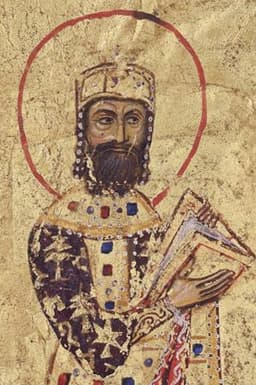
Alexios I Komnenos
Emperor · Medieval
78.4Total

Moctezuma I
Emperor · Medieval
58.9Total
Basic Information
Born
1048
1398
Died
1118
1469
Era
Medieval
Medieval
Nationality
Byzantine Empire
Aztec Empire
Occupation
Emperor
Emperor
Civilization
Western
Other
Score Comparison
Military (10%)
61.7
82.0
Political (20%)
78.0
45.0
Influence (20%)
88.0
58.3
Legacy (20%)
80.0
56.0
Leadership (15%)
78.0
66.0
Strategy (15%)
68.0
55.0
TOTAL
78.4
58.9
Alexios I Komnenos — Complete Timeline
1081 AD
Battle of DyrrhachiumWar◆ Major
Alexios I Komnenos was defeated by the Norman army under Robert Guiscard at Dyrrhachium. The Byzantine forces were routed, and Alexios barely escaped. This loss allowed the Normans to occupy much of the western Balkans, though Alexios later recovered some territory.
Norman InvasionDefeatBalkans
Impact: regionaltragic
1090 AD
Reforms of the Byzantine Military and EconomyReform◆ Major
Alexios I implemented a series of reforms to restore Byzantine power. He reorganized the army by relying more on foreign mercenaries, reformed the currency (the hyperpyron), and granted tax exemptions to the Church. These measures stabilized the empire after decades of decline.
Military ReformEconomic ReformKomnenian Restoration
Impact: nationalconstructive
1095 AD
Appeal to the West: Council of PiacenzaPolitical Action
Alexios I sent envoys to Pope Urban II at the Council of Piacenza, requesting military aid against the Seljuk Turks. This appeal contributed to Urban's call for the First Crusade at the Council of Clermont later that year, initiating the Crusader movement.
First CrusadePope Urban IISeljuk Turks
Impact: global
1097 AD
First Crusade: Siege of NicaeaWar◆ Major
Alexios I cooperated with the Crusader army to besiege and capture Nicaea from the Seljuk Turks. The city was surrendered to Byzantine control, and Alexios used the Crusaders to recover key territories in Anatolia, though tensions later arose over land claims.
First CrusadeNicaeaByzantine-Crusader Relations
Impact: regionalconstructive
Moctezuma I — Complete Timeline
1428 AD
Conquest of the TepanecsWar◆ Major
Itzcoatl led the Triple Alliance forces in a war against the Tepanecs of Azcapotzalco, the dominant power in the region. The victory broke Tepanec hegemony and established Tenochtitlan as the leading city-state in central Mexico.
WarTepanec WarAztec Expansion
Impact: regional
Formed the Triple AlliancePolitical Action
Itzcoatl, as tlatoani of Tenochtitlan, formed the Triple Alliance with Texcoco and Tlacopan. This military and political pact created the Aztec Empire, enabling coordinated conquests and the subjugation of neighboring city-states in the Valley of Mexico.
Aztec EmpireAlliancePolitical Foundation
Impact: regional
1430 AD
Burned Historical CodicesCultural◆ Major
Itzcoatl ordered the burning of historical codices from conquered peoples, rewriting Aztec history to legitimize his rule and the empire's divine origins. This act destroyed pre-Aztec records and reshaped Mesoamerican historical memory.
Cultural DestructionHistorical RevisionAztec Ideology
Impact: regionaldestructive
Expert Analysis
Alexios I Komnenos vs Moctezuma I
# The Emperor's Two Paths: Alexios Komnenos and Moctezuma I
On a dusty plain in modern-day Albania, in the autumn of 1081, a Byzantine emperor watched his elite Varangian Guard—Norsemen armed with massive battle-axes—charge headlong into a Norman line. Moments later, they were slaughtered. Alexios I Komnenos, just months into his reign, had gambled everything on a pitched battle against Robert Guiscard, and he had lost catastrophically. Three centuries later and an ocean away, another emperor stood atop a pyramid in Tenochtitlan, watching the smoke rise from conquered cities. Moctezuma I had never lost a war. Both men inherited thrones in times of crisis; both expanded their empires and reshaped their civilizations. But their paths diverged in ways that reveal the deepest truths about power, survival, and the strange alchemy of historical memory.
Origins
Alexios was born into the Byzantine military aristocracy in 1048, a world of court intrigue and constant frontier warfare. The empire he entered was bleeding from every border—Normans in the west, Seljuk Turks in the east, Pecheneg nomads in the north. His family, the Komnenoi, had produced generals but not emperors. Alexios learned early that survival meant mastering the art of the possible: knowing when to fight, when to flee, and when to bargain.
Moctezuma I, born in 1398, grew up in Tenochtitlan, an island city rising from Lake Texcoco. The Aztecs were then a tributary people, subject to the dominant Tepanec Empire. Moctezuma’s uncle, Itzcoatl, would change that. Young Moctezuma learned war in the chinampa fields and temple plazas, where the gods demanded blood and the state demanded obedience. His world was one of absolute hierarchy, where the tlatoani—the speaker—was both priest and king, and where history itself could be rewritten to serve power.
Rise to Power
Alexios seized the throne in 1081 through a military coup, marching on Constantinople while the previous emperor cowered behind the city walls. He was thirty-three, a proven general, but his legitimacy was fragile. The Norman invasion that met him at Dyrrhachium was his first test, and he failed it. Yet Alexios survived, retreating into the mountains, rebuilding his forces, and learning a lesson that would define his reign: the Byzantine army could not defeat its enemies in open battle. It would have to outlast them.
Moctezuma’s rise was more orderly. He served as a general under Itzcoatl during the great war against the Tepanecs, which culminated in 1428 with the formation of the Triple Alliance—Tenochtitlan, Texcoco, and Tlacopan. The alliance transformed the Aztecs from subjects into masters. When Itzcoatl died in 1440, Moctezuma inherited a war machine that was already crushing its neighbors. His path was clear: continue the conquests, consolidate the tribute, and prove himself worthy of the gods.
Leadership & Governance
Alexios governed through improvisation and desperation. His military reforms, begun around 1090, were radical: he abandoned the traditional Byzantine reliance on native troops and instead hired foreign mercenaries—Normans, Turks, Franks—binding them to his service with promises of land and gold. He debased the currency to pay them, a short-term fix with long-term consequences. Politically, he was a master of diplomacy, playing enemies against each other, granting trade concessions to Venice in exchange for naval support, and, most famously, appealing to Pope Urban II at the Council of Piacenza in 1095 for Western knights to fight the Turks. This appeal would unleash the First Crusade—a force Alexios could neither control nor fully trust.
Moctezuma ruled through ritual and terror. His conquests were methodical: he expanded the empire east to the Gulf of Mexico and south to Oaxaca, demanding tribute in gold, maize, cacao, and human sacrifices. His political genius lay in integrating conquered elites into the Aztec system, allowing local rulers to remain in place as long as they paid tribute and accepted Huitzilopochtli, the Aztec war god. The burning of historical codices in 1430, ordered by Itzcoatl but continued under Moctezuma, was a deliberate act of state-building—erase the past, control the present.
Triumph & Tragedy
Alexios’s greatest triumph came in 1097, when the First Crusade—that strange army of Western knights he had summoned—captured Nicaea from the Seljuks. Working with the Crusaders, he accepted the city’s surrender, raising the Byzantine flag over its walls. For a moment, it seemed his gamble had paid off. The Crusaders would restore lost Byzantine territories; the empire would rise again. But the tragedy was already unfolding. The Crusaders, suspicious of Alexios, broke their oaths to return conquered lands to Byzantium. They marched on Antioch and Jerusalem without him, founding their own kingdoms. Alexios had opened a door he could not close.
Moctezuma’s triumph was the consolidation of Aztec hegemony. By his death in 1469, the Triple Alliance controlled most of central Mexico. His tragedy was invisible to him: the Aztec system of tribute and sacrifice created countless enemies, peoples who would later ally with Spanish invaders. Moctezuma I could not have foreseen Cortés, but the seeds of the Aztec fall were sown in his reign.
Character & Destiny
Alexios was pragmatic to the point of cynicism. He lied to Crusaders, betrayed allies, debased his currency, and hired his enemies. Yet he did so to save an empire. His personality—flexible, patient, cunning—was perfectly suited to a world of shifting alliances and existential threats. He died in 1118, having founded a dynasty that would rule Byzantium for a century.
Moctezuma was a builder of structures, not a survivor. He expanded the Aztec state but made it more brittle. His world was one of rigid hierarchies and divine mandates, where the emperor was the living embodiment of the sun god’s will. There was no room for compromise, no space for the kind of desperate improvisation that saved Alexios. When the Spanish finally came, Moctezuma II—his great-grandson—would face a crisis his ancestor’s system could not handle.
Legacy
Alexios is remembered as the founder of the Komnenian restoration, the emperor who saved Byzantium from collapse and inadvertently launched the Crusades. His legacy is ambiguous: he preserved the empire but changed its character, making it dependent on Western mercenaries and Latin merchants. Modern historians debate whether he was a savior or a short-term fixer.
Moctezuma I is remembered as a great conqueror, the architect of Aztec power. Yet his legacy is overshadowed by the Spanish conquest. In Mexico today, he is a figure of pride and tragedy—a reminder of what was built and what was destroyed.
Conclusion
Two emperors, two worlds. Alexios faced collapse and adapted, using every tool at his disposal—deception, diplomacy, desperation—to keep his empire alive. Moctezuma faced expansion and built, creating a system of tribute and terror that worked brilliantly until it met a force it could not comprehend. One emperor saved his civilization for another century; the other built an empire that would be erased in a generation. The difference was not in their intelligence or ambition, but in their relationship to change. Alexios knew that survival meant becoming something new. Moctezuma believed that power meant becoming something eternal. History, as always, favored the survivor.
Rankings
🥇
Alexios I KomnenosLeader
Mil: 61.7Pol: 78.0Inf: 88.0
78.4
🥈
Moctezuma I
Mil: 82.0Pol: 45.0Inf: 58.3
58.9
+19.5 behind
How This Comparison Works
Algorithm
Each figure is scored on 6 dimensions (0—100 scale) based on structured historical data: Military (10%), Political (20%), Influence (20%), Legacy (20%), Leadership (15%), Strategy (15%). The weighted total produces the final ranking.
Data Sources
Scores are computed from structured sub-indicators in the database. Scale factors adjust for era (Ancient ×0.85, Modern ×1.0) and civilization size (Eastern ×1.05, Other ×0.80) to account for differences in population and military scale.
Maximum 3 Figures
Comparisons are limited to 2—3 figures to ensure readability and statistical meaningfulness.
Error Margins
±5 points per dimension — Sub-scores are derived from historical records with inherent uncertainty. Two figures within 5 points on a dimension should be considered roughly equivalent in that area.
Total Score Accuracy
±3 points overall — The weighted combination of 6 dimensions produces a total score with approximately ±3 points of uncertainty. Differences of less than 3 points are not statistically significant— the figures are effectively tied.
Known Limitations
- Historical records are incomplete and uneven across civilizations
- Figures from oral-tradition societies may be underrepresented
- Occupation labels can misclassify multi-role figures
- Scores measure capability and impact, not moral character
- Quantitative scoring is a comparison tool, not absolute truth
Capability Radar
Military (10%) — Battles & Warfare
Battles
75
65
Win Rate
70
70
Expansion
60
80
Political (20%) — Governance & Reform
Reform
85
60
Diplomacy
90
65
Economy
70
70
Influence (20%) — Cultural & Global Reach
Cultural
70
60
Global
75
50
Legacy (20%) — Historical Impact
Historical
85
65
Longevity
80
55
Leadership (15%) — Power & Stability
Tenure
80
70
Stability
75
65
Strategy (15%) — Tactics & Innovation
Strategy
85
75
Tactics
80
60
Reform
75
55
Similar Comparisons
Comments & Discussion
Alexios the Turncloak Emperor6/16/2026
Don't romanticize Alexios. He wasn't a savvy survivor—he was a paranoid usurper who destabilized the empire by trusting Normans as mercenaries after they crushed him at Dyrrhachium. The Varangian Guard massacre wasn't bad luck; it was strategic incompetence. His "reforms" just bought time by selling trade privileges to Venice, bleeding Byzantine coffers dry. Moctezuma I at least expanded the Triple Alliance without begging foreign fleets for scraps.
浮华收割者6/16/2026
阿莱克修斯像个在赌场输光后借钱度日的败家子,而蒙特祖玛一世才是真正的强者。看他的战绩:征服了瓦哈卡和科塔斯特拉,把阿兹特克帝国疆域扩大一倍,还修建了防洪堤和引水渠。阿莱克修斯呢?他靠骗取十字军的忠诚来苟延残喘。一个靠忽悠异族俘虏来续命,一个用血汗建起文明——谁更值得铭记?
The Pelican and the Eagle6/16/2026
Compare their diplomatic cunning: Moctezuma I created the Flower Wars to train soldiers and collect sacrifices without exhausting his own people's morale—brilliant demographic management. Alexios, by contrast, pawned Byzantine sovereignty to popes and Venetians, triggering the Fourth Crusade's sack of Constantinople. Moctezuma built an empire through strategic display; Alexios built a house of cards.
长矛与协议6/16/2026
别被数据欺骗——阿莱克修斯所谓的"复兴"全靠卖地换和平。他放弃了安纳托利亚大部分地区,用黄金贿赂塞尔柱人,结果只换来十年喘息。蒙特祖玛一世却用军事与外交双管齐下:他吞并了瓦斯特克和米斯特克地区,使特诺奇蒂特兰成为中美洲最大城市。一个靠许诺扩张,一个用铁血统治——这才是统治者的区别。
历史碎碎念者6/16/2026
阿莱克修斯有一件事值得赞扬:他写了《阿莱克修斯传》,证明他比任何现代史学家都更懂自我包装。蒙特祖玛一世呢?他的记录被西班牙人烧光了。我们只能通过考古和传说知道他修了特奥蒂瓦坎金字塔的祭坛。一个拼命写自己的故事,一个让后人拼凑他的传说
Chronicler43066/16/2026
The "balance" here is laughable. Alexios faced a dying empire with plague, Turk invaders, and Norman pirates. Moctezuma inherited an ascendant state with reliable tribute and no existential threats. Of course Moctezuma's numbers look better—he had better starting conditions! Alexios' reign saw Constantinople's population drop by 30%? That's not his failure—it's playing the hand he was dealt. Compare apples to apples.