Loading...
Alexios I Komnenos vs Kirtivarman II
Alexios I Komnenos leads by 42.0 pts · 2 figures compared
…
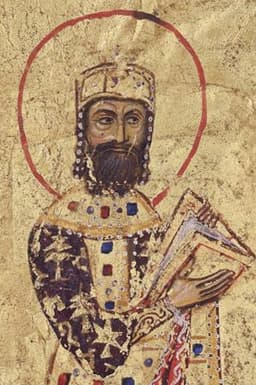
Alexios I Komnenos
Emperor · Medieval
78.4Total

Kirtivarman II
Emperor · Medieval
36.4Total
Basic Information
Born
1048
746
Died
1118
757
Era
Medieval
Medieval
Nationality
Byzantine Empire
India
Occupation
Emperor
Emperor
Civilization
Western
Indian
Score Comparison
Military (10%)
61.7
21.2
Political (20%)
78.0
30.7
Influence (20%)
88.0
46.3
Legacy (20%)
80.0
37.5
Leadership (15%)
78.0
33.6
Strategy (15%)
68.0
36.8
TOTAL
78.4
36.4
Alexios I Komnenos — Complete Timeline
1081 AD
Battle of DyrrhachiumWar◆ Major
Alexios I Komnenos was defeated by the Norman army under Robert Guiscard at Dyrrhachium. The Byzantine forces were routed, and Alexios barely escaped. This loss allowed the Normans to occupy much of the western Balkans, though Alexios later recovered some territory.
Norman InvasionDefeatBalkans
Impact: regionaltragic
1090 AD
Reforms of the Byzantine Military and EconomyReform◆ Major
Alexios I implemented a series of reforms to restore Byzantine power. He reorganized the army by relying more on foreign mercenaries, reformed the currency (the hyperpyron), and granted tax exemptions to the Church. These measures stabilized the empire after decades of decline.
Military ReformEconomic ReformKomnenian Restoration
Impact: nationalconstructive
1095 AD
Appeal to the West: Council of PiacenzaPolitical Action
Alexios I sent envoys to Pope Urban II at the Council of Piacenza, requesting military aid against the Seljuk Turks. This appeal contributed to Urban's call for the First Crusade at the Council of Clermont later that year, initiating the Crusader movement.
First CrusadePope Urban IISeljuk Turks
Impact: global
1097 AD
First Crusade: Siege of NicaeaWar◆ Major
Alexios I cooperated with the Crusader army to besiege and capture Nicaea from the Seljuk Turks. The city was surrendered to Byzantine control, and Alexios used the Crusaders to recover key territories in Anatolia, though tensions later arose over land claims.
First CrusadeNicaeaByzantine-Crusader Relations
Impact: regionalconstructive
Kirtivarman II — Complete Timeline
753 AD
Defeat by DantidurgaWar◆ Major
Kirtivarman II, the last Badami Chalukya king, was defeated by the Rashtrakuta chief Dantidurga. This battle ended the Badami Chalukya dynasty and established Rashtrakuta rule over the Deccan region.
Impact: regionaldestructive
Expert Analysis
Alexios I Komnenos vs Kirtivarman II
# The Emperor Who Shaped an Age, and the King Who Could Not
In the autumn of 1081, a desperate Byzantine emperor watched his army shatter on the plains of Dyrrhachium. Norman lancers cut through his Varangian Guard as if they were reeds, and the Adriatic wind carried the screams of dying men toward the walls of a city that would soon fall. Alexios I Komnenos, still new to the purple, had gambled everything on a pitched battle—and lost. Yet this defeat would not define him. Seven centuries earlier and thousands of miles away, another ruler faced his own moment of annihilation. In 753, Kirtivarman II, the last king of the Badami Chalukya dynasty, saw his forces crumble before the Rashtrakuta chief Dantidurga. That battle did define him. It ended everything. Why did one emperor rise from disaster to reshape an age, while another vanished into the footnotes of history? The answer lies not in the battles themselves, but in what each man brought to the throne.
Origins
Alexios was born in 1048 into a world of decay. The Byzantine Empire, once the unshakable bastion of Christendom, had spent decades bleeding from internal coups, Norman invasions, and Seljuk raids. His family, the Komnenoi, were military aristocrats who understood power as a living thing—something to be seized, nurtured, and defended. Alexios grew up in camps and councils, watching his father and uncles maneuver through a court where loyalty was measured in hours. This was a man forged in crisis, not comfort.
Kirtivarman II, by contrast, inherited a throne that seemed solid. The Badami Chalukyas had ruled the Deccan for over two centuries, building temples and patronizing arts. Born in 746, Kirtivarman ascended as a young prince into a kingdom that appeared stable but had begun to crack. The Rashtrakutas, former feudatories, were growing restless. The Chalukya bureaucracy, once efficient, had grown complacent. Kirtivarman had been raised in the shadow of greatness, not the fire of survival.
Rise to Power
Alexios did not stumble into power; he climbed over bodies to reach it. In 1081, he led a military revolt against the incompetent Emperor Nikephoros III, leveraging his family’s prestige and the army’s loyalty. He was crowned in Hagia Sophia, but the crown felt like a noose. The Normans were at Dyrrhachium, the Pechenegs raided the Balkans, and the Seljuks held Anatolia. Alexios understood that his legitimacy depended on action, not ritual.
Kirtivarman’s path was smoother and therefore more treacherous. He inherited the throne from his father, likely in his late teens or early twenties, with little opposition. The Chalukya court had grown accustomed to peace, and the young king had no rivals to crush, no crises to master. He ruled from the ancient capital of Badami, surrounded by ministers who told him what he wanted to hear. His rise was not a test; it was a formality.
Leadership & Governance
Alexios governed like a man who knew the abyss was at his feet. After Dyrrhachium, he did not retreat into denial. He reformed. In 1090, he overhauled the Byzantine military and economy, reducing the size of the expensive native army and relying instead on foreign mercenaries—Normans, Pechenegs, and Turks—whom he paid with land grants and trade privileges. He centralized tax collection, curbed the power of rebellious nobles, and rebuilt the navy. But his most brilliant stroke was diplomatic. In 1095, Alexios sent envoys to Pope Urban II at the Council of Piacenza, appealing for Western knights to fight the Seljuks. He did not ask for a crusade; he asked for mercenaries. What he got was the First Crusade—a force so vast and unruly that it nearly consumed his empire.
Yet Alexios managed it. He guided the Crusaders to Nicaea in 1097, ensuring the city surrendered to Byzantine forces rather than the Franks. He extracted oaths of fealty from their leaders, using their swords to reclaim Anatolian cities while keeping them dependent on his supplies. He was a master of the possible, not the ideal. His leadership was a constant negotiation between survival and ambition.
Kirtivarman had no such vision. His governance was passive, reactive. The Chalukya administration continued as it had for decades, collecting taxes and commissioning temple carvings, but the machinery was rusting. When Dantidurga, the Rashtrakuta chief, began raiding Chalukya territory, Kirtivarman responded with traditional methods: mustering feudal levies, seeking alliances with minor dynasties. He did not reform the army, did not court foreign powers, did not rethink his strategy. He fought the future with the tools of the past.
Triumph & Tragedy
Alexios’s greatest moment came not on a battlefield but in a palace. By 1098, he had reclaimed Nicaea, much of western Anatolia, and the Aegean coast. The Crusaders, for all their chaos, had done what Byzantine armies could not: broken the Seljuk hold on Asia Minor. Alexios watched from Constantinople as his enemies burned and his empire breathed again. The tragedy was that he could not control the forces he unleashed. The Crusaders would later sack Constantinople in 1204, but that was a wound for his descendants. Alexios died in 1118, having restored the empire’s fortunes and founded a dynasty that would rule for a century.
Kirtivarman’s tragedy was simpler and more complete. In 753, at a battle that history barely records, Dantidurga defeated him. The Chalukya kingdom collapsed. The Rashtrakutas took Badami, and Kirtivarman disappears from the chronicles. There is no record of his death in 757, no story of exile or resistance. He simply ended.
Character & Destiny
Alexios was pragmatic to the point of cynicism. He lied to Crusaders, broke oaths when convenient, and trusted no one. But this suspicion was not paranoia; it was wisdom. He understood that in a world of wolves, the sheep must learn to bite. His personality—cautious, calculating, relentless—shaped every decision. He survived because he was willing to change.
Kirtivarman seems to have been a man of tradition. He ruled as his ancestors had, expecting the gods and the armies to protect him. When the world changed, he did not. The difference was not intelligence or courage; it was adaptability. Alexios could bend without breaking. Kirtivarman could only break.
Legacy
Alexios left behind a restored empire, a dynasty, and a transformed world. The Crusades, which he inadvertently started, reshaped the Mediterranean for centuries. His reforms bought Byzantium another hundred years of life. Today, he is remembered as a savior, albeit a flawed one—a man who held the torch when the wind howled.
Kirtivarman left behind ruins. The Badami Chalukyas are studied by specialists, their temples admired by tourists, but their last king is a footnote. He is remembered not for what he did, but for what he failed to prevent. His legacy is a lesson in the cost of inertia.
Conclusion
The difference between Alexios I Komnenos and Kirtivarman II is not merely the difference between success and failure. It is the difference between a man who saw history as a river to be navigated and a man who saw it as a temple to be preserved. Alexios understood that survival requires transformation, even at the cost of principle. Kirtivarman believed that tradition would shield him. In the end, the river swept him away. Their stories remind us that leadership is not about the throne one inherits, but the choices one makes when the throne begins to shake.
Rankings
🥇
Alexios I KomnenosLeader
Mil: 61.7Pol: 78.0Inf: 88.0
78.4
🥈
Kirtivarman II
Mil: 21.2Pol: 30.7Inf: 46.3
36.4
+42.0 behind
How This Comparison Works
Algorithm
Each figure is scored on 6 dimensions (0—100 scale) based on structured historical data: Military (10%), Political (20%), Influence (20%), Legacy (20%), Leadership (15%), Strategy (15%). The weighted total produces the final ranking.
Data Sources
Scores are computed from structured sub-indicators in the database. Scale factors adjust for era (Ancient ×0.85, Modern ×1.0) and civilization size (Eastern ×1.05, Other ×0.80) to account for differences in population and military scale.
Maximum 3 Figures
Comparisons are limited to 2—3 figures to ensure readability and statistical meaningfulness.
Error Margins
±5 points per dimension — Sub-scores are derived from historical records with inherent uncertainty. Two figures within 5 points on a dimension should be considered roughly equivalent in that area.
Total Score Accuracy
±3 points overall — The weighted combination of 6 dimensions produces a total score with approximately ±3 points of uncertainty. Differences of less than 3 points are not statistically significant— the figures are effectively tied.
Known Limitations
- Historical records are incomplete and uneven across civilizations
- Figures from oral-tradition societies may be underrepresented
- Occupation labels can misclassify multi-role figures
- Scores measure capability and impact, not moral character
- Quantitative scoring is a comparison tool, not absolute truth
Capability Radar
Military (10%) — Battles & Warfare
Battles
75
15
Win Rate
70
10
Expansion
60
5
Political (20%) — Governance & Reform
Reform
85
10
Diplomacy
90
10
Economy
70
15
Influence (20%) — Cultural & Global Reach
Cultural
70
10
Global
75
5
Legacy (20%) — Historical Impact
Historical
85
15
Longevity
80
10
Leadership (15%) — Power & Stability
Tenure
80
20
Stability
75
10
Strategy (15%) — Tactics & Innovation
Strategy
85
10
Tactics
80
15
Reform
75
5
Similar Comparisons
Comments & Discussion
KOMNENOS'S_GHOST6/16/2026
Alexios didn't just survive—he literally reinvented Byzantine warfare on the fly after Dyrrhachium. Compare: he lost that battle but won the war against Robert Guiscard through scorched-earth tactics and Venetian naval alliances. Kirtivarman II got one shot with his feudal Chalukya army and folded. Alexios understood that losing a battle doesn't lose a kingdom if you control the narrative. That's leadership, not luck.
策略解剖者6/16/2026
从军事后勤看,阿莱克修斯懂得打消耗战,而Kirtivarman II根本不懂可持续战争。1081年后,阿莱克修斯建立了税收制和普罗诺埃亚军田系统,彻底改造了拜占庭军队。但查卢基亚末王呢?他的失败是结构性的——没有改革,没有后备计划,就靠一次会战定生死。这就是将才和庸君的区别。
DATA_SKEPTIC6/16/2026
Let's pump the brakes here. We're comparing a ruler with 37 years on the throne to one with maybe 4. Kirtivarman II's entire known reign is practically a footnote—we don't even have clear dates for his battles. Alexios left volumes of histories (Anna Komnene's Alexiad alone is 15 books). You can't declare one "greater" when the evidence base is a palace inscription and three copper plates. That's historiography, not history.
青铜与丝绸6/16/2026
作为南印度史爱好者,得替Kirtivarman说句话。阿莱克修斯有东正教和威尼斯撑腰,而查卢基亚在753年面对的是达蒂杜尔加领导的罗湿陀罗拘陀崛起浪潮——那是一个文明级别的冲击。Kirtivarman继承的帝国已经衰落,他输给的是一个新帝国的诞生,不是因为个人无能。把他俩放在同一标准不公平,就像说一支蜡烛不如火炬,因为火炬更亮。
CLASSICS_REVISITED6/16/2026
What strikes me is the difference in imperial ideology. Alexios ruled a universal Christian empire with patriarchs, synods, and the memory of Rome—he could mobilize spiritual as well as secular authority after defeat. Kirtivarman was a Hindu monarch in a fragmenting political system where legitimacy was purely dynastic and regional. When Alexios lost at Dyrrhachium, he still had Constantinople. When Kirtivarman fell, there was nothing left to rally. The institutional framework, not the man, made