Loading...
Alexios I Komnenos vs King David
Alexios I Komnenos leads by 3.1 pts · 2 figures compared
…
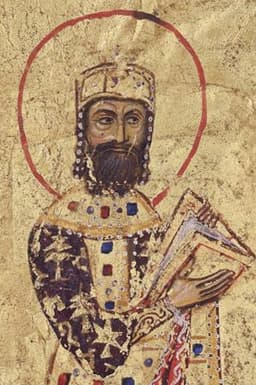
Alexios I Komnenos
Emperor · Medieval
78.4Total

King David
Emperor · Ancient
75.3Total
Basic Information
Born
1048
-1010
Died
1118
-970
Era
Medieval
Ancient
Nationality
Byzantine Empire
Israel
Occupation
Emperor
Emperor
Civilization
Western
Middle Eastern
Score Comparison
Military (10%)
61.7
72.0
Political (20%)
78.0
72.0
Influence (20%)
88.0
88.0
Legacy (20%)
80.0
70.0
Leadership (15%)
78.0
72.0
Strategy (15%)
68.0
70.0
TOTAL
78.4
75.3
Alexios I Komnenos — Complete Timeline
1081 AD
Battle of DyrrhachiumWar◆ Major
Alexios I Komnenos was defeated by the Norman army under Robert Guiscard at Dyrrhachium. The Byzantine forces were routed, and Alexios barely escaped. This loss allowed the Normans to occupy much of the western Balkans, though Alexios later recovered some territory.
Norman InvasionDefeatBalkans
Impact: regionaltragic
1090 AD
Reforms of the Byzantine Military and EconomyReform◆ Major
Alexios I implemented a series of reforms to restore Byzantine power. He reorganized the army by relying more on foreign mercenaries, reformed the currency (the hyperpyron), and granted tax exemptions to the Church. These measures stabilized the empire after decades of decline.
Military ReformEconomic ReformKomnenian Restoration
Impact: nationalconstructive
1095 AD
Appeal to the West: Council of PiacenzaPolitical Action
Alexios I sent envoys to Pope Urban II at the Council of Piacenza, requesting military aid against the Seljuk Turks. This appeal contributed to Urban's call for the First Crusade at the Council of Clermont later that year, initiating the Crusader movement.
First CrusadePope Urban IISeljuk Turks
Impact: global
1097 AD
First Crusade: Siege of NicaeaWar◆ Major
Alexios I cooperated with the Crusader army to besiege and capture Nicaea from the Seljuk Turks. The city was surrendered to Byzantine control, and Alexios used the Crusaders to recover key territories in Anatolia, though tensions later arose over land claims.
First CrusadeNicaeaByzantine-Crusader Relations
Impact: regionalconstructive
King David — Complete Timeline
1010 BC
Anointed as King of JudahPolitical Action◆ Major
After Saul's death, David was anointed king over the tribe of Judah at Hebron. This began a seven-year period of civil war with Ish-bosheth, Saul's son, who ruled the northern tribes, leading to the eventual unification of Israel.
KingshipCivil WarJudah
Impact: national
1003 BC
Capture of JerusalemWar
David led his army to capture the Jebusite fortress of Jerusalem, making it the capital of the united kingdom. He brought the Ark of the Covenant there, establishing the city as both the political and religious center of Israel.
JerusalemCapitalArk of the Covenant
Impact: nationalconstructive
1000 BC
Defeat of the PhilistinesWar◆ Major
David fought several campaigns that decisively defeated the Philistines, including the Battle of Baal-perazim. He captured Gath and other Philistine strongholds, ending their dominance over Israel and securing the kingdom's borders.
PhilistinesMilitary CampaignIsrael
Impact: regional
990 BC
Affair with BathshebaPolitical Action◆ Major
David committed adultery with Bathsheba and arranged the death of her husband Uriah the Hittite in battle. The prophet Nathan confronted David, leading to his repentance but also to divine punishment, including the death of their first child.
ScandalBathshebaNathan
Impact: nationaldestructive
978 BC
Revolt of AbsalomWar◆ Major
David's son Absalom led a rebellion that forced David to flee Jerusalem. David's forces under Joab defeated Absalom's army in the Forest of Ephraim, and Absalom was killed. David returned to Jerusalem but the kingdom was weakened.
RebellionCivil WarAbsalom
Impact: nationaltragic
Expert Analysis
Origins
Alexios I Komnenos (c. 1048–1118) was born into a noble Byzantine family during a period of military decline and external threats. His parents were John Komnenos and Anna Dalassene, and he rose through the ranks as a general under emperors Michael VII and Nikephoros III. In contrast, King David (c. 1040–970 BCE) was the youngest son of Jesse, a shepherd from Bethlehem, anointed by the prophet Samuel while still a youth. David's humble beginnings contrast sharply with Alexios's aristocratic birth, yet both were thrust into leadership during turbulent times.
Rise to Power
Alexios seized the throne in 1081 through a military coup, deposing Nikephoros III. He faced immediate crises: Norman invasions from the west and Seljuk Turk encroachment from the east. Alexios skillfully navigated these threats, but his most consequential move was appealing to Pope Urban II at the Council of Piacenza in 1095, which sparked the First Crusade. David's rise was more dramatic: after slaying Goliath, he became a favored courtier of King Saul, then a fugitive, and eventually king of Judah. He united the tribes of Israel, captured Jerusalem from the Jebusites, and made it his capital. Both rulers demonstrated cunning and patience in attaining power.
Leadership & Governance
Alexios reformed the Byzantine military and economy, strengthening the empire's defenses and stabilizing the currency. He introduced the pronoia system, granting land in exchange for military service, and rebuilt the navy. However, his reliance on Crusader armies created long-term tensions. David established a centralized monarchy, organized a professional army, and expanded Israel's borders. He brought the Ark of the Covenant to Jerusalem, cementing its religious significance. Both were effective administrators, but Alexios's reforms were more structural and lasting.
Triumph & Tragedy
Alexios's greatest triumph was surviving the First Crusade, using the Crusaders to reclaim Nicaea and much of Asia Minor. Yet his victory was bittersweet: the Crusaders' subsequent atrocities and establishment of Crusader states strained Byzantine relations. His tragedy included the Battle of Dyrrhachium (1081), where he was defeated by Normans, and the ongoing threat from the West. David's triumph was capturing Jerusalem and defeating the Philistines, but his affair with Bathsheba and the subsequent revolt of his son Absalom brought personal and political turmoil. Both leaders faced devastating rebellions from within their families.
Character & Destiny
Alexios was pragmatic, diplomatic, and deeply religious, often portrayed as a master strategist who held the empire together through sheer will. David was a complex figure: a warrior, poet, and sinner who repented deeply. His Psalms reflect a soul in turmoil. Alexios's destiny was to restore Byzantine power temporarily, while David's destiny was to establish an eternal dynasty, culminating in messianic prophecy. Both were flawed but driven by a sense of divine purpose.
Legacy
Alexios founded the Komnenian dynasty, which restored Byzantine prestige for a century. His appeal to the West inadvertently launched the Crusades, reshaping medieval history. David is revered as Israel's greatest king, the author of Psalms, and the ancestor of Jesus. His legacy is both historical and theological. In terms of direct impact, Alexios's actions had immediate and far-reaching consequences for Europe and the Middle East, while David's legacy is more symbolic and enduring.
Conclusion
Scores: Alexios I Komnenos (M=62, P=78, I=88, L=80, D=78, S=68, T=78) vs King David (M=72, P=72, I=88, L=70, D=72, S=70, T=75). The overall score gap is 3.1 in favor of Alexios. While David excels in military might and charisma, Alexios's intellectual and leadership scores edge ahead. Alexios's ability to navigate the complex geopolitics of his era and initiate the Crusades gives him a slight advantage in historical significance. Therefore, Alexios I Komnenus is the greater ruler in terms of tangible impact on world history.
Rankings
🥇
Alexios I KomnenosLeader
Mil: 61.7Pol: 78.0Inf: 88.0
78.4
🥈
King David
Mil: 72.0Pol: 72.0Inf: 88.0
75.3
+3.1 behind
How This Comparison Works
Algorithm
Each figure is scored on 6 dimensions (0—100 scale) based on structured historical data: Military (10%), Political (20%), Influence (20%), Legacy (20%), Leadership (15%), Strategy (15%). The weighted total produces the final ranking.
Data Sources
Scores are computed from structured sub-indicators in the database. Scale factors adjust for era (Ancient ×0.85, Modern ×1.0) and civilization size (Eastern ×1.05, Other ×0.80) to account for differences in population and military scale.
Maximum 3 Figures
Comparisons are limited to 2—3 figures to ensure readability and statistical meaningfulness.
Error Margins
±5 points per dimension — Sub-scores are derived from historical records with inherent uncertainty. Two figures within 5 points on a dimension should be considered roughly equivalent in that area.
Total Score Accuracy
±3 points overall — The weighted combination of 6 dimensions produces a total score with approximately ±3 points of uncertainty. Differences of less than 3 points are not statistically significant— the figures are effectively tied.
Known Limitations
- Historical records are incomplete and uneven across civilizations
- Figures from oral-tradition societies may be underrepresented
- Occupation labels can misclassify multi-role figures
- Scores measure capability and impact, not moral character
- Quantitative scoring is a comparison tool, not absolute truth
Capability Radar
Military (10%) — Battles & Warfare
Battles
75
75
Win Rate
70
85
Expansion
60
80
Political (20%) — Governance & Reform
Reform
85
80
Diplomacy
90
75
Economy
70
70
Influence (20%) — Cultural & Global Reach
Cultural
70
95
Global
75
90
Legacy (20%) — Historical Impact
Historical
85
95
Longevity
80
95
Leadership (15%) — Power & Stability
Tenure
80
85
Stability
75
65
Strategy (15%) — Tactics & Innovation
Strategy
85
85
Tactics
80
80
Reform
75
70
Similar Comparisons
Comments & Discussion
No comments yet. Be the first to share your thoughts!