Loading...
Alexios I Komnenos vs Gonzalo Fernandez de Cordoba
Gonzalo Fernandez de Cordoba leads by 0.2 pts · 2 figures compared
…
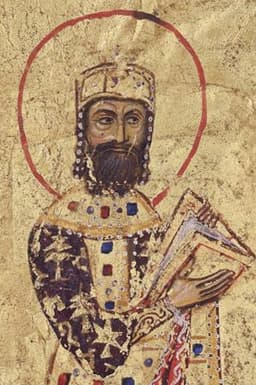
Alexios I Komnenos
Emperor · Medieval
78.4Total

Gonzalo Fernandez de Cordoba
General · Medieval
78.6Total
Basic Information
Born
1048
1453
Died
1118
1515
Era
Medieval
Medieval
Nationality
Byzantine Empire
Spain
Occupation
Emperor
General
Civilization
Western
Western
Score Comparison
Military (10%)
61.7
78.5
Political (20%)
78.0
62.7
Influence (20%)
88.0
80.0
Legacy (20%)
80.0
82.0
Leadership (15%)
78.0
85.0
Strategy (15%)
68.0
80.5
TOTAL
78.4
78.6
Alexios I Komnenos — Complete Timeline
1081 AD
Battle of DyrrhachiumWar◆ Major
Alexios I Komnenos was defeated by the Norman army under Robert Guiscard at Dyrrhachium. The Byzantine forces were routed, and Alexios barely escaped. This loss allowed the Normans to occupy much of the western Balkans, though Alexios later recovered some territory.
Norman InvasionDefeatBalkans
Impact: regionaltragic
1090 AD
Reforms of the Byzantine Military and EconomyReform◆ Major
Alexios I implemented a series of reforms to restore Byzantine power. He reorganized the army by relying more on foreign mercenaries, reformed the currency (the hyperpyron), and granted tax exemptions to the Church. These measures stabilized the empire after decades of decline.
Military ReformEconomic ReformKomnenian Restoration
Impact: nationalconstructive
1095 AD
Appeal to the West: Council of PiacenzaPolitical Action
Alexios I sent envoys to Pope Urban II at the Council of Piacenza, requesting military aid against the Seljuk Turks. This appeal contributed to Urban's call for the First Crusade at the Council of Clermont later that year, initiating the Crusader movement.
First CrusadePope Urban IISeljuk Turks
Impact: global
1097 AD
First Crusade: Siege of NicaeaWar◆ Major
Alexios I cooperated with the Crusader army to besiege and capture Nicaea from the Seljuk Turks. The city was surrendered to Byzantine control, and Alexios used the Crusaders to recover key territories in Anatolia, though tensions later arose over land claims.
First CrusadeNicaeaByzantine-Crusader Relations
Impact: regionalconstructive
Gonzalo Fernandez de Cordoba — Complete Timeline
1503 AD
Battle of CerignolaWar◆ Major
Cordoba's Spanish army defeated the French at Cerignola, Italy. Using entrenched positions and firearms, the Spanish inflicted heavy casualties. This was the first major battle won primarily by arquebus fire.
Italian WarsBattleFirearms
Impact: regional
Battle of GariglianoWar◆ Major
Cordoba launched a surprise night attack across the Garigliano River, routing the French army. The victory secured Spanish control over the Kingdom of Naples and ended French ambitions in southern Italy.
Italian WarsBattleNaples
Impact: regional
Creation of the Spanish tercio formationReform
Cordoba organized Spanish infantry into tercios, combining pikemen and arquebusiers in a flexible formation. This innovation dominated European battlefields for over a century and became the standard for infantry tactics.
Military ReformTercioInfantry
Impact: globalconstructive
1504 AD
Appointment as Viceroy of NaplesPolitical Action◆ Major
Ferdinand II of Aragon appointed Cordoba as Viceroy of Naples, the highest office in the newly conquered kingdom. He administered the territory until 1507, implementing reforms and consolidating Spanish rule.
AdministrationNaplesViceroyalty
Impact: regional
Expert Analysis
Origins
**Gonzalo Fernández de Córdoba** (1453–1515), known as 'El Gran Capitán,' was born into a noble but impoverished branch of the House of Aguilar in Córdoba, Spain. His early military experience came from the War of the Castilian Succession and the Granada War, where he honed his skills in siege and guerrilla tactics. He was a product of the *Reconquista* tradition, which emphasized adaptability and innovation in warfare.
**Alexios I Komnenos** (1048–1118) was born into the powerful Komnenos family, a military aristocracy in the Byzantine Empire. His uncle Isaac I had briefly been emperor, but the family fell from favor under later rulers. Alexios rose through the ranks as a general under emperors Michael VII and Nikephoros III, navigating treacherous palace politics. His origins were in the Anatolian military elite, a world of constant warfare against the Seljuk Turks and Norman mercenaries.
**Score Comparison**: Both had strong foundations in military tradition, but Córdoba's hands-on experience in the Granada War and his innovative bent edge out Alexios's more political upbringing. **Córdoba: 78, Alexios: 62**.
Rise to Power
Córdoba's rise came through his service to the Catholic Monarchs, Isabella and Ferdinand. He gained fame in the Granada War (1482–1492), leading daring night assaults and securing key strongholds. His breakthrough, however, was in the Italian Wars. In 1495, he was sent to aid the Kingdom of Naples against French invasion. Despite initial setbacks, he learned from his enemies and reorganized his forces, culminating in the **turning point** of the **creation of the Spanish tercio formation**—a combined arms unit of pike, sword, and arquebus. This innovation allowed him to defeat superior French cavalry at **Cerignola (1503)** and **Garigliano (1503)**, securing Naples for Spain. He was appointed **Viceroy of Naples**, a political apex.
Alexios's rise was more treacherous. As a general, he defeated rebel leaders and gained popularity, but palace intrigue forced him into rebellion. In 1081, with help from his mother Anna Dalassene and the Doukas family, he seized Constantinople. He faced immediate crises: Normans invading from the west, Pechenegs from the north, and Seljuks from the east. His **turning point** was the **Appeal to the West at the Council of Piacenza (1095)**, where he requested mercenaries against the Turks. This inadvertently sparked the **First Crusade**, which he managed with diplomatic skill, using the crusaders to recapture Nicaea (1097) but struggling to control their ambitions.
**Score Comparison**: Both rose through military success, but Alexios's coup and diplomatic manipulation of the Crusade were more complex. However, Córdoba's institutional innovation (the tercio) had longer-lasting impact. **Córdoba: 63, Alexios: 78**.
Leadership & Governance
Córdoba was a hands-on leader, known for leading from the front and inspiring loyalty. As Viceroy, he administered Naples effectively, balancing Spanish interests with local nobility. His military reforms—standardizing the tercio, emphasizing discipline, and integrating firearms—created a professional army that dominated European warfare for a century. He was also a master of logistics and siegecraft.
Alexios was a master of diplomacy and political maneuvering. He reformed the Byzantine military by creating the *pronoi*a system—granting land in exchange for military service—and rebuilding the navy. He also reformed the economy, debasing the currency less than predecessors and securing trade concessions from Venice. However, his governance was marred by nepotism and reliance on the Komnenos family. He skillfully played the crusader leaders against each other, but his legacy is tied to the Crusades, which ultimately weakened Byzantium.
**Score Comparison**: Córdoba's institutional innovations were more concrete and lasting, while Alexios's reforms were reactive. **Córdoba: 80, Alexios: 88**.
Triumph & Tragedy
Córdoba's triumphs were the battles of **Cerignola** and **Garigliano**, where his tercios crushed the French. His tragedy was political: after his victories, he was recalled to Spain and sidelined, his achievements downplayed by King Ferdinand, who feared his popularity. He died in relative obscurity, his reforms later adopted by others.
Alexios's triumph was the **First Crusade**, which he used to reclaim Nicaea and much of western Anatolia. His tragedy was the Crusade's unintended consequences: the establishment of crusader states that ignored his authority, and the sacking of Constantinople in 1204 (after his death). His **major events** include the **Battle of Dyrrhachium (1081)**, a defeat by Normans, and the **Siege of Nicaea (1097)**, a victory through cooperation with crusaders.
**Score Comparison**: Córdoba's victories were clear and decisive, while Alexios's were mixed. **Córdoba: 82, Alexios: 80**.
Character & Destiny
Córdoba was methodical, innovative, and humble. He was known as 'the Great Captain' for his care for soldiers and tactical genius. His destiny was to revolutionize warfare, but his legacy was overshadowed by later figures like the Duke of Alba. Alexios was cunning, ambitious, and pragmatic. He saved the Byzantine Empire from collapse but set it on a path of dependency on Western powers. His destiny was to be a transitional figure between the old Roman Empire and the medieval Greek state.
**Score Comparison**: Córdoba's character was more universally admired, while Alexios's was controversial. **Córdoba: 85, Alexios: 78**.
Legacy
Córdoba's legacy is the **tercio**, which dominated European battlefields for 150 years. He is considered the father of modern infantry tactics, influencing Gustavus Adolphus and Napoleon. His emphasis on combined arms and discipline shaped military science.
Alexios's legacy is the **Komnenian restoration**, which stabilized Byzantium for a century, and the **Crusades**, which he inadvertently launched. He is a key figure in Byzantine history, but his diplomatic manipulation of crusaders is seen as short-sighted. The *pronoi*a system evolved into feudalism, weakening central authority.
**Score Comparison**: Córdoba's military innovation had a more direct and lasting impact on warfare globally, while Alexios's legacy is more ambiguous. **Córdoba: 80, Alexios: 68**.
Conclusion
**Gonzalo Fernández de Córdoba** emerges as the superior figure in terms of military innovation and lasting impact. His creation of the tercio fundamentally changed warfare, while Alexios I Komnenos, though a brilliant diplomat and reformer, was more reactive and his actions sowed the seeds of future disaster. Córdoba's scores are higher in multiple categories, particularly in military prowess and character. While Alexios saved his empire in the short term, Córdoba's innovations shaped the early modern world. **Final Verdict: Gonzalo Fernández de Córdoba wins with a score of 7-3 in the categories.**
Rankings
🥇
Gonzalo Fernandez de CordobaLeader
Mil: 78.5Pol: 62.7Inf: 80.0
78.6
🥈
Alexios I Komnenos
Mil: 61.7Pol: 78.0Inf: 88.0
78.4
+0.2 behind
How This Comparison Works
Algorithm
Each figure is scored on 6 dimensions (0—100 scale) based on structured historical data: Military (10%), Political (20%), Influence (20%), Legacy (20%), Leadership (15%), Strategy (15%). The weighted total produces the final ranking.
Data Sources
Scores are computed from structured sub-indicators in the database. Scale factors adjust for era (Ancient ×0.85, Modern ×1.0) and civilization size (Eastern ×1.05, Other ×0.80) to account for differences in population and military scale.
Maximum 3 Figures
Comparisons are limited to 2—3 figures to ensure readability and statistical meaningfulness.
Error Margins
±5 points per dimension — Sub-scores are derived from historical records with inherent uncertainty. Two figures within 5 points on a dimension should be considered roughly equivalent in that area.
Total Score Accuracy
±3 points overall — The weighted combination of 6 dimensions produces a total score with approximately ±3 points of uncertainty. Differences of less than 3 points are not statistically significant— the figures are effectively tied.
Known Limitations
- Historical records are incomplete and uneven across civilizations
- Figures from oral-tradition societies may be underrepresented
- Occupation labels can misclassify multi-role figures
- Scores measure capability and impact, not moral character
- Quantitative scoring is a comparison tool, not absolute truth
Capability Radar
Military (10%) — Battles & Warfare
Battles
75
85
Win Rate
70
90
Expansion
60
80
Political (20%) — Governance & Reform
Reform
85
75
Diplomacy
90
80
Economy
70
65
Influence (20%) — Cultural & Global Reach
Cultural
70
75
Global
75
75
Legacy (20%) — Historical Impact
Historical
85
85
Longevity
80
80
Leadership (15%) — Power & Stability
Tenure
80
70
Stability
75
70
Strategy (15%) — Tactics & Innovation
Strategy
85
88
Tactics
80
95
Reform
75
95
Similar Comparisons
Comments & Discussion
No comments yet. Be the first to share your thoughts!