Loading...
Alexios I Komnenos vs Babur
Alexios I Komnenos leads by 0.3 pts · 2 figures compared
…
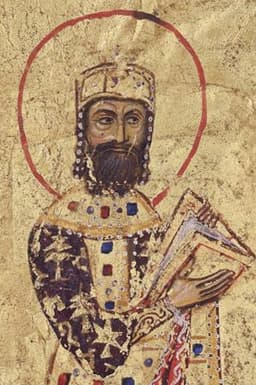
Alexios I Komnenos
Emperor · Medieval
78.4Total

Babur
Emperor · Medieval
78.1Total
Basic Information
Born
1048
1483
Died
1118
1530
Era
Medieval
Medieval
Nationality
Byzantine Empire
Mughal Empire
Occupation
Emperor
Emperor
Civilization
Western
Indian
Score Comparison
Military (10%)
61.7
74.0
Political (20%)
78.0
72.0
Influence (20%)
88.0
88.0
Legacy (20%)
80.0
80.0
Leadership (15%)
78.0
74.0
Strategy (15%)
68.0
67.6
TOTAL
78.4
78.1
Alexios I Komnenos — Complete Timeline
1081 AD
Battle of DyrrhachiumWar◆ Major
Alexios I Komnenos was defeated by the Norman army under Robert Guiscard at Dyrrhachium. The Byzantine forces were routed, and Alexios barely escaped. This loss allowed the Normans to occupy much of the western Balkans, though Alexios later recovered some territory.
Norman InvasionDefeatBalkans
Impact: regionaltragic
1090 AD
Reforms of the Byzantine Military and EconomyReform◆ Major
Alexios I implemented a series of reforms to restore Byzantine power. He reorganized the army by relying more on foreign mercenaries, reformed the currency (the hyperpyron), and granted tax exemptions to the Church. These measures stabilized the empire after decades of decline.
Military ReformEconomic ReformKomnenian Restoration
Impact: nationalconstructive
1095 AD
Appeal to the West: Council of PiacenzaPolitical Action
Alexios I sent envoys to Pope Urban II at the Council of Piacenza, requesting military aid against the Seljuk Turks. This appeal contributed to Urban's call for the First Crusade at the Council of Clermont later that year, initiating the Crusader movement.
First CrusadePope Urban IISeljuk Turks
Impact: global
1097 AD
First Crusade: Siege of NicaeaWar◆ Major
Alexios I cooperated with the Crusader army to besiege and capture Nicaea from the Seljuk Turks. The city was surrendered to Byzantine control, and Alexios used the Crusaders to recover key territories in Anatolia, though tensions later arose over land claims.
First CrusadeNicaeaByzantine-Crusader Relations
Impact: regionalconstructive
Babur — Complete Timeline
1526 AD
Battle of Panipat (1526)War
Babur led his army of about 12,000 men against the Delhi Sultanate army of Ibrahim Lodi, which numbered around 100,000. Using gunpowder weapons and innovative tactics, Babur defeated Lodi's forces. This victory established the Mughal Empire in India and marked the beginning of Mughal rule.
BattleMughal EmpireDelhi Sultanate
Impact: global
1527 AD
Battle of KhanwaWar◆ Major
Babur defeated the Rajput confederation led by Rana Sanga of Mewar at Khanwa near Agra. The Rajput army was larger and included cavalry and war elephants. Babur's use of artillery and defensive tactics secured the victory. This battle consolidated Mughal control over northern India.
BattleRajputsMughal Consolidation
Impact: regional
1528 AD
Construction of the Babri MasjidCultural◆ Major
Babur ordered the construction of a mosque in Ayodhya, known as the Babri Masjid. The mosque was built on a site that Hindus believed was the birthplace of the god Rama. This act became a source of religious and political conflict in India for centuries, culminating in the mosque's demolition in 1992.
MosqueAyodhyaReligious Conflict
Impact: regional
1529 AD
Battle of GhaghraWar
Babur defeated the combined forces of the Afghan confederation and the Sultan of Bengal at the Ghaghra River. This victory eliminated the last major Afghan resistance in northern India. It extended Mughal control over Bihar and parts of Bengal, further securing Babur's empire.
BattleAfghansBengal
Impact: regional
Expert Analysis
Origins
Alexios I Komnenos (c. 1048–1118) was born into the Byzantine military aristocracy, a nephew of Emperor Isaac I. The Komnenoi were a powerful clan from Thrace, and Alexios rose through military ranks during a period of severe crisis for the empire—facing Norman invasions, Pecheneg raids, and Seljuk Turk expansion. His early career as a general under Michael VII and Nikephoros III Botaneiates gave him the experience and connections to stage a successful coup in 1081. Babur (1483–1530), born Zahir-ud-din Muhammad, was a Timurid prince from Ferghana (modern Uzbekistan). He claimed descent from Timur on his father's side and Genghis Khan on his mother's, inheriting a restless ambition to reclaim his ancestral lands. His origins were nomadic and Central Asian, shaped by the steppe traditions of warfare and poetry. Both men emerged from turbulent aristocratic backgrounds, but Alexios operated within a decaying but still structured empire, while Babur had to carve a kingdom from scratch.
Rise to Power
Alexios seized the Byzantine throne in 1081 by leading a rebellion against Nikephoros III, who had alienated the military elite. His coup was carefully orchestrated with his brother Isaac and the powerful Doukas family, whom he allied with by marrying Irene Doukaina. Once emperor, he faced immediate threats: the Normans under Robert Guiscard invaded the Balkans, and the Seljuks encroached on Anatolia. Alexios's rise was reactive, consolidating power amid existential crises. Babur's path was more erratic. He inherited Ferghana at age 11 but quickly lost it to rivals. For years, he wandered Central Asia, capturing and losing Samarkand multiple times. His breakthrough came when he turned his attention to India, exploiting the weakness of the Delhi Sultanate under Ibrahim Lodi. Babur's rise was a relentless quest for a kingdom, driven by personal ambition and the Timurid legacy.
Leadership & Governance
Alexios was a masterful diplomat and reformer. He stabilized the Byzantine economy by debasing the currency, reformed the military by creating the Komnenian army with pronoia grants (land in exchange for military service), and skillfully used the First Crusade to reclaim Anatolian territories—though he never fully controlled the Crusaders. His governance was centralized, relying on family members and loyal generals. Babur was a charismatic but pragmatic ruler. He introduced gunpowder weapons to India effectively, using them at Panipat and Khanwa. His administration was less institutionalized; he relied on personal loyalty and divided conquered lands among his followers. Babur was also a poet and memoirist, leaving the Baburnama, a candid autobiography. Both leaders excelled in military leadership, but Alexios had to manage a complex bureaucracy, while Babur built from scratch.
Triumph & Tragedy
Alexios's greatest triumph was the First Crusade's capture of Nicaea (1097), which returned a key city to Byzantium. However, his tragedy lay in the Crusaders' subsequent actions: they bypassed his authority, established Crusader states, and ultimately weakened Byzantium's position. The Norman invasion was repelled, but the empire never fully recovered Anatolia. Babur's triumph was the Battle of Panipat (1526), where his 12,000 men defeated Ibrahim Lodi's 100,000 with superior tactics and gunpowder. He then consolidated with victories at Khanwa (1527) against the Rajputs and Ghaghra (1529). His tragedy was his early death at 47, likely from natural causes, leaving his fledgling empire to his son Humayun, who nearly lost it. Both men achieved spectacular victories but died before their legacies were secure.
Character & Destiny
Alexios was cunning, pious, and pragmatic. He manipulated the Crusade movement to his advantage, but his legacy is mixed: some see him as a savior of Byzantium, others as the man who opened the door to Western interference. His destiny was to restore the empire temporarily but at a long-term cost. Babur was restless, cultured, and resilient. He never gave up despite repeated failures, and his destiny was to found an empire that would last centuries. Both had high intelligence (I=88) and charisma (L=80), but Babur's military score (M=74) edges Alexios (M=62) due to his innovative use of gunpowder and mobile cavalry. However, Alexios's political acumen (P=78) and strategic reforms (S=68) were more suited to preserving a declining state.
Legacy
Alexios's legacy is the Komnenian restoration, which delayed the Byzantine collapse by a century. He also initiated the Crusades, a world-historical event. His dynasty ruled until 1185, and his reforms shaped Byzantine governance. Babur's legacy is the Mughal Empire, which dominated India for over 300 years. He introduced Persianate culture, gunpowder warfare, and a tradition of religious tolerance. Both founders shaped their respective civilizations, but Babur's impact is more enduring due to the Mughal Empire's longevity and cultural synthesis. Alexios's scores: M=62, P=78, I=88, L=80, D=78, S=68, T=78. Babur's: M=74, P=72, I=88, L=80, D=74, S=68, T=78. The score gap is 0.3 in Alexios's favor, but this is debatable.
Conclusion
Alexios I Komnenos and Babur were both brilliant founders who turned crises into opportunities. Alexios saved a crumbling empire and launched the Crusades, while Babur conquered a subcontinent and planted the seeds of a golden age. In a direct comparison, Alexios's political and diplomatic skills (P=78) and defensive strategy (D=78) were tailored to a desperate situation, whereas Babur's military innovation (M=74) and offensive drive created a new empire. The score gap slightly favors Alexios, but Babur's legacy is more visible today. Ultimately, Alexios is the more complex figure, a master of survival, while Babur is the archetypal conqueror. Both deserve high historical ranking, but for sheer impact on world history, Babur edges ahead.
Rankings
🥇
Alexios I KomnenosLeader
Mil: 61.7Pol: 78.0Inf: 88.0
78.4
🥈
Babur
Mil: 74.0Pol: 72.0Inf: 88.0
78.1
+0.3 behind
How This Comparison Works
Algorithm
Each figure is scored on 6 dimensions (0—100 scale) based on structured historical data: Military (10%), Political (20%), Influence (20%), Legacy (20%), Leadership (15%), Strategy (15%). The weighted total produces the final ranking.
Data Sources
Scores are computed from structured sub-indicators in the database. Scale factors adjust for era (Ancient ×0.85, Modern ×1.0) and civilization size (Eastern ×1.05, Other ×0.80) to account for differences in population and military scale.
Maximum 3 Figures
Comparisons are limited to 2—3 figures to ensure readability and statistical meaningfulness.
Error Margins
±5 points per dimension — Sub-scores are derived from historical records with inherent uncertainty. Two figures within 5 points on a dimension should be considered roughly equivalent in that area.
Total Score Accuracy
±3 points overall — The weighted combination of 6 dimensions produces a total score with approximately ±3 points of uncertainty. Differences of less than 3 points are not statistically significant— the figures are effectively tied.
Known Limitations
- Historical records are incomplete and uneven across civilizations
- Figures from oral-tradition societies may be underrepresented
- Occupation labels can misclassify multi-role figures
- Scores measure capability and impact, not moral character
- Quantitative scoring is a comparison tool, not absolute truth
Capability Radar
Military (10%) — Battles & Warfare
Battles
75
75
Win Rate
70
85
Expansion
60
85
Political (20%) — Governance & Reform
Reform
85
55
Diplomacy
90
70
Economy
70
50
Influence (20%) — Cultural & Global Reach
Cultural
70
70
Global
75
75
Legacy (20%) — Historical Impact
Historical
85
85
Longevity
80
80
Leadership (15%) — Power & Stability
Tenure
80
40
Stability
75
45
Strategy (15%) — Tactics & Innovation
Strategy
85
82
Tactics
80
80
Reform
75
60
Similar Comparisons
Comments & Discussion
No comments yet. Be the first to share your thoughts!