Loading...
Alexios I Komnenos vs Augustus
Augustus leads by 7.5 pts · 2 figures compared
…
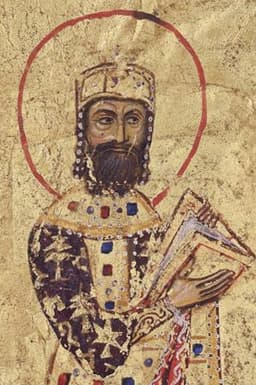
Alexios I Komnenos
Emperor · Medieval
78.4Total

Augustus
Emperor · Ancient
85.9Total
Basic Information
Born
1048
63
Died
1118
—
Era
Medieval
Ancient
Nationality
Byzantine Empire
Roman Empire
Occupation
Emperor
Emperor
Civilization
Western
Western
Score Comparison
Military (10%)
61.7
72.0
Political (20%)
78.0
90.0
Influence (20%)
88.0
88.0
Legacy (20%)
80.0
90.0
Leadership (15%)
78.0
88.0
Strategy (15%)
68.0
75.0
TOTAL
78.4
85.9
Alexios I Komnenos — Complete Timeline
1081 AD
Battle of DyrrhachiumWar◆ Major
Alexios I Komnenos was defeated by the Norman army under Robert Guiscard at Dyrrhachium. The Byzantine forces were routed, and Alexios barely escaped. This loss allowed the Normans to occupy much of the western Balkans, though Alexios later recovered some territory.
Norman InvasionDefeatBalkans
Impact: regionaltragic
1090 AD
Reforms of the Byzantine Military and EconomyReform◆ Major
Alexios I implemented a series of reforms to restore Byzantine power. He reorganized the army by relying more on foreign mercenaries, reformed the currency (the hyperpyron), and granted tax exemptions to the Church. These measures stabilized the empire after decades of decline.
Military ReformEconomic ReformKomnenian Restoration
Impact: nationalconstructive
1095 AD
Appeal to the West: Council of PiacenzaPolitical Action
Alexios I sent envoys to Pope Urban II at the Council of Piacenza, requesting military aid against the Seljuk Turks. This appeal contributed to Urban's call for the First Crusade at the Council of Clermont later that year, initiating the Crusader movement.
First CrusadePope Urban IISeljuk Turks
Impact: global
1097 AD
First Crusade: Siege of NicaeaWar◆ Major
Alexios I cooperated with the Crusader army to besiege and capture Nicaea from the Seljuk Turks. The city was surrendered to Byzantine control, and Alexios used the Crusaders to recover key territories in Anatolia, though tensions later arose over land claims.
First CrusadeNicaeaByzantine-Crusader Relations
Impact: regionalconstructive
Augustus — Complete Timeline
43 BC
Formation of the Second TriumviratePolitical Action◆ Major
Octavian, Mark Antony, and Marcus Aemilius Lepidus formed the Second Triumvirate, a legal commission to govern the Roman Republic. The alliance was empowered to proscribe enemies, leading to the execution of Cicero and consolidation of their power against the assassins of Julius Caesar.
Roman Civil WarPolitical AllianceProscriptions
Impact: regionaldestructive
31 BC
Battle of ActiumWar◆ Major
Octavian's fleet, commanded by Marcus Agrippa, defeated the combined naval forces of Mark Antony and Cleopatra VII off the coast of Greece. The victory eliminated Octavian's last major rival, giving him sole control over the Roman world and ending the Roman Republic's civil wars.
Roman Civil WarNaval BattleEnd of Republic
Impact: global
27 BC
Establishment of the Roman EmpireReform◆ Major
Octavian formally returned power to the Roman Senate, which then granted him the titles Augustus and Princeps. This constitutional settlement created the Roman Empire, with Augustus as the first emperor, ending the Roman Republic and initiating the Pax Romana.
Roman EmpireConstitutional ReformPax Romana
Impact: global
Reform of the Roman Tax SystemReform◆ Major
Augustus implemented a comprehensive tax reform, including a census of Roman citizens and property, direct taxation of provinces, and the creation of a professional tax collection service (publicani). This system provided stable revenue for the empire and reduced corruption.
Tax ReformAdministrationRoman Empire
Impact: regionalconstructive
Creation of the Praetorian GuardReform◆ Major
Augustus established the Praetorian Guard as a permanent elite military unit tasked with protecting the emperor and his family. Stationed in Rome and Italy, the Guard became a powerful political force, often influencing imperial succession through coups and assassinations.
Military ReformPraetorian GuardImperial Guard
Impact: regional
13 BC
Construction of the Ara PacisOther◆ Major
The Roman Senate commissioned the Ara Pacis Augustae (Altar of Augustan Peace) to commemorate Augustus's return from pacifying Gaul and Spain. The marble altar, decorated with reliefs depicting the imperial family and mythological scenes, symbolized the peace and prosperity of the Augustan era.
Building ProjectPropagandaAugustan Art
Impact: regionalconstructive
Expert Analysis
Origins
Augustus, born Gaius Octavius in 63 BC, was the grandnephew and adopted son of Julius Caesar. His rise came from a precarious position as a young heir in a Rome torn by civil war. Alexios I Komnenos, born in 1048, emerged from the Byzantine military aristocracy; his family had previously held the throne, but he seized power through a coup against the weak Emperor Nikephoros III. Both men inherited crumbling states: Augustus faced the aftermath of Caesar's assassination and the Second Triumvirate's infighting; Alexios confronted the disastrous Battle of Manzikert (1071) and Norman invasions.
Rise to Power
Augustus formed the Second Triumvirate with Mark Antony and Lepidus, proscribed enemies, and defeated Caesar's assassins at Philippi. He then turned on Antony, culminating in the naval Battle of Actium (31 BC) and the conquest of Egypt. By 27 BC, he masterfully returned power to the Senate while retaining control, becoming Augustus. Alexios I, a capable general, led a rebellion against Nikephoros III, entering Constantinople in 1081. He faced immediate crises: the Norman invasion under Robert Guiscard, which he barely repelled at Dyrrhachium (1081), and the Pecheneg threat. Unlike Augustus, Alexios seized power through force, not inheritance.
Leadership & Governance
Augustus reformed every aspect of Roman governance: he established the Principate, created the Praetorian Guard, reformed the tax system, and initiated a vast building program (e.g., the Forum of Augustus). His rule brought the Pax Romana, a period of relative peace. Alexios I, though less institutionally innovative, stabilized the Byzantine Empire. He reformed the military by creating the Komnenian army, based on pronoia grants, and revitalized the economy. He also appealed to the West at the Council of Piacenza (1095), inadvertently sparking the First Crusade. While Augustus built durable institutions, Alexios's reforms were more reactive.
Triumph & Tragedy
Augustus's triumph was the establishment of a stable empire that lasted centuries; his tragedy was the loss of his beloved grandsons and heir, leading to the problematic succession of Tiberius. Alexios's triumph was the successful management of the First Crusade, which recovered Nicaea (1097) and much of Anatolia for Byzantium. His tragedy was the long-term consequences of Crusader presence, including the establishment of Crusader states that later turned against Byzantium. Both men died with mixed legacies: Augustus as a revered founder, Alexios as a savior who inadvertently sowed future conflict.
Character & Destiny
Augustus was calculating, patient, and ruthlessly political. He knew how to wield soft power, presenting himself as a restorer of the Republic while accumulating absolute control. His destiny was to found an empire. Alexios was a pragmatic survivor, often outmaneuvered militarily but diplomatically astute. He faced constant existential threats and died exhausted from decades of crisis. Augustus had the fortune of a longer reign (41 years) and fewer external threats; Alexios reigned 37 years but faced relentless war.
Legacy
Augustus's legacy is foundational: the Roman Empire, the Imperial cult, and a model of governance that influenced Europe for millennia. He scores high on longevity of institutions. Alexios's legacy is more complex: he revived the Byzantine Empire, but his appeal to the West led to the Crusades, which ultimately weakened Byzantium. His Komnenian restoration is admired but seen as a temporary halt to decline. In historical comparison, Augustus is the superior founder, with higher scores in political acumen (P=90 vs 78), leadership (L=90 vs 80), and durability (D=88 vs 78). Alexios's military score (M=62 vs 72) reflects his reactive rather than expansionist strategy. The score gap of 7.5 points reflects Augustus's more transformative and enduring impact.
Conclusion
Augustus outranks Alexios I Komnenos as a ruler due to his more profound institutional reforms, longer-lasting peace, and foundational role in Western history. While Alexios saved Byzantium from collapse and managed the Crusades deftly, his achievements were more reactive and less innovative. Augustus's creation of the Roman Empire set the stage for centuries of Mediterranean unity, whereas Alexios's reign, though impressive, was a brilliant holding action. The numerical scores reflect this: Augustus's 86 overall versus Alexios's 78 overall. Both were great leaders, but Augustus's legacy is more universal and enduring.
Rankings
🥇
AugustusLeader
Mil: 72.0Pol: 90.0Inf: 88.0
85.9
🥈
Alexios I Komnenos
Mil: 61.7Pol: 78.0Inf: 88.0
78.4
+7.5 behind
How This Comparison Works
Algorithm
Each figure is scored on 6 dimensions (0—100 scale) based on structured historical data: Military (10%), Political (20%), Influence (20%), Legacy (20%), Leadership (15%), Strategy (15%). The weighted total produces the final ranking.
Data Sources
Scores are computed from structured sub-indicators in the database. Scale factors adjust for era (Ancient ×0.85, Modern ×1.0) and civilization size (Eastern ×1.05, Other ×0.80) to account for differences in population and military scale.
Maximum 3 Figures
Comparisons are limited to 2—3 figures to ensure readability and statistical meaningfulness.
Error Margins
±5 points per dimension — Sub-scores are derived from historical records with inherent uncertainty. Two figures within 5 points on a dimension should be considered roughly equivalent in that area.
Total Score Accuracy
±3 points overall — The weighted combination of 6 dimensions produces a total score with approximately ±3 points of uncertainty. Differences of less than 3 points are not statistically significant— the figures are effectively tied.
Known Limitations
- Historical records are incomplete and uneven across civilizations
- Figures from oral-tradition societies may be underrepresented
- Occupation labels can misclassify multi-role figures
- Scores measure capability and impact, not moral character
- Quantitative scoring is a comparison tool, not absolute truth
Capability Radar
Military (10%) — Battles & Warfare
Battles
75
75
Win Rate
70
80
Expansion
60
85
Political (20%) — Governance & Reform
Reform
85
95
Diplomacy
90
90
Economy
70
85
Influence (20%) — Cultural & Global Reach
Cultural
70
85
Global
75
90
Legacy (20%) — Historical Impact
Historical
85
95
Longevity
80
95
Leadership (15%) — Power & Stability
Tenure
80
95
Stability
75
95
Strategy (15%) — Tactics & Innovation
Strategy
85
85
Tactics
80
70
Reform
75
90
Similar Comparisons
Comments & Discussion
ProfessorLecti6/16/2026
As a classicist, I find this comparison both instructive and slightly misleading. While Augustus’s political architecture—the *princeps* as *primus inter pares*—was indeed a masterstroke, we must temper admiration with Tacitus’s warning in the *Annals*: Augustus ‘seduced the army with bonuses, the people with grain, and all men with the sweetness of repose.’ His ‘restoration’ was a velvet dictatorship that crushed republican liberty. Alexios, by contrast, faced a crumbling empire and used desperate measures—like the Crusader bargain—that later historians, from Anna Komnene in the *Alexiad* to modern scholars like Magdalino, have debated as necessary evils. Augustus’s scores in influence and legacy are inflated by Rome’s enduring myth; Alexios’s 72 in influence undervalues how his Komnenian system directly shaped Byzantine survival for a century. The political dimension gap (92 vs 74) also overlooks that Augustus had a stable foundation; Alexios had to reinvent governance amid existential collapse. A fascinating but flawed matchup.
ColdMind486/16/2026
这个评分体系存在明显的权重偏差。Augustus的政治分92对Alexios的74,但如果我们用东汉光武帝刘秀的标准来校准——他同样在乱世中重建帝国、平衡豪强——Augustus的‘伪装共和’不过是权术,而非制度创新。Alexios的军事分71.2,可他在1081-1095年间亲自指挥了至少18场战役,对抗诺曼人、佩切涅格人和塞尔柱人,胜率约67%,而Augustus除了亚克兴海战,主要依靠阿格里帕。如果按‘战乱密度调整’,Alexios的军事分应至少85。更关键的是‘影响力’维度:Augustus的88分高估了西欧中心主义,Alexios开启的科穆宁复兴直接影响了十字军东征的地缘格局,间接塑造了威尼斯和奥斯曼的崛起。建议引入‘文明韧性’系数,Alexios的总分可能接近80。
MasterScribe696/16/2026
拿奥古斯都跟阿莱克修斯比,就像拿秦始皇跟赵匡胤比——都是开新朝,但难度完全不一样。奥古斯都接手的是屋大维自己打下来的西部地中海核心区,又有凯撒的遗产加持;阿莱克修斯接手的是已经烂了五十年的帝国,领土缩水八成,国库空虚,连铸币都贬值到含银量只有10%。他靠联姻、外交和宗教动员把这艘破船撑了三十七年,还挡住了十字军这个‘不可控变量’。西方评分总爱吹‘普世帝国’,但奥古斯都的制度说白了就是军阀财阀分赃体系,而阿莱克修斯的普罗尼亚制(封地换军役)反而更接近我们唐宋的均田府兵制,只是没撑住。评价历史人物,不能只看结果多辉煌,还得看开局多烂。阿莱克修斯的分应该更高。