Loading...
Alexios I Komnenos vs Ashoka the Great
Alexios I Komnenos leads by 2.1 pts · 2 figures compared
…
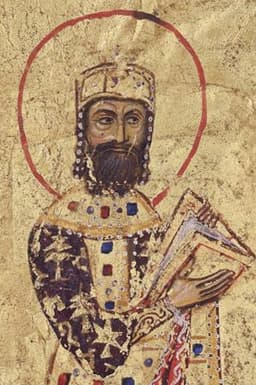
Alexios I Komnenos
Emperor · Medieval
78.4Total

Ashoka the Great
Emperor · Ancient
76.3Total
Basic Information
Born
1048
-304
Died
1118
-232
Era
Medieval
Ancient
Nationality
Byzantine Empire
India
Occupation
Emperor
Emperor
Civilization
Western
Indian
Score Comparison
Military (10%)
61.7
72.0
Political (20%)
78.0
82.0
Influence (20%)
88.0
71.0
Legacy (20%)
80.0
90.0
Leadership (15%)
78.0
72.0
Strategy (15%)
68.0
58.0
TOTAL
78.4
76.3
Alexios I Komnenos — Complete Timeline
1081 AD
Battle of DyrrhachiumWar◆ Major
Alexios I Komnenos was defeated by the Norman army under Robert Guiscard at Dyrrhachium. The Byzantine forces were routed, and Alexios barely escaped. This loss allowed the Normans to occupy much of the western Balkans, though Alexios later recovered some territory.
Norman InvasionDefeatBalkans
Impact: regionaltragic
1090 AD
Reforms of the Byzantine Military and EconomyReform◆ Major
Alexios I implemented a series of reforms to restore Byzantine power. He reorganized the army by relying more on foreign mercenaries, reformed the currency (the hyperpyron), and granted tax exemptions to the Church. These measures stabilized the empire after decades of decline.
Military ReformEconomic ReformKomnenian Restoration
Impact: nationalconstructive
1095 AD
Appeal to the West: Council of PiacenzaPolitical Action
Alexios I sent envoys to Pope Urban II at the Council of Piacenza, requesting military aid against the Seljuk Turks. This appeal contributed to Urban's call for the First Crusade at the Council of Clermont later that year, initiating the Crusader movement.
First CrusadePope Urban IISeljuk Turks
Impact: global
1097 AD
First Crusade: Siege of NicaeaWar◆ Major
Alexios I cooperated with the Crusader army to besiege and capture Nicaea from the Seljuk Turks. The city was surrendered to Byzantine control, and Alexios used the Crusaders to recover key territories in Anatolia, though tensions later arose over land claims.
First CrusadeNicaeaByzantine-Crusader Relations
Impact: regionalconstructive
Ashoka the Great — Complete Timeline
261 BC
Kalinga WarWar
Ashoka launched a brutal conquest of the Kalinga region (modern Odisha). The war caused massive casualties, with over 100,000 killed and 150,000 deported. The suffering witnessed during this campaign led Ashoka to renounce military conquest and embrace Buddhism.
ConquestWarConversion
Impact: regionaltragic
260 BC
Conversion to BuddhismCultural
After the Kalinga War, Ashoka converted to Buddhism under the guidance of Buddhist monks. He adopted the principle of Dhamma (righteous law) and began promoting non-violence, vegetarianism, and religious tolerance throughout his empire.
ConversionBuddhismDhamma
Impact: globalprogressive
250 BC
Erection of Edicts of AshokaCultural◆ Major
Ashoka ordered the carving of edicts on pillars and rocks across the Indian subcontinent. These inscriptions, written in Prakrit and other languages, proclaimed his policies of non-violence, social welfare, and religious harmony. They are the earliest deciphered written records from ancient India.
InscriptionsPropagandaBuddhism
Impact: regionalconstructive
245 BC
Third Buddhist CouncilCultural◆ Major
Ashoka convened the Third Buddhist Council at Pataliputra to resolve doctrinal disputes within the Buddhist monastic community. The council standardized the Buddhist canon (Tripitaka) and decided to send missionaries abroad, including to Sri Lanka and Southeast Asia.
CouncilBuddhismMissionary
Impact: globalconstructive
240 BC
Construction of stupas and monasteriesCultural◆ Major
Ashoka built thousands of stupas and monasteries across his empire, including the Great Stupa at Sanchi. These structures became centers of Buddhist worship and pilgrimage, spreading Buddhist art and architecture throughout Asia.
ArchitectureBuddhismPatronage
Impact: regionalconstructive
Expert Analysis
Origins
Alexios I Komnenos (c. 1048–1118) was born into the Byzantine military aristocracy, the nephew of Emperor Isaac I Komnenos. The Byzantine Empire was in crisis: Seljuk Turks had overrun Anatolia after the Battle of Manzikert (1071), and internal rebellions fractured the state. Alexios rose through military ranks, serving under several emperors before seizing power in a coup in 1081. His family background and military experience shaped his pragmatic, survival-focused rule.
In contrast, Ashoka the Great (304–232 BCE) was the third emperor of the Maurya Dynasty, grandson of Chandragupta Maurya. He inherited a vast empire covering most of the Indian subcontinent. His early life was marked by political intrigue; he was not the eldest son but emerged as the successor after a power struggle. Ashoka's origins tied him to a tradition of imperial expansion and centralized rule.
Rise to Power
Alexios I seized the throne in 1081 by leading a rebellion against Emperor Nikephoros III Botaneiates. With the support of the powerful Doukas family and the army, he marched on Constantinople and was crowned. His rise was driven by personal ambition and the need to restore order; he immediately faced invasions from Normans, Pechenegs, and Seljuks. His reign began with the costly Battle of Dyrrhachium (1081) against the Normans, which he lost but later recovered through diplomacy and alliances.
Ashoka's rise was more conventional. After his father Bindusara's death, Ashoka fought his brothers for the throne, reportedly killing several. He was crowned around 268 BCE and initially pursued aggressive expansion. His most significant conquest was the Kalinga War (c. 261 BCE), a brutal campaign that resulted in massive casualties and destruction. This war became a turning point, as the suffering witnessed led Ashoka to renounce violence and embrace Buddhism.
Leadership & Governance
Alexios I was a pragmatic and adaptable leader. He reformed the Byzantine military by creating a new army based on pronoia (land grants in exchange for service), and he stabilized the economy by debasing the currency and reforming taxation. He skillfully used diplomacy, playing Crusaders, Normans, and Turks against each other. His appeal to the West at the Council of Piacenza (1095) led to the First Crusade, which he leveraged to recover Nicaea and parts of Anatolia. However, his reign saw the rise of Venetian commercial privileges, which weakened the empire long-term. He centralized power, curbed the influence of the aristocracy, and established the Komnenian dynasty. His leadership scores reflect high political and diplomatic skills (P=78, I=88) but moderate military ability (M=62).
Ashoka's governance transformed from conquest to welfare. After Kalinga, he adopted Buddhism and promoted dhamma (righteousness), emphasizing non-violence, religious tolerance, social justice, and animal welfare. He erected edicts across his empire, inscribed on rocks and pillars, proclaiming his policies and moral precepts. He built hospitals, dug wells, planted trees, and sent missionaries to spread Buddhism, including to Sri Lanka and Southeast Asia. He convened the Third Buddhist Council (c. 250 BCE) to purify the sangha. His governance was highly centralized and bureaucratic, but focused on ethical administration. His leadership scores show high integrity (L=90) and diplomacy (D=72), but lower military (M=72) and strategy (S=58) compared to his early reign.
Triumph & Tragedy
Alexios I's greatest triumph was surviving and stabilizing the Byzantine Empire against overwhelming odds. He repelled the Norman invasion, defeated the Pechenegs, and used the Crusaders to recover key territories. The Siege of Nicaea (1097) was a major success, as he regained the city without a fight through negotiation. His reforms laid the foundation for the Komnenian restoration. However, his tragedy was the unintended consequences of the Crusades: the Crusaders established independent states and later sacked Constantinople (1204), a process he inadvertently set in motion. His death in 1118 left the empire stronger but still vulnerable.
Ashoka's triumph was his moral transformation and the spread of Buddhism. The Kalinga War, though tragic, led to a unique experiment in non-violent governance. His edicts and missions created a legacy of peace that influenced Asia for centuries. However, his tragedy was the decline of the Maurya Empire after his death; his pacifist policies may have weakened the military, and the empire fragmented within 50 years. His son Kunala was blinded in a political intrigue, and the dynasty ended soon after.
Character & Destiny
Alexios I was cunning, resilient, and pragmatic. He was a master of survival, using deception and diplomacy when needed. His memoirs, written by his daughter Anna Komnene in the *Alexiad*, portray him as a devoted emperor but also a manipulative figure. His destiny was to be a transitional figure, saving the empire but inadvertently changing the course of European history through the Crusades. He died of natural causes, having secured the throne for his son John II.
Ashoka was ruthless in his early years, then deeply penitent and idealistic. He is often called 'Ashoka the Great' for his unique conversion from conqueror to peacemaker. His destiny was to become a symbol of righteous rule, influencing Buddhist and Hindu traditions. He died in 232 BCE, his later years possibly marked by illness and court intrigues. He is remembered as one of India's greatest emperors.
Legacy
Alexios I's legacy is mixed. He is credited with the Komnenian restoration, stabilizing Byzantium for another century. His appeal to the West initiated the Crusades, a pivotal event in world history. However, the Crusades also brought disaster to Byzantium. His reforms strengthened the state but also empowered the aristocracy and Venetians. He is a key figure in Byzantine history, often overshadowed by his daughter's chronicle. Score: 7/10 for impact.
Ashoka's legacy is profound. He is remembered as a model of benevolent rule, his edicts providing early evidence of state-sponsored morality. Buddhism spread across Asia due to his efforts, and his pillars remain iconic. He is a national hero in India, his Ashoka Chakra adorning the national flag. However, his empire declined quickly after his death, limiting his long-term political impact. Score: 9/10 for moral and cultural influence.
Conclusion
Alexios I Komnenos scores higher overall (78 vs 76) due to his strategic and diplomatic skills in a critical period. Ashoka's higher legacy score (L=90) is offset by lower strategy and military scores. Alexios's actions had immediate, tangible impacts on medieval geopolitics, while Ashoka's influence was more gradual and ideological. Both were transformative rulers, but Alexios faced more immediate existential threats and navigated them with cunning. In a direct comparison, Alexios's pragmatic statecraft edges out Ashoka's idealistic reform. Final verdict: Alexios I Komnenos narrowly prevails.
Rankings
🥇
Alexios I KomnenosLeader
Mil: 61.7Pol: 78.0Inf: 88.0
78.4
🥈
Ashoka the Great
Mil: 72.0Pol: 82.0Inf: 71.0
76.3
+2.1 behind
How This Comparison Works
Algorithm
Each figure is scored on 6 dimensions (0—100 scale) based on structured historical data: Military (10%), Political (20%), Influence (20%), Legacy (20%), Leadership (15%), Strategy (15%). The weighted total produces the final ranking.
Data Sources
Scores are computed from structured sub-indicators in the database. Scale factors adjust for era (Ancient ×0.85, Modern ×1.0) and civilization size (Eastern ×1.05, Other ×0.80) to account for differences in population and military scale.
Maximum 3 Figures
Comparisons are limited to 2—3 figures to ensure readability and statistical meaningfulness.
Error Margins
±5 points per dimension — Sub-scores are derived from historical records with inherent uncertainty. Two figures within 5 points on a dimension should be considered roughly equivalent in that area.
Total Score Accuracy
±3 points overall — The weighted combination of 6 dimensions produces a total score with approximately ±3 points of uncertainty. Differences of less than 3 points are not statistically significant— the figures are effectively tied.
Known Limitations
- Historical records are incomplete and uneven across civilizations
- Figures from oral-tradition societies may be underrepresented
- Occupation labels can misclassify multi-role figures
- Scores measure capability and impact, not moral character
- Quantitative scoring is a comparison tool, not absolute truth
Capability Radar
Military (10%) — Battles & Warfare
Battles
75
85
Win Rate
70
90
Expansion
60
95
Political (20%) — Governance & Reform
Reform
85
95
Diplomacy
90
90
Economy
70
85
Influence (20%) — Cultural & Global Reach
Cultural
70
95
Global
75
90
Legacy (20%) — Historical Impact
Historical
85
95
Longevity
80
95
Leadership (15%) — Power & Stability
Tenure
80
90
Stability
75
90
Strategy (15%) — Tactics & Innovation
Strategy
85
80
Tactics
80
75
Reform
75
70
Similar Comparisons
Comments & Discussion
No comments yet. Be the first to share your thoughts!