Loading...
Alexios I Komnenos vs Ardashir I
Alexios I Komnenos leads by 2.8 pts · 2 figures compared
…
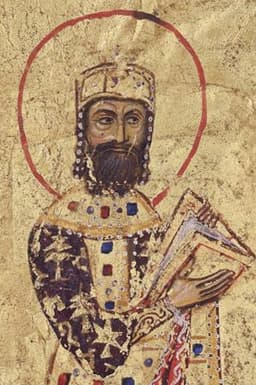
Alexios I Komnenos
Emperor · Medieval
78.4Total

Ardashir I
Emperor · Ancient
75.6Total
Basic Information
Born
1048
180
Died
1118
242
Era
Medieval
Ancient
Nationality
Byzantine Empire
Sassanid Empire
Occupation
Emperor
Emperor
Civilization
Western
Middle Eastern
Score Comparison
Military (10%)
61.7
65.0
Political (20%)
78.0
78.0
Influence (20%)
88.0
82.0
Legacy (20%)
80.0
72.0
Leadership (15%)
78.0
78.0
Strategy (15%)
68.0
72.0
TOTAL
78.4
75.6
Alexios I Komnenos — Complete Timeline
1081 AD
Battle of DyrrhachiumWar◆ Major
Alexios I Komnenos was defeated by the Norman army under Robert Guiscard at Dyrrhachium. The Byzantine forces were routed, and Alexios barely escaped. This loss allowed the Normans to occupy much of the western Balkans, though Alexios later recovered some territory.
Norman InvasionDefeatBalkans
Impact: regionaltragic
1090 AD
Reforms of the Byzantine Military and EconomyReform◆ Major
Alexios I implemented a series of reforms to restore Byzantine power. He reorganized the army by relying more on foreign mercenaries, reformed the currency (the hyperpyron), and granted tax exemptions to the Church. These measures stabilized the empire after decades of decline.
Military ReformEconomic ReformKomnenian Restoration
Impact: nationalconstructive
1095 AD
Appeal to the West: Council of PiacenzaPolitical Action
Alexios I sent envoys to Pope Urban II at the Council of Piacenza, requesting military aid against the Seljuk Turks. This appeal contributed to Urban's call for the First Crusade at the Council of Clermont later that year, initiating the Crusader movement.
First CrusadePope Urban IISeljuk Turks
Impact: global
1097 AD
First Crusade: Siege of NicaeaWar◆ Major
Alexios I cooperated with the Crusader army to besiege and capture Nicaea from the Seljuk Turks. The city was surrendered to Byzantine control, and Alexios used the Crusaders to recover key territories in Anatolia, though tensions later arose over land claims.
First CrusadeNicaeaByzantine-Crusader Relations
Impact: regionalconstructive
Ardashir I — Complete Timeline
224 AD
Battle of HormozdganWar
Ardashir I defeated the Parthian king Artabanus IV at the Battle of Hormozdgan. This victory ended Parthian rule and allowed Ardashir to establish the Sassanid Empire, which would dominate Persia for four centuries.
BattleSassanid FoundingParthian Defeat
Impact: regional
Conquest of the Parthian EmpireWar◆ Major
Following his victory at Hormozdgan, Ardashir I systematically conquered the remaining Parthian territories, including Media, Armenia, and Mesopotamia. He established a centralized administration and a Zoroastrian state church.
ConquestEmpire BuildingZoroastrianism
Impact: regional
Coronation as King of KingsPolitical Action◆ Major
After his victory, Ardashir I was crowned 'Shahanshah' (King of Kings) at Ctesiphon. He claimed descent from the Achaemenid dynasty, legitimizing his rule and reviving Persian imperial traditions.
CoronationImperial TitleLegitimacy
Impact: regionalconstructive
Expert Analysis
Origins
Alexios I Komnenos was born into the Byzantine military aristocracy in 1048, a time when the empire faced existential threats from Normans, Pechenegs, and Turks. His family, the Komnenoi, had a history of rebellion and military command, but Alexios rose through competence rather than birthright. He seized the throne in 1081 amidst chaos, deposing Nikephoros III Botaneiates. In contrast, Ardashir I emerged from obscurity as a vassal king in Persis (modern Fars) under the Parthian Arsacid Empire. Claiming descent from the legendary Sasan, he capitalized on Parthian weakness and internal strife, uniting Persian petty kingdoms under his banner. Both founders faced crumbling empires, but Ardashir built from the periphery while Alexios seized the center.
Rise to Power
Alexios gained power through military success and political maneuvering. As a general under previous emperors, he crushed rebellions and won battles, but his coup was a gamble. He faced immediate invasion from the Normans under Robert Guiscard, leading to the Battle of Dyrrhachium (1081), a costly defeat that nearly ended his reign. Yet he survived through diplomacy and resilience. Ardashir’s rise was more direct: he rebelled against the Parthian king Artabanus IV, defeated him at the Battle of Hormozdgan (224 AD), and was crowned King of Kings. He systematically conquered the remaining Parthian territories, consolidating power through military force and propaganda. Alexios’s path was defensive and reactive; Ardashir’s was offensive and transformative.
Leadership & Governance
Alexios is known for his administrative reforms: he reformed the Byzantine military by creating the pronoia system (land grants in exchange for service) and revitalized the economy. His most famous act was appealing to Pope Urban II at the Council of Piacenza (1095), which indirectly sparked the First Crusade. While the Crusades helped recover Nicaea (1097) and parts of Anatolia, they also introduced new problems. Alexios governed through diplomacy, intrigue, and careful balancing of factions. Ardashir, by contrast, established a centralized Sassanid state with Zoroastrianism as the state religion. He built administrative structures, codified laws, and promoted Persian identity. Both were reformers, but Alexios’s governance was more improvisational, while Ardashir’s was systematic.
Triumph & Tragedy
Alexios’s greatest triumph was stabilizing the Byzantine Empire after decades of decline. He recovered lost territories, defeated the Pechenegs, and used the Crusaders to his advantage. Yet his tragedy was that the Crusades ultimately escaped his control, leading to the formation of Crusader states that later turned against Byzantium. The Siege of Nicaea (1097) was a high point, but his later years saw tensions with Crusaders. Ardashir’s triumph was the complete overthrow of the Parthian Empire and the founding of a dynasty that lasted four centuries. His tragedy is less personal; the Sassanid state he built faced later Roman wars, but he died in power. Alexios’s story is one of survival against odds; Ardashir’s is one of total victory.
Character & Destiny
Alexios was a pragmatic, shrewd, and sometimes duplicitous ruler. He wrote his memoirs (the Alexiad, via his daughter Anna Komnene), revealing a man of deep piety and political cunning. His destiny was to be a transitional figure, bridging the dark age of Byzantium to its Komnenian restoration. Ardashir was a visionary founder, driven by a sense of Persian destiny and religious zeal. He claimed to restore the Achaemenid legacy. Alexios’s character was more flexible; Ardashir’s more rigid. Both were ruthless when needed.
Legacy
Alexios I Komnenos is remembered as the founder of the Komnenian dynasty and a key figure in the Crusades. His reforms revitalized Byzantium but also sowed seeds for future conflict. Ardashir I is revered in Iran as the founder of the Sassanid Empire, a golden age of Persian culture and power. Both left lasting institutions, but Alexios’s legacy is mixed due to the Crusades. Ardashir’s legacy is more uniformly positive in Persian history.
Conclusion
Alexios I Komnenos (score 78) edges out Ardashir I (score 76) by a narrow margin. Alexios faced a more complex geopolitical landscape and managed to reverse Byzantine decline through cunning and adaptability. Ardashir’s achievement—founding an empire that lasted 400 years—is monumental, but his task was more straightforward: conquering a decaying Parthian state. Alexios’s ability to navigate internal and external threats, innovate governance, and influence world history through the Crusades gives him a slight edge. Both are exceptional, but Alexios’s multifaceted challenges and enduring impact on European history make him the greater emperor.
Rankings
🥇
Alexios I KomnenosLeader
Mil: 61.7Pol: 78.0Inf: 88.0
78.4
🥈
Ardashir I
Mil: 65.0Pol: 78.0Inf: 82.0
75.6
+2.8 behind
How This Comparison Works
Algorithm
Each figure is scored on 6 dimensions (0—100 scale) based on structured historical data: Military (10%), Political (20%), Influence (20%), Legacy (20%), Leadership (15%), Strategy (15%). The weighted total produces the final ranking.
Data Sources
Scores are computed from structured sub-indicators in the database. Scale factors adjust for era (Ancient ×0.85, Modern ×1.0) and civilization size (Eastern ×1.05, Other ×0.80) to account for differences in population and military scale.
Maximum 3 Figures
Comparisons are limited to 2—3 figures to ensure readability and statistical meaningfulness.
Error Margins
±5 points per dimension — Sub-scores are derived from historical records with inherent uncertainty. Two figures within 5 points on a dimension should be considered roughly equivalent in that area.
Total Score Accuracy
±3 points overall — The weighted combination of 6 dimensions produces a total score with approximately ±3 points of uncertainty. Differences of less than 3 points are not statistically significant— the figures are effectively tied.
Known Limitations
- Historical records are incomplete and uneven across civilizations
- Figures from oral-tradition societies may be underrepresented
- Occupation labels can misclassify multi-role figures
- Scores measure capability and impact, not moral character
- Quantitative scoring is a comparison tool, not absolute truth
Capability Radar
Military (10%) — Battles & Warfare
Battles
75
85
Win Rate
70
90
Expansion
60
85
Political (20%) — Governance & Reform
Reform
85
90
Diplomacy
90
75
Economy
70
80
Influence (20%) — Cultural & Global Reach
Cultural
70
80
Global
75
80
Legacy (20%) — Historical Impact
Historical
85
85
Longevity
80
85
Leadership (15%) — Power & Stability
Tenure
80
80
Stability
75
85
Strategy (15%) — Tactics & Innovation
Strategy
85
85
Tactics
80
80
Reform
75
90
Similar Comparisons
Comments & Discussion
No comments yet. Be the first to share your thoughts!