Loading...
Alessandro Farnese Duke of Parma vs Yue Zhongqi
Alessandro Farnese Duke of Parma leads by 13.1 pts · 2 figures compared
…
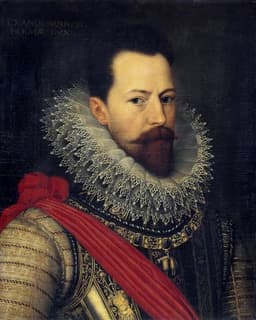
Alessandro Farnese Duke of Parma
General · Modern
69.9Total

Yue Zhongqi
General · Modern
56.8Total
Basic Information
Born
1545
1686
Died
1592
1754
Era
Modern
Modern
Nationality
Spain
China
Occupation
General
General
Civilization
Western
Eastern
Score Comparison
Military (10%)
79.9
67.5
Political (20%)
69.2
54.7
Influence (20%)
68.0
54.9
Legacy (20%)
72.0
46.7
Leadership (15%)
62.0
71.0
Strategy (15%)
72.0
57.5
TOTAL
69.9
56.8
Alessandro Farnese Duke of Parma — Complete Timeline
1579 AD
Siege of MaastrichtWar◆ Major
Farnese led Spanish forces in a successful siege of Maastricht, a key rebel stronghold. The city was stormed after a brutal four-month siege, and its defenders were massacred, demonstrating Farnese's military effectiveness.
SiegeDutch RevoltSpanish Army
Impact: regionaldestructive
1585 AD
Siege of AntwerpWar
Farnese captured Antwerp, the largest city in the Netherlands, after a year-long siege. He constructed a bridge of boats across the Scheldt River to blockade the city, forcing its surrender and splitting the rebel provinces.
SiegeDutch RevoltMilitary Engineering
Impact: regional
Reconquest of the Southern NetherlandsWar◆ Major
Through a series of campaigns, Farnese reconquered the southern provinces of the Netherlands (modern-day Belgium) for Spain. This established the basis for the later split between the Dutch Republic and the Spanish Netherlands.
ReconquestNetherlandsSpanish Empire
Impact: regional
1590 AD
Invasion of FranceWar◆ Major
Farnese led a Spanish army into France to support the Catholic League against Henry of Navarre. He relieved the Siege of Paris and later the Siege of Rouen, but his campaigns were hampered by supply issues and political constraints.
French Wars of ReligionSpanish InterventionMilitary Campaign
Impact: regional
Yue Zhongqi — Complete Timeline
1720 AD
Campaign in TibetWar◆ Major
Yue Zhongqi led Qing forces into Tibet to expel the Dzungar invaders. The campaign successfully restored Qing control over Lhasa and installed the 7th Dalai Lama, solidifying Qing influence in Tibet for decades.
TibetDzungar-Qing WarExpedition
Impact: regional
1731 AD
Battle of Khalkha RiverWar
Yue Zhongqi commanded Qing forces against the Dzungars at the Khalkha River. The battle ended in a Qing defeat, leading to Yue's recall and temporary loss of command due to perceived failure.
Dzungar-Qing WarBattleDefeat
Impact: regionaltragic
Expert Analysis
Origins
Alessandro Farnese (1545–1592) was born into the powerful Farnese family in Rome, the son of Duke Ottavio Farnese of Parma and Margaret of Austria, an illegitimate daughter of Emperor Charles V. Raised at the Spanish court, he received a thorough military education under the supervision of his uncle, King Philip II of Spain. His noble lineage and connections provided him with resources and opportunities from an early age.
Yue Zhongqi (1686–1754) was born in Lanzhou, Gansu, into a military family of Han Chinese origin. He was a descendant of the famed Song dynasty general Yue Fei. His father, Yue Shenglong, served as a Qing official. Yue Zhongqi followed the family tradition, joining the Qing military and rising through the ranks based on merit and loyalty to the Manchu rulers.
Rise to Power
Farnese's rise began with his participation in the Battle of Lepanto (1571), where he commanded the papal contingent. His performance earned him recognition. In 1578, he was appointed Governor-General of the Spanish Netherlands, tasked with suppressing the Dutch Revolt. His strategic acumen became evident during the Siege of Maastricht (1579), which he captured after a brutal four-month assault. This victory solidified his reputation.
Yue Zhongqi rose to prominence during the Qing expansion into Central Asia. He served under Emperor Kangxi and later Yongzheng. His major breakthrough came when he was appointed commander of the Qing forces in Tibet. In 1720, he led a campaign to expel Dzungar invaders from Lhasa, successfully restoring Qing control and installing the 7th Dalai Lama. This achievement made him a key figure in Qing frontier policy.
Leadership & Governance
Farnese was a master of siege warfare and logistics. His leadership style combined tactical flexibility with relentless determination. At the Siege of Antwerp (1584–1585), he constructed a bridge of boats across the Scheldt River to blockade the city, a feat of engineering and strategy. He offered generous surrender terms to rebels, encouraging defections. His governance focused on restoring Catholic authority and Spanish control, often through a mix of military pressure and diplomacy.
Yue Zhongqi led by example, known for his personal bravery and strict discipline. He emphasized training and loyalty to the Qing dynasty. In Tibet, he worked to integrate local Tibetan leaders into the Qing administration, balancing military force with political accommodation. However, his defeat at the Battle of Khalkha River (1731) against the Dzungars exposed his limitations in open-field combat. He was recalled and temporarily imprisoned, though later rehabilitated.
Triumph & Tragedy
Farnese's greatest triumph was the reconquest of the Southern Netherlands (modern-day Belgium) by 1585, effectively splitting the Dutch Revolt. His Siege of Antwerp remains a textbook example of siegecraft. His tragedy came during the French Wars of Religion: he invaded France to support the Catholic League, but his efforts were hampered by limited resources and political intrigue. He died in 1592 from a wound sustained at the Siege of Caudebec, leaving his mission incomplete.
Yue Zhongqi's triumph was the successful 1720 Tibet campaign, which secured Qing suzerainty over Tibet for decades. His tragedy was the defeat at Khalkha River, which led to his downfall. He was stripped of rank and spent years in obscurity before being pardoned. His legacy suffered due to this failure, though he is still respected for his earlier achievements.
Character & Destiny
Farnese was pragmatic and calculated, often preferring negotiation to unnecessary bloodshed. He was a loyal servant of the Spanish crown, but his independence sometimes clashed with Philip II's micromanagement. His character—determined yet diplomatic—enabled him to achieve much with limited resources. His early death cut short a career that might have altered the course of the Dutch Revolt.
Yue Zhongqi was courageous and principled, but his rigid adherence to Qing orthodoxy and his defeat in battle defined his fate. He was a product of the Qing military system, which rewarded loyalty but punished failure harshly. His character, while honorable, could not overcome the strategic challenges of the Dzungar frontier.
Legacy
Farnese's legacy is enduring: he established the basis for the Spanish Netherlands, which later became Belgium. His military innovations, especially in siege warfare, influenced European tactics. He scored 79.9 in military and 72.0 in legacy. His impact on the Dutch Revolt's outcome is significant, though his death prevented full victory.
Yue Zhongqi's legacy is more modest. He is remembered as a capable general who secured Tibet for the Qing, but his defeat limited his influence. He scored 67.5 in military and 46.7 in legacy. His descendant status as Yue Fei's heir adds cultural weight, but his historical impact is regional.
Conclusion
Alessandro Farnese had greater impact than Yue Zhongqi. With a total score of 69.9 versus 56.8, Farnese's campaigns reshaped the political map of Western Europe and influenced the course of the Eighty Years' War. Yue Zhongqi's achievements, while important for Qing expansion, were less transformative on a global scale. Farnese's strategic brilliance and legacy in siege warfare cement his place as the superior commander.
Rankings
🥇
Alessandro Farnese Duke of ParmaLeader
Mil: 79.9Pol: 69.2Inf: 68.0
69.9
🥈
Yue Zhongqi
Mil: 67.5Pol: 54.7Inf: 54.9
56.8
+13.1 behind
How This Comparison Works
Algorithm
Each figure is scored on 6 dimensions (0—100 scale) based on structured historical data: Military (10%), Political (20%), Influence (20%), Legacy (20%), Leadership (15%), Strategy (15%). The weighted total produces the final ranking.
Data Sources
Scores are computed from structured sub-indicators in the database. Scale factors adjust for era (Ancient ×0.85, Modern ×1.0) and civilization size (Eastern ×1.05, Other ×0.80) to account for differences in population and military scale.
Maximum 3 Figures
Comparisons are limited to 2—3 figures to ensure readability and statistical meaningfulness.
Error Margins
±5 points per dimension — Sub-scores are derived from historical records with inherent uncertainty. Two figures within 5 points on a dimension should be considered roughly equivalent in that area.
Total Score Accuracy
±3 points overall — The weighted combination of 6 dimensions produces a total score with approximately ±3 points of uncertainty. Differences of less than 3 points are not statistically significant— the figures are effectively tied.
Known Limitations
- Historical records are incomplete and uneven across civilizations
- Figures from oral-tradition societies may be underrepresented
- Occupation labels can misclassify multi-role figures
- Scores measure capability and impact, not moral character
- Quantitative scoring is a comparison tool, not absolute truth
Capability Radar
Military (10%) — Battles & Warfare
Battles
85
65
Win Rate
88
60
Expansion
80
55
Political (20%) — Governance & Reform
Reform
65
30
Diplomacy
78
45
Economy
60
35
Influence (20%) — Cultural & Global Reach
Cultural
60
35
Global
70
25
Legacy (20%) — Historical Impact
Historical
75
40
Longevity
65
30
Leadership (15%) — Power & Stability
Tenure
70
50
Stability
55
40
Strategy (15%) — Tactics & Innovation
Strategy
90
60
Tactics
92
55
Reform
75
30
Similar Comparisons
Alessandro Farnese Duke of Parma vs Napoleon BonaparteAlessandro Farnese Duke of Parma vs Stanislaw KoniecpolskiAlessandro Farnese Duke of Parma vs Erich LudendorffAlessandro Farnese Duke of Parma vs Duke of WellingtonAlessandro Farnese Duke of Parma vs Uesugi KenshinAlessandro Farnese Duke of Parma vs Julius Caesar
Comments & Discussion
No comments yet. Be the first to share your thoughts!