Loading...
Alessandro Farnese Duke of Parma vs Ye Jianying
Alessandro Farnese Duke of Parma leads by 11.8 pts · 2 figures compared
…
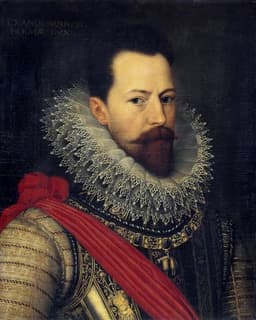
Alessandro Farnese Duke of Parma
General · Modern
69.9Total

Ye Jianying
General · Modern
58.1Total
Basic Information
Born
1545
1897
Died
1592
1986
Era
Modern
Modern
Nationality
Spain
China
Occupation
General
General
Civilization
Western
Eastern
Score Comparison
Military (10%)
79.9
40.0
Political (20%)
69.2
53.8
Influence (20%)
68.0
58.0
Legacy (20%)
72.0
54.0
Leadership (15%)
62.0
85.0
Strategy (15%)
72.0
52.5
TOTAL
69.9
58.1
Alessandro Farnese Duke of Parma — Complete Timeline
1579 AD
Siege of MaastrichtWar◆ Major
Farnese led Spanish forces in a successful siege of Maastricht, a key rebel stronghold. The city was stormed after a brutal four-month siege, and its defenders were massacred, demonstrating Farnese's military effectiveness.
SiegeDutch RevoltSpanish Army
Impact: regionaldestructive
1585 AD
Siege of AntwerpWar
Farnese captured Antwerp, the largest city in the Netherlands, after a year-long siege. He constructed a bridge of boats across the Scheldt River to blockade the city, forcing its surrender and splitting the rebel provinces.
SiegeDutch RevoltMilitary Engineering
Impact: regional
Reconquest of the Southern NetherlandsWar◆ Major
Through a series of campaigns, Farnese reconquered the southern provinces of the Netherlands (modern-day Belgium) for Spain. This established the basis for the later split between the Dutch Republic and the Spanish Netherlands.
ReconquestNetherlandsSpanish Empire
Impact: regional
1590 AD
Invasion of FranceWar◆ Major
Farnese led a Spanish army into France to support the Catholic League against Henry of Navarre. He relieved the Siege of Paris and later the Siege of Rouen, but his campaigns were hampered by supply issues and political constraints.
French Wars of ReligionSpanish InterventionMilitary Campaign
Impact: regional
Ye Jianying — Complete Timeline
1976 AD
Arrest of the Gang of FourPolitical Action
Ye Jianying, as a senior marshal and Politburo member, coordinated with Hua Guofeng to arrest the Gang of Four. This ended the Cultural Revolution and led to the rehabilitation of many officials.
Cultural RevolutionPower Struggle
Impact: nationalconstructive
1977 AD
Supported Deng Xiaoping's ReturnPolitical Action◆ Major
Ye Jianying was instrumental in reinstating Deng Xiaoping to his posts after the Cultural Revolution. This paved the way for Deng's economic reforms and China's opening up.
Political RehabilitationReform Era
Impact: nationalconstructive
1978 AD
Appointed Chairman of the Standing Committee of the National People's CongressPolitical Action◆ Major
Ye Jianying became the head of China's legislature. He oversaw the drafting of the 1982 Constitution and promoted legal reforms, including the establishment of the Special Economic Zones.
Legal ReformConstitution
Impact: nationalconstructive
Expert Analysis
Origins
Alessandro Farnese (1545-1592) was born into the powerful Farnese family in Parma, Italy. His grandfather was Pope Paul III, and his mother was Margaret of Parma, half-sister of Philip II of Spain. Raised at the Spanish court, he received military training under his uncle, Don John of Austria. Farnese fought at the Battle of Lepanto (1571) and later served in the Netherlands.
Ye Jianying (1897-1986) was born in Meixian, Guangdong, China, to a moderately wealthy merchant family. He joined the Chinese Communist Party in 1927 after participating in the Northern Expedition. He studied at the Whampoa Military Academy and served as an instructor, building early connections with future leaders. His early career included roles in the Red Army during the Long March and the Yan'an period.
Rise to Power
Farnese rose to prominence after his appointment as Governor-General of the Spanish Netherlands in 1578. His major turning point was the Siege of Antwerp (1584-1585), where he constructed a bridge of boats across the Scheldt River to blockade the city. After a 13-month siege, Antwerp fell, and Farnese became the leading Spanish commander in the region. He then reconquered the southern provinces (modern Belgium) for Spain, establishing the base for the Spanish Netherlands.
Ye Jianying rose through the ranks of the Chinese Communist Party during the civil war and the Anti-Japanese War. He became a marshal in 1955 and served as Minister of National Defense. His key turning point came in 1976 after Mao's death. As a senior marshal and Politburo member, he coordinated with Hua Guofeng to arrest the Gang of Four on October 6, 1976, ending the Cultural Revolution. This action elevated him to the top leadership, later becoming Chairman of the Standing Committee of the National People's Congress (1978-1983).
Leadership & Governance
Farnese's leadership style was methodical and strategic. He excelled in siege warfare, using engineering and logistics to isolate enemy cities. His governance of the reconquered provinces was pragmatic: he offered generous terms to rebels who surrendered, integrating them into the Spanish administration. However, his military campaigns drained Spanish resources, and he faced constant interference from Madrid. His political score of 69.2 reflects his effectiveness as a military governor, but he never achieved full victory in the Netherlands.
Ye Jianying's leadership was marked by political maneuvering and coalition-building. He scored 85.0 in leadership, higher than Farnese's 62.0, reflecting his ability to navigate the treacherous politics of the Cultural Revolution. As head of the legislature, he oversaw the drafting of the 1982 Constitution, which established legal reforms and the Special Economic Zones. His governance focused on stability and legalism, contrasting with Farnese's military authoritarianism.
Triumph & Tragedy
Farnese's greatest triumph was the reconquest of the Southern Netherlands (1579-1585), which secured Spain's hold on Belgium for another century. His siege of Antwerp (score 79.9 military) is considered a masterpiece of military engineering. However, his failure to conquer the northern provinces (the Dutch Republic) was his tragedy. The Spanish Armada's defeat in 1588 also undermined his efforts, and he died in 1592 from an injury, leaving his campaign unfinished.
Ye Jianying's triumph was the arrest of the Gang of Four, which ended the Cultural Revolution and allowed Deng Xiaoping's reforms. His support for Deng's return (1977) was crucial for China's economic transformation. However, his later role involved suppressing the 1980s democracy movement, and his legacy is mixed: he is remembered as a stabilizer but also as a figure who upheld authoritarian rule. His total score of 58.1 reflects a less dominant impact than Farnese.
Character & Destiny
Farnese was known for his patience and attention to detail. He personally led his troops and shared their hardships, earning respect. But he was also a product of the Spanish court, often constrained by Philip II's micromanagement. His destiny was tied to the decline of Spanish power; despite his skills, he could not reverse the broader trends of Dutch independence and Spanish economic decline.
Ye Jianying was a survivor, adept at shifting alliances. He was known as a 'balancer' within the CCP, avoiding direct confrontation. His decision to arrest the Gang of Four was a calculated risk that paid off. However, his conservatism limited his vision; he did not push for radical reforms but supported Deng's pragmatic approach. His fate was to be a transitional figure, bridging Mao's era and the reform era.
Legacy
Farnese's legacy is the lasting division of the Netherlands: the southern provinces remained Catholic and Spanish until the 18th century, shaping modern Belgium's identity. His military tactics influenced later siege warfare, but his overall impact declined as Spain's empire waned. Today, he is remembered as a capable but ultimately unsuccessful general, with a legacy score of 72.0.
Ye Jianying's legacy is more profound in terms of political change. By removing the Gang of Four, he enabled China's economic rise. The 1982 Constitution and legal reforms set the framework for modern China's governance. However, his legacy is overshadowed by Deng's reforms and the subsequent authoritarian consolidation. His influence score of 58.0 reflects his role as a facilitator rather than a primary architect.
Conclusion
Alessandro Farnese scored 69.9 total, while Ye Jianying scored 58.1. Farnese had greater military impact (79.9 vs 40.0), but Ye Jianying had higher leadership (85.0 vs 62.0). In terms of historical impact, Farnese's reconquest shaped the religious and political map of Europe for centuries, while Ye Jianying's actions were crucial but secondary to Deng's reforms. Farnese's legacy is more tangible: the Southern Netherlands' Catholic identity persists today. Ye Jianying's role, while pivotal, was a single event in a larger narrative. Therefore, Alessandro Farnese had a greater and more lasting impact on history.
Rankings
🥇
Alessandro Farnese Duke of ParmaLeader
Mil: 79.9Pol: 69.2Inf: 68.0
69.9
🥈
Ye Jianying
Mil: 40.0Pol: 53.8Inf: 58.0
58.1
+11.8 behind
How This Comparison Works
Algorithm
Each figure is scored on 6 dimensions (0—100 scale) based on structured historical data: Military (10%), Political (20%), Influence (20%), Legacy (20%), Leadership (15%), Strategy (15%). The weighted total produces the final ranking.
Data Sources
Scores are computed from structured sub-indicators in the database. Scale factors adjust for era (Ancient ×0.85, Modern ×1.0) and civilization size (Eastern ×1.05, Other ×0.80) to account for differences in population and military scale.
Maximum 3 Figures
Comparisons are limited to 2—3 figures to ensure readability and statistical meaningfulness.
Error Margins
±5 points per dimension — Sub-scores are derived from historical records with inherent uncertainty. Two figures within 5 points on a dimension should be considered roughly equivalent in that area.
Total Score Accuracy
±3 points overall — The weighted combination of 6 dimensions produces a total score with approximately ±3 points of uncertainty. Differences of less than 3 points are not statistically significant— the figures are effectively tied.
Known Limitations
- Historical records are incomplete and uneven across civilizations
- Figures from oral-tradition societies may be underrepresented
- Occupation labels can misclassify multi-role figures
- Scores measure capability and impact, not moral character
- Quantitative scoring is a comparison tool, not absolute truth
Capability Radar
Military (10%) — Battles & Warfare
Battles
85
45
Win Rate
88
50
Expansion
80
30
Political (20%) — Governance & Reform
Reform
65
50
Diplomacy
78
70
Economy
60
40
Influence (20%) — Cultural & Global Reach
Cultural
60
40
Global
70
40
Legacy (20%) — Historical Impact
Historical
75
60
Longevity
65
45
Leadership (15%) — Power & Stability
Tenure
70
65
Stability
55
75
Strategy (15%) — Tactics & Innovation
Strategy
90
60
Tactics
92
55
Reform
75
40
Similar Comparisons
Alessandro Farnese Duke of Parma vs Napoleon BonapartePrince Rupert of the Rhine vs Ye JianyingAlessandro Farnese Duke of Parma vs Stanislaw KoniecpolskiAlessandro Farnese Duke of Parma vs Erich LudendorffAlessandro Farnese Duke of Parma vs Duke of WellingtonAlessandro Farnese Duke of Parma vs Julius Caesar
Comments & Discussion
No comments yet. Be the first to share your thoughts!