Loading...
Alejandro Toledo vs Napoleon Bonaparte
Napoleon Bonaparte leads by 18.3 pts · 2 figures compared
…
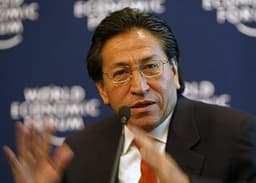
Alejandro Toledo
Politician · Modern
52.6Total

Napoleon Bonaparte
General · Modern
70.9Total
Basic Information
Born
1946
1769
Died
—
1821
Era
Modern
Modern
Nationality
Peru
France
Occupation
Politician
General
Civilization
Western
Western
Score Comparison
Military (10%)
27.7
94.0
Political (20%)
61.3
72.0
Influence (20%)
57.2
40.0
Legacy (20%)
44.2
80.0
Leadership (15%)
62.2
78.0
Strategy (15%)
60.0
90.0
TOTAL
52.6
70.9
Alejandro Toledo — Complete Timeline
2001 AD
Presidency and Economic Recovery (2001-2006)Political Action◆ Major
Alejandro Toledo assumed the presidency of Peru, becoming the first democratically elected president of indigenous Quechua descent. His administration focused on macroeconomic stability, attracting foreign investment, and reducing poverty. He oversaw a period of steady economic growth following the Fujimori era.
First Indigenous PresidentEconomic StabilityDemocracy
Impact: nationalconstructive
2019 AD
Corruption Conviction and Extradition (2019-2023)Political Action◆ Major
Toledo was arrested in the United States on extradition charges related to the Odebrecht scandal. He was accused of accepting $20 million in bribes from the Brazilian construction company in exchange for contracts during his presidency. In 2023, he was extradited to Peru to face trial.
CorruptionOdebrechtExtradition
Impact: nationaldestructive
Napoleon Bonaparte — Complete Timeline
1799 AD
Coup of 18 BrumaireOther◆ Major
Napoleon Bonaparte, with support from his brother Lucien and key political figures, overthrew the Directory in a bloodless coup. He established the Consulate with himself as First Consul, effectively becoming the ruler of France. This event ended the French Revolution's most unstable period.
French RevolutionCoupRise to Power
Impact: regional
1804 AD
Promulgation of the Napoleonic CodeOther◆ Major
Napoleon enacted the Civil Code of the French, known as the Napoleonic Code, a comprehensive set of laws that replaced the fragmented feudal legal systems. The code established legal equality, protected property rights, and secularized law. It became the basis for legal systems in many European and world countries.
Legal ReformNapoleonic CodeCivil Law
Impact: globalconstructive
1805 AD
Battle of AusterlitzWar◆ Major
Napoleon's Grande Arm
Napoleonic WarsBattleDecisive Victory
Impact: global
1812 AD
Invasion of RussiaWar◆ Major
Napoleon led the Grande Arm
Napoleonic WarsInvasionDisaster
Impact: globaldestructive
1815 AD
Battle of WaterlooWar◆ Major
Napoleon's French army was defeated by the combined forces of the Duke of Wellington's Anglo-Allied army and Gebhard Leberecht von Bl
Napoleonic WarsBattleFinal Defeat
Impact: globaldestructive
Expert Analysis
alejandro-toledo-vs-napoleon-bonaparte
# The Emperor and the Economist: Two Paths from Obscurity to Power
On a June morning in 1815, Napoleon Bonaparte watched his grand army dissolve into chaos at Waterloo, his dream of European domination bleeding into the muddy fields of Belgium. Nearly two centuries later, on a July day in 2019, another man of humble origins—Alejandro Toledo—was handcuffed by American authorities in California, accused of taking millions in bribes from a Brazilian construction giant. Both men rose from obscurity to the pinnacle of power. Both fell in disgrace. But the forces that drove them, and the worlds they tried to shape, could hardly have been more different.
Origins
Napoleon was born in 1769 on the Mediterranean island of Corsica, a year after France purchased the territory from Genoa. His family were minor nobility, but poor—his father was a lawyer who struggled to feed eight children. The young Napoleon spoke Italian-accented French and was mocked by classmates at military school for his provincial origins. Yet France in the 1780s was a society in violent flux, where talent could vault a man over the old hierarchies of birth. The revolution had shattered the monarchy, and a generation of ambitious young officers saw opportunity in chaos.
Alejandro Toledo was born in 1946 in a small Andean village in Peru, the eighth of sixteen children. His father was a bricklayer, his mother sold fish in the market. The family spoke Quechua, the language of the Incas, and young Alejandro walked barefoot to a one-room schoolhouse. Peru in the mid-twentieth century was a country of deep racial and economic divides, where indigenous people were widely expected to remain peasants. Toledo's path was not military but academic—he won a scholarship to study in the United States, earning a PhD in economics from Stanford. Where Napoleon learned to command armies, Toledo learned to analyze markets.
Rise to Power
Napoleon's ascent was meteoric. At 24, he drove the British out of Toulon and was promoted to brigadier general. At 26, he crushed a royalist uprising in Paris with a "whiff of grapeshot." At 30, he led a daring campaign into Italy, defeating larger Austrian armies through speed and audacity. By 1804, at 35, he crowned himself Emperor of the French. His path was forged in gunpowder and blood—every promotion came from victory on the battlefield.
Toledo's rise was slower and more democratic. In the 1990s, he emerged as a leading critic of President Alberto Fujimori, whose authoritarian rule had brought economic stability but at the cost of democratic institutions. Toledo traveled Peru's highlands, speaking Quechua to villagers, positioning himself as a voice for the forgotten indigenous majority. In 2000, he led massive protests against Fujimori's fraudulent re-election. When Fujimori fled into exile, Toledo won the presidency in 2001, the first democratically elected president of indigenous descent in Peru's history. His power came not from conquest but from the ballot box.
Leadership & Governance
Napoleon ruled with a blend of military brilliance and administrative genius. His 94.0 military score reflects campaigns that remain studied in war colleges—the lightning marches of 1805 that crushed Austria and Russia at Austerlitz, the deadly flanking maneuvers at Jena. But he was more than a general. His Napoleonic Code standardized French law, abolished feudal privileges, and spread the ideals of meritocracy across Europe. He built roads, founded banks, and reformed education. Yet his political score of 75.0 hints at a fatal flaw: he could conquer but could not consolidate. He placed his brothers on thrones across Europe, alienating local populations. He invaded Russia in 1812 with 600,000 men and returned with fewer than 100,000.
Toledo governed as a technocrat in a fragile democracy. His 68.3 political score reflects genuine achievements—Peru's economy grew at over 5% annually during his term, inflation fell, and foreign investment surged. He expanded rural schools and health clinics, and his administration was praised for transparency. But his strategy score of 35.3 reveals a leader who failed to build lasting institutions. Corruption persisted, and Toledo's own party fragmented. After leaving office, he drifted into the orbit of Odebrecht, the Brazilian construction giant that bribed politicians across Latin America. In 2019, he was arrested in the United States, accused of accepting $20 million in bribes for a highway contract.
Triumph & Tragedy
Napoleon's greatest moment came on December 2, 1805, when he shattered the combined armies of Austria and Russia at Austerlitz. "Soldiers, I am pleased with you," he told his men. It was the height of his power—master of Europe, arbiter of kings. His greatest tragedy was the Russian campaign of 1812, a catastrophe born of hubris. He underestimated the vastness of Russia, the brutality of its winter, and the resilience of its people. By 1814, he was exiled to Elba. He escaped, returned for 100 days, and met his final defeat at Waterloo in 1815. He died in 1821 on the remote island of Saint Helena, a prisoner of the British.
Toledo's triumph was his election in 2001, a symbol of hope for Peru's indigenous majority. He stood before the nation as a boy from the highlands who had reached the highest office. His tragedy came two decades later, in a California courtroom, accused of betraying the very people who had lifted him up. His legacy score of 60.6 reflects a man who started as a reformer and ended as a cautionary tale.
Character & Destiny
Napoleon was driven by an insatiable ambition. "Impossible is a word to be found only in the dictionary of fools," he said. His personality was a furnace of energy, confidence, and tactical genius. But that same ambition blinded him to limits. He could not stop, could not compromise, could not share power. His destiny was to rise higher than any man of his era, and to fall further.
Toledo was shaped by a different hunger—the desire to prove that an indigenous boy could succeed in a society that had long denied his people dignity. He was a man of ideas, not armies. But the same drive that lifted him from poverty also made him vulnerable. He craved the approval of the powerful, the trappings of success. Where Napoleon fell to the force of armies, Toledo fell to the allure of easy money.
Legacy
Napoleon left a divided legacy. To some, he was a tyrant who caused millions of deaths. To others, he was the architect of modern Europe—the spread of legal codes, the abolition of feudalism, the rise of nationalism. His name adorns streets, codes, and battle studies. His influence score of 82.0 reflects a man who reshaped the continent.
Toledo's legacy is more modest and more tragic. He is remembered as a pioneer—the first indigenous president of Peru—but also as a symbol of democratic promise betrayed. His corruption conviction stains his achievements. In Peru, he is a reminder that even the noblest rise can end in a fall.
Conclusion
These two men, separated by centuries and continents, share a common arc: the climb from marginal origins to supreme power, and the descent into disgrace. Napoleon's fall was epic, a Shakespearean tragedy of overreach. Toledo's fall was sordid, a modern tale of corruption. Yet both reveal the same truth about power: it tests character more than it rewards it. The Corsican who conquered Europe and the Quechua boy who conquered poverty both discovered that the hardest empire to rule is the one within. Their stories remain, not as lessons in triumph, but as warnings about the human heart.
Rankings
🥇
Napoleon BonaparteLeader
Mil: 94.0Pol: 72.0Inf: 40.0
70.9
🥈
Alejandro Toledo
Mil: 27.7Pol: 61.3Inf: 57.2
52.6
+18.3 behind
How This Comparison Works
Algorithm
Each figure is scored on 6 dimensions (0—100 scale) based on structured historical data: Military (10%), Political (20%), Influence (20%), Legacy (20%), Leadership (15%), Strategy (15%). The weighted total produces the final ranking.
Data Sources
Scores are computed from structured sub-indicators in the database. Scale factors adjust for era (Ancient ×0.85, Modern ×1.0) and civilization size (Eastern ×1.05, Other ×0.80) to account for differences in population and military scale.
Maximum 3 Figures
Comparisons are limited to 2—3 figures to ensure readability and statistical meaningfulness.
Error Margins
±5 points per dimension — Sub-scores are derived from historical records with inherent uncertainty. Two figures within 5 points on a dimension should be considered roughly equivalent in that area.
Total Score Accuracy
±3 points overall — The weighted combination of 6 dimensions produces a total score with approximately ±3 points of uncertainty. Differences of less than 3 points are not statistically significant— the figures are effectively tied.
Known Limitations
- Historical records are incomplete and uneven across civilizations
- Figures from oral-tradition societies may be underrepresented
- Occupation labels can misclassify multi-role figures
- Scores measure capability and impact, not moral character
- Quantitative scoring is a comparison tool, not absolute truth
Capability Radar
Military (10%) — Battles & Warfare
Battles
48
95
Win Rate
50
90
Expansion
56
95
Political (20%) — Governance & Reform
Reform
45
95
Diplomacy
50
80
Economy
35
85
Influence (20%) — Cultural & Global Reach
Cultural
55
85
Global
30
90
Legacy (20%) — Historical Impact
Historical
40
95
Longevity
25
90
Leadership (15%) — Power & Stability
Tenure
40
85
Stability
20
70
Strategy (15%) — Tactics & Innovation
Strategy
53
95
Tactics
59
98
Reform
64
92
Similar Comparisons
Comments & Discussion
数据打假人6/17/2026
说两人都是“从底层崛起”简直误导人。拿破仑的贵族背景让他进巴黎军校,托莱多靠奖学金和打工读大学。关键是:拿破仑40岁前打赢50场战役,托莱多呢?他当了5年总统,经济发展率确实高,但2017年人均GDP还不如他上任前!光环之下,数据不会骗人。
流水账历史迷6/17/2026
拿破仑以“百日王朝”闻名,托莱多以“百年耻辱”结束。拿破仑滑铁卢后流放圣赫勒拿岛,五年后离世;托莱多在美国被逮捕,等待引渡回秘鲁。前者活在史诗里,后者活在法庭文件中。一个因失败而伟大,一个因贪婪而渺小。巧合的是,两人都是从波尔多的困境中爬起,却在不同的世界里倒下。
Historian3416/17/2026
Napoleon won battles; Toledo won elections. One conquered Europe with cannon and cavalry, the other conquered Peru with charisma and Quechua. But here’s the difference: Napoleon’s legacy is etched in bronze and blood, while Toledo’s is buried in Swiss bank accounts. The Emperor at least died fighting for an empire; Toledo surrendered his dignity for a bribe from Odebrecht. One was a tragic hero, the other just tragic.
Historian5456/17/2026
Both men styled themselves as Caesar reborn—Napoleon literally crowned himself Emperor and redesigned Paris like Augustus, while Toledo quoted Inca ancestors and wore traditional ponchos. But one understood imperial longevity takes iron discipline; the other thought Peruvian democracy could survive on rhetoric and JNE favors. History applauds Napoleon’s Napoleonic Code but execrates Toledo’s “corruption as governance.”
Historian8036/17/2026
Stop romanticizing Napoleon as a “risen outsider”—he was a colonial Corsican who imposed French empire over Europe, using nationalism as a weapon. Toledo? A Quechua-speaking Andean who sold out his own people to Brazilian developers. The real irony: Napoleon’s nationalism eventually freed Europe from monarchs; Toledo’s “indigenous presidency” enslaved Peru to neoliberalism. Both were authoritarian snakes in different scales.