Loading...
Alejandro Toledo vs Huseyn Shaheed Suhrawardy
Huseyn Shaheed Suhrawardy leads by 0.3 pts · 2 figures compared
…
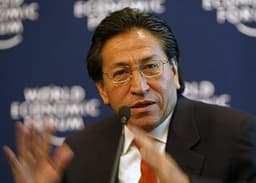
Alejandro Toledo
Politician · Modern
52.6Total

Huseyn Shaheed Suhrawardy
Politician · Modern
52.9Total
Basic Information
Born
1946
1892
Died
—
1963
Era
Modern
Modern
Nationality
Peru
Pakistan
Occupation
Politician
Politician
Civilization
Western
Indian
Score Comparison
Military (10%)
27.7
36.4
Political (20%)
61.3
61.3
Influence (20%)
57.2
56.4
Legacy (20%)
44.2
46.7
Leadership (15%)
62.2
55.3
Strategy (15%)
60.0
60.0
TOTAL
52.6
52.9
Alejandro Toledo — Complete Timeline
2001 AD
Presidency and Economic Recovery (2001-2006)Political Action◆ Major
Alejandro Toledo assumed the presidency of Peru, becoming the first democratically elected president of indigenous Quechua descent. His administration focused on macroeconomic stability, attracting foreign investment, and reducing poverty. He oversaw a period of steady economic growth following the Fujimori era.
First Indigenous PresidentEconomic StabilityDemocracy
Impact: nationalconstructive
2019 AD
Corruption Conviction and Extradition (2019-2023)Political Action◆ Major
Toledo was arrested in the United States on extradition charges related to the Odebrecht scandal. He was accused of accepting $20 million in bribes from the Brazilian construction company in exchange for contracts during his presidency. In 2023, he was extradited to Peru to face trial.
CorruptionOdebrechtExtradition
Impact: nationaldestructive
Huseyn Shaheed Suhrawardy — Complete Timeline
1956 AD
Became Prime Minister of PakistanPolitical Action◆ Major
Huseyn Shaheed Suhrawardy became Prime Minister after Chaudhry Muhammad Ali's resignation. He was the first prime minister from East Pakistan. His tenure focused on regional autonomy and economic development for the eastern wing.
Prime MinisterEast Pakistan
Impact: national
Signed the 1956 Constitution into EffectPolitical Action◆ Major
As Prime Minister, Suhrawardy oversaw the implementation of the 1956 constitution, which established Pakistan as an Islamic republic. He advocated for a federal system with greater autonomy for provinces. The constitution was short-lived due to the 1958 coup.
ConstitutionFederalism
Impact: nationalconstructive
1957 AD
Resigned Under Pressure from President Iskander MirzaPolitical Action
Suhrawardy resigned after losing the confidence of President Iskander Mirza and facing opposition from the military establishment. His resignation highlighted the dominance of the presidency over the prime minister. He returned to opposition politics.
ResignationPolitical Conflict
Impact: national
Expert Analysis
Origins
Alejandro Toledo was born on March 28, 1946, in the small Andean village of Cabana, Peru, into a Quechua-speaking peasant family. He was the eighth of sixteen children, and his family worked as subsistence farmers. Toledo's early life was marked by poverty; he worked as a shoeshiner and sold newspapers to help support his family. Despite these hardships, he excelled academically, winning a scholarship to study at the University of San Francisco in the United States, where he earned a BA in economics. He later obtained a master's and PhD in economics from Stanford University, focusing on human resources and labor economics.
Huseyn Shaheed Suhrawardy was born on September 8, 1892, in Midnapore, Bengal Presidency, British India (now in West Bengal, India), into a prominent Muslim family. His father was a judge, and his mother was from a wealthy landowning family. Suhrawardy studied at Calcutta University and later at Oxford University, where he earned a law degree. He returned to India and began his legal career in Calcutta, quickly becoming involved in politics, joining the Bengal Provincial Muslim League.
Rise to Power
Toledo's political rise began in the 1990s after a career in academia and international organizations such as the World Bank. In 1995, he founded the party Perú Posible. He ran for president in 2000 against the controversial incumbent Alberto Fujimori. After a flawed election, Toledo led mass protests (the "March of the Four Suyos") that contributed to Fujimori's resignation. In 2001, Toledo won the presidency in a runoff against Alan García, securing 53.1% of the vote. He became the first democratically elected president of indigenous descent in Peru.
Suhrawardy's rise was rooted in the independence movement. He joined the All India Muslim League and became a key figure in Bengal politics. In 1946, he formed a coalition government in Bengal with the Hindu Mahasabha, which was controversial. After the partition of India in 1947, he moved to East Pakistan and became a leader of the Awami Muslim League. He served as a minister in several provincial governments and later as the leader of the opposition. In 1956, he became Prime Minister of Pakistan after the resignation of Chaudhry Muhammad Ali, becoming the first and only prime minister from East Pakistan.
Leadership & Governance
Toledo's presidency (2001-2006) focused on economic recovery and democratic consolidation. He inherited an economy recovering from the Fujimori era's authoritarianism and corruption. Toledo implemented market-friendly policies, privatized state-owned enterprises, and signed a free trade agreement with the United States. His government reduced inflation and increased GDP growth, averaging 5% annually. However, his administration was plagued by corruption scandals, including allegations of nepotism. Toledo's leadership style was inclusive, emphasizing indigenous rights and social programs like "Juntos" (Together), a conditional cash transfer program.
Suhrawardy's tenure as Prime Minister (1956-1957) was brief but impactful. He oversaw the implementation of the 1956 constitution, which declared Pakistan an Islamic republic and introduced a parliamentary system. He advocated for provincial autonomy and a secular state, which put him at odds with the military establishment and conservative Islamists. His leadership style was conciliatory, seeking to balance the interests of East and West Pakistan. However, he faced intense opposition from President Iskander Mirza and the military, leading to his resignation in 1957 after only 13 months in office.
Triumph & Tragedy
Toledo's greatest success was stabilizing Peru's economy and strengthening democratic institutions after the authoritarian Fujimori regime. His administration achieved GDP growth and reduced poverty by 15 percentage points. He also championed indigenous rights, creating the Ministry of Culture and promoting bilingual education. However, his legacy is marred by corruption: in 2019, he was arrested in the United States on charges of taking $20 million in bribes from Odebrecht, a Brazilian construction company. He was extradited to Peru in 2023, facing trial. This scandal overshadowed his earlier achievements.
Suhrawardy's triumph was the enactment of the 1956 constitution, which was Pakistan's first and only consensual constitution before the 1973 version. He also strengthened the role of East Pakistan in national politics, advocating for Bengali language rights and greater autonomy. His tragedy was his inability to sustain his government against military and presidential pressure. His resignation highlighted the instability of Pakistan's early democratic system. Furthermore, his collaboration with the Hindu Mahasabha in 1946 made him controversial among Muslim nationalists, and his legacy in Bangladesh is mixed due to his association with Pakistan.
Character & Destiny
Toledo was a charismatic and determined figure, driven by his humble origins to fight for social justice. His economic expertise was evident in his policy choices, but his decision-making was sometimes flawed by overconfidence and a tendency to surround himself with questionable associates. His character shaped his destiny: his rise from poverty to presidency was a testament to his perseverance, but his fall from grace due to corruption charges reflected a lack of ethical vigilance.
Suhrawardy was a shrewd politician and a skilled orator, known for his ability to build coalitions. He was a secularist in a increasingly religious political environment, which made him a target for Islamist opposition. His character—conciliatory but also pragmatic—led him to make compromises that alienated his base. His destiny was to be a transitional figure, unable to overcome the structural weaknesses of Pakistan's political system.
Legacy
Toledo's legacy is complex. In Peru, he is remembered as the first indigenous president who restored democracy and economic stability. However, his corruption conviction has tarnished his reputation. His scores reflect this: Political 61.3, Leadership 62.2, but Legacy only 44.2. His impact on indigenous rights is tangible, with increased representation and cultural recognition. Internationally, he is a cautionary tale about the fragility of democratic gains.
Suhrawardy's legacy in Pakistan is limited due to his short tenure. He is remembered as a champion of East Pakistan's rights and a secularist. His constitution influenced later political frameworks. In Bangladesh, he is seen as a precursor to Bengali nationalism, though his support for a united Pakistan complicates his image. His scores: Political 61.3, Leadership 55.3, Legacy 46.7. His overall score (52.9) slightly edges Toledo's (52.6), reflecting a similar level of impact but with different contexts.
Conclusion
While Toledo and Suhrawardy both scored similarly overall (52.6 vs 52.9), their impacts differ in scope and duration. Toledo's presidency had a direct, transformative effect on Peru's economy and democracy, but his corruption conviction severely limits his positive legacy. Suhrawardy's influence was more foundational, shaping Pakistan's constitutional framework and highlighting the tensions between East and West Pakistan. However, his failure to consolidate power and his brief tenure reduce his long-term impact. On balance, Toledo had a greater concrete impact on his country's trajectory, despite his fall. His economic reforms and democratic restoration were substantive, whereas Suhrawardy's achievements were more symbolic and short-lived. Thus, Toledo edges ahead in terms of practical governance, but his legacy is more contested.
Rankings
🥇
Huseyn Shaheed SuhrawardyLeader
Mil: 36.4Pol: 61.3Inf: 56.4
52.9
🥈
Alejandro Toledo
Mil: 27.7Pol: 61.3Inf: 57.2
52.6
+0.3 behind
How This Comparison Works
Algorithm
Each figure is scored on 6 dimensions (0—100 scale) based on structured historical data: Military (10%), Political (20%), Influence (20%), Legacy (20%), Leadership (15%), Strategy (15%). The weighted total produces the final ranking.
Data Sources
Scores are computed from structured sub-indicators in the database. Scale factors adjust for era (Ancient ×0.85, Modern ×1.0) and civilization size (Eastern ×1.05, Other ×0.80) to account for differences in population and military scale.
Maximum 3 Figures
Comparisons are limited to 2—3 figures to ensure readability and statistical meaningfulness.
Error Margins
±5 points per dimension — Sub-scores are derived from historical records with inherent uncertainty. Two figures within 5 points on a dimension should be considered roughly equivalent in that area.
Total Score Accuracy
±3 points overall — The weighted combination of 6 dimensions produces a total score with approximately ±3 points of uncertainty. Differences of less than 3 points are not statistically significant— the figures are effectively tied.
Known Limitations
- Historical records are incomplete and uneven across civilizations
- Figures from oral-tradition societies may be underrepresented
- Occupation labels can misclassify multi-role figures
- Scores measure capability and impact, not moral character
- Quantitative scoring is a comparison tool, not absolute truth
Capability Radar
Military (10%) — Battles & Warfare
Battles
48
46
Win Rate
50
45
Expansion
56
50
Political (20%) — Governance & Reform
Reform
45
40
Diplomacy
50
60
Economy
35
30
Influence (20%) — Cultural & Global Reach
Cultural
55
40
Global
30
40
Legacy (20%) — Historical Impact
Historical
40
50
Longevity
25
30
Leadership (15%) — Power & Stability
Tenure
40
30
Stability
20
20
Strategy (15%) — Tactics & Innovation
Strategy
53
54
Tactics
59
53
Reform
64
57
Similar Comparisons
Comments & Discussion
No comments yet. Be the first to share your thoughts!