Loading...
Alboin vs Uijong of Goryeo
Alboin leads by 7.1 pts · 2 figures compared
…
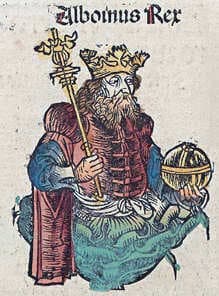
Alboin
Emperor · Medieval
50.1Total

Uijong of Goryeo
Emperor · Medieval
43.0Total
Basic Information
Born
530
1127
Died
572
1173
Era
Medieval
Medieval
Nationality
Lombards
Korea
Occupation
Emperor
Emperor
Civilization
Western
Eastern
Score Comparison
Military (10%)
72.5
50.8
Political (20%)
32.2
33.6
Influence (20%)
54.1
45.5
Legacy (20%)
45.0
34.2
Leadership (15%)
48.4
44.5
Strategy (15%)
60.0
63.2
TOTAL
50.1
43.0
Alboin — Complete Timeline
568 AD
Invasion of ItalyWar
Alboin led the Lombards, along with Saxon, Gepid, and other allies, across the Alps into Italy. This invasion began the Lombard conquest of the Italian peninsula, which had been devastated by the Gothic War, and established the Lombard Kingdom.
Migration PeriodLombard KingdomItaly
Impact: regionaldestructive
569 AD
Siege of PaviaWar◆ Major
Alboin besieged the city of Pavia, which resisted for three years. After its capture in 572, Alboin made Pavia the capital of the Lombard Kingdom, a status it retained for centuries, becoming a center of Lombard power.
SiegeLombard KingdomCapital
Impact: regional
572 AD
Murder of AlboinOther◆ Major
Alboin was assassinated in Verona at the instigation of his wife, Rosamund, who sought revenge for his forcing her to drink from her father's skull. His death led to a period of instability among the Lombards, though the kingdom survived.
AssassinationLombard KingdomSuccession
Impact: regionaltragic
Uijong of Goryeo — Complete Timeline
1160 AD
Neglect of military officialsPolitical Action
Uijong's reign was marked by favoritism toward civil officials and neglect of the military, including unfair promotions and insults. This created deep resentment among generals, culminating in the 1170 coup.
PolicyMilitaryGoryeo
Impact: nationaldestructive
1170 AD
Military coup by Jeong Jung-buPolitical Action
General Jeong Jung-bu led a coup against King Uijong, who had neglected military officials in favor of civil scholars. The king was deposed and exiled to Geojedo Island, marking the beginning of a century of military rule in Goryeo.
CoupMilitary RuleGoryeo
Impact: nationaldestructive
Exile to GeojedoPolitical Action◆ Major
After being deposed, Uijong was exiled to Geojedo Island, where he was later murdered in 1173 on the orders of the military regime. His death eliminated any possibility of a royal restoration.
ExileAssassinationGoryeo
Impact: nationaltragic
Expert Analysis
Origins
Alboin, born around 530 AD, was the son of King Audoin of the Lombards, a Germanic tribe then settled in Pannonia (modern Hungary). His mother is not well-documented, but his upbringing was martial, steeped in the warrior culture of the Lombards. He gained early fame leading raids against the neighboring Gepids, and his marriage to Rosamund, daughter of the Gepid king Cunimund, was a political move that ended in violence—Alboin later killed Cunimund and fashioned a drinking cup from his skull. This act would later seal his fate.
Uijong of Goryeo (1127–1173), born Wang Hyeon, was the son of King Injong and Queen Gongye. As a prince, he received a Confucian education emphasizing civil administration and literary arts. He ascended the throne in 1146 at age 19, inheriting a kingdom where the balance between civil and military officials was already strained. His early training gave him a preference for scholarly pursuits, setting the stage for his neglect of the military class.
Rise to Power
Alboin became king of the Lombards in 560 after his father's death. His first major act was to lead his people across the Alps into Italy in 568, responding to pressure from the Avars and seeking new lands. The invasion was swift: by 569, he had captured Milan, and by 572, after a three-year siege, Pavia fell. Alboin made Pavia his capital, establishing the Lombard Kingdom in Italy. His military prowess was evident, scoring 72.5 in military score, but his political score was only 32.2, reflecting his inability to consolidate power through diplomacy.
Uijong's rise was hereditary. He became king at 19, but real power was contested between civil and military factions. Early in his reign, he relied on civil scholars like Kim Bu-sik, author of the Samguk Sagi, and neglected military officials. This favoritism led to unfair promotions and insults, as noted in key events. His political score of 33.6 is similar to Alboin's, indicating weak political acumen.
Leadership & Governance
Alboin's leadership was direct and martial. He ruled through personal bravery and the loyalty of his warriors, but he failed to establish lasting institutions. His governance was based on conquest and tribute, not administration. For example, after capturing Pavia, he did not integrate the local Roman population but imposed Lombard rule, leading to long-term instability. His leadership score of 48.4 reflects a style that inspired followers but lacked strategic depth.
Uijong governed through a civil bureaucracy, but his bias toward civil officials alienated the military. He promoted scholars over generals, even as Goryeo faced external threats from the Jin dynasty. His strategy score of 63.2 suggests he had some strategic sense, but his leadership score of 44.5 indicates he failed to manage the court. The military coup led by General Jeong Jung-bu in 1170 was a direct result of this neglect. Uijong was deposed and exiled, later murdered in 1173.
Triumph & Tragedy
Alboin's greatest triumph was the conquest of northern Italy, establishing a Lombard kingdom that lasted over 200 years. His invasion reshaped the Italian peninsula, ending Byzantine dominance in the north. However, his tragedy was his murder in 572, orchestrated by his wife Rosamund, after he forced her to drink from her father's skull. This act of cruelty destroyed his legacy—he died without securing succession, leading to a period of fragmentation.
Uijong's triumph was his early patronage of culture, such as supporting the compilation of historical texts. But his tragedy was his downfall: his neglect of the military led to his deposition, exile, and murder. His death marked the end of effective royal authority, as the military regime dominated Goryeo for decades. His total score of 43.0 reflects a reign that ended in failure.
Character & Destiny
Alboin was a warrior king—brave, violent, and impulsive. His character drove his conquests but also his death. Drinking from his father-in-law's skull was a brutal act that earned him enemies. Historical assessments note his military skill but also his lack of political foresight. His destiny was to die at the hands of those he wronged.
Uijong was a scholar-king—intellectual but weak. He favored civil officials and dismissed military concerns, leading to a coup. His character was passive; he trusted his advisors too much. His destiny was to be overthrown by the very army he neglected.
Legacy
Alboin's legacy is mixed. He is remembered as the founder of the Lombard Kingdom, which influenced Italian history through the Middle Ages. However, his reign was brief, and his murder prevented long-term stability. His influence score is 54.1, indicating some lasting impact but not transformative.
Uijong's legacy is largely negative. He is seen as the king who lost control to the military, triggering a period of turmoil. His reign is studied as a cautionary tale of civil-military imbalance. His influence score is 45.5, lower than Alboin's.
Conclusion
Alboin had greater impact than Uijong. Despite a shorter reign, Alboin's conquest of Italy established a kingdom that lasted centuries, while Uijong's failures led to his own overthrow and a military dictatorship. Alboin's military score of 72.5 and total score of 50.1 surpass Uijong's 50.8 and 43.0 respectively. Alboin's actions reshaped a region; Uijong's reign ended in collapse. Therefore, Alboin is the more significant historical figure.
Rankings
🥇
AlboinLeader
Mil: 72.5Pol: 32.2Inf: 54.1
50.1
🥈
Uijong of Goryeo
Mil: 50.8Pol: 33.6Inf: 45.5
43.0
+7.1 behind
How This Comparison Works
Algorithm
Each figure is scored on 6 dimensions (0—100 scale) based on structured historical data: Military (10%), Political (20%), Influence (20%), Legacy (20%), Leadership (15%), Strategy (15%). The weighted total produces the final ranking.
Data Sources
Scores are computed from structured sub-indicators in the database. Scale factors adjust for era (Ancient ×0.85, Modern ×1.0) and civilization size (Eastern ×1.05, Other ×0.80) to account for differences in population and military scale.
Maximum 3 Figures
Comparisons are limited to 2—3 figures to ensure readability and statistical meaningfulness.
Error Margins
±5 points per dimension — Sub-scores are derived from historical records with inherent uncertainty. Two figures within 5 points on a dimension should be considered roughly equivalent in that area.
Total Score Accuracy
±3 points overall — The weighted combination of 6 dimensions produces a total score with approximately ±3 points of uncertainty. Differences of less than 3 points are not statistically significant— the figures are effectively tied.
Known Limitations
- Historical records are incomplete and uneven across civilizations
- Figures from oral-tradition societies may be underrepresented
- Occupation labels can misclassify multi-role figures
- Scores measure capability and impact, not moral character
- Quantitative scoring is a comparison tool, not absolute truth
Capability Radar
Military (10%) — Battles & Warfare
Battles
55
46
Win Rate
60
45
Expansion
65
50
Political (20%) — Governance & Reform
Reform
20
5
Diplomacy
35
10
Economy
25
10
Influence (20%) — Cultural & Global Reach
Cultural
30
5
Global
25
5
Legacy (20%) — Historical Impact
Historical
40
10
Longevity
30
5
Leadership (15%) — Power & Stability
Tenure
40
15
Stability
20
5
Strategy (15%) — Tactics & Innovation
Strategy
55
57
Tactics
50
58
Reform
30
63
Similar Comparisons
Comments & Discussion
No comments yet. Be the first to share your thoughts!