Loading...
Alboin vs Julius Caesar
Julius Caesar leads by 32.7 pts · 2 figures compared
…
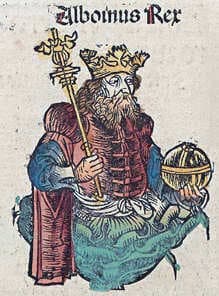
Alboin
Emperor · Medieval
50.1Total

Julius Caesar
General · Ancient
82.8Total
Basic Information
Born
530
-100
Died
572
-44
Era
Medieval
Ancient
Nationality
Lombards
Roman Republic
Occupation
Emperor
General
Civilization
Western
Western
Score Comparison
Military (10%)
72.5
88.0
Political (20%)
32.2
78.0
Influence (20%)
54.1
85.0
Legacy (20%)
45.0
82.0
Leadership (15%)
48.4
80.0
Strategy (15%)
60.0
85.0
TOTAL
50.1
82.8
Alboin — Complete Timeline
568 AD
Invasion of ItalyWar
Alboin led the Lombards, along with Saxon, Gepid, and other allies, across the Alps into Italy. This invasion began the Lombard conquest of the Italian peninsula, which had been devastated by the Gothic War, and established the Lombard Kingdom.
Migration PeriodLombard KingdomItaly
Impact: regionaldestructive
569 AD
Siege of PaviaWar◆ Major
Alboin besieged the city of Pavia, which resisted for three years. After its capture in 572, Alboin made Pavia the capital of the Lombard Kingdom, a status it retained for centuries, becoming a center of Lombard power.
SiegeLombard KingdomCapital
Impact: regional
572 AD
Murder of AlboinOther◆ Major
Alboin was assassinated in Verona at the instigation of his wife, Rosamund, who sought revenge for his forcing her to drink from her father's skull. His death led to a period of instability among the Lombards, though the kingdom survived.
AssassinationLombard KingdomSuccession
Impact: regionaltragic
Julius Caesar — Complete Timeline
58 BC
Gallic WarsWar◆ Major
Caesar, as proconsul of Gaul, launched a series of campaigns that conquered all of Gaul (modern France, Belgium, and parts of Switzerland). He fought numerous battles, including against the Helvetii, the Belgae, and the Gallic chieftain Vercingetorix. The wars brought immense wealth and a loyal army to Caesar.
Gallic WarsConquestRoman Expansion
Impact: regional
49 BC
Crossing the RubiconPolitical Action◆ Major
Caesar led Legio XIII across the Rubicon River into Italy, defying the Roman Senate's order to disband his army. This act triggered a civil war against Pompey and the Optimates, ultimately leading to Caesar's dictatorship and the end of the Roman Republic.
Roman Civil WarEnd of RepublicPower Struggle
Impact: global
48 BC
Battle of PharsalusWar◆ Major
Caesar's outnumbered army defeated the larger forces of Pompey the Great at Pharsalus in Greece. Caesar's tactical use of a reserve line to counter Pompey's cavalry charge proved decisive. Pompey fled to Egypt, where he was assassinated, leaving Caesar as the undisputed master of the Roman world.
Roman Civil WarBattleDecisive Victory
Impact: regional
44 BC
Appointment as Dictator for LifePolitical Action◆ Major
The Roman Senate appointed Caesar dictator perpetuo (dictator for life), granting him unprecedented personal power. This move concentrated military, legislative, and judicial authority in one person, effectively ending the Roman Republic's traditional system of checks and balances and alarming many senators.
DictatorshipEnd of RepublicPower Consolidation
Impact: regionaldestructive
Assassination on the Ides of MarchPolitical Action◆ Major
A group of Roman senators, led by Marcus Junius Brutus and Gaius Cassius Longinus, stabbed Caesar to death at a meeting of the Senate in the Theatre of Pompey. The assassination was intended to restore the Republic, but instead triggered another civil war that led to the rise of the Roman Empire.
AssassinationRoman PoliticsEnd of Republic
Impact: globaldestructive
Expert Analysis
alboin-vs-julius-caesar
# The Conqueror's Cup
On a spring evening in 572, in a palace in Verona, King Alboin of the Lombards raised a goblet carved from the skull of his dead father-in-law. He ordered his wife, Rosamund, to drink from it at a banquet. She obeyed. But within hours, she had conspired with her husband’s foster brother to murder him in his bed. The Ides of March had come for Alboin too, but without poetry, without senators, without a legacy that would echo across millennia.
Six centuries earlier, on another spring day in 44 BCE, Julius Caesar had fallen beneath twenty-three dagger blows in the Senate chamber of Rome. Both men were conquerors who invaded Italy. Both were assassinated. Yet one became a god, the other a footnote. Why?
Origins
Julius Caesar was born into the patrician Julian clan in 100 BCE, a family claiming descent from the goddess Venus. His Rome was a republic in decay, its institutions straining under the weight of empire, its aristocracy locked in civil wars. Caesar grew up surrounded by political murder, proscriptions, and the example of his uncle Marius, a populist general who had marched on Rome itself. From childhood, Caesar learned that in Rome, survival meant ambition.
Alboin was born around 530, son of the Lombard king Audoin. His people were Germanic tribesmen who had wandered from the Baltic to the Danube, living as federates of the Byzantine Empire. The Lombards had no senate, no written laws, no marble temples. Their world was one of blood feuds, cattle raids, and oaths sworn on swords. Alboin learned that power came from the spear, not the vote.
The difference in their civilizations shaped everything. Rome had institutions, however corrupt. Lombard society had only the king’s war band. Caesar could manipulate a complex political system; Alboin could only kill or be killed.
Rise to Power
Caesar’s path was a masterclass in political calculation. He borrowed fortunes to fund public games, built alliances with the wealthy Crassus and the popular Pompey, conquered Gaul in eight years of brilliant campaigning, and then—when the Senate ordered him to disband his army—crossed the Rubicon River in 49 BCE, choosing civil war over submission. His rise was a long, deliberate chess game.
Alboin’s rise was simpler. When his father died around 560, Alboin became king of the Lombards. His first major act was to defeat the neighboring Gepids in battle, killing their king, Cunimund. He then took the king’s daughter, Rosamund, as his wife and had the skull fashioned into a drinking cup. There was no subtlety, no negotiation. Victory was total, and total victory demanded total humiliation.
The difference in their eras explains this. Caesar lived in a world where legitimacy mattered—the Senate, the assemblies, the ancient forms of Roman government. Alboin lived in a world where legitimacy came from victory alone.
Leadership & Governance
As dictator of Rome, Caesar reformed the calendar, extended citizenship to provincials, initiated public works, and planned campaigns against Parthia. His military genius lay in speed and logistics: he built bridges across the Rhine in ten days, besieged Alesia with double fortifications, and won at Pharsalus against overwhelming odds. His political genius lay in clemency: he pardoned his enemies, promoted talent regardless of birth, and centralized power without abolishing the Republic’s forms entirely.
Alboin’s leadership was purely martial. In 568, he led a confederation of Lombards, Saxons, and Gepids across the Alps into Italy, encountering little resistance from the war-weary Byzantine garrisons. He captured Milan in 569 and besieged Pavia for three years. When Pavia finally fell in 572, he made it his capital. But he never established lasting institutions. He divided Italy among his dukes, who governed as independent warlords. He issued no laws, built no roads, minted no lasting coinage.
Caesar governed through administration; Alboin governed through plunder. One built an empire; the other merely seized territory.
Triumph & Tragedy
Caesar’s greatest moment was his triumph over Gaul—a conquest that added a province larger than Italy itself to the Roman world. His greatest failure was his assassination, the result of his own arrogance. He had accepted a dictatorship for life, allowed himself to be worshipped as a god, and dismissed the warnings of soothsayers and his wife. “The Ides of March have come,” he said to the seer, who replied, “Yes, but not yet gone.”
Alboin’s greatest moment was the conquest of northern Italy, which established a Lombard kingdom that would last for two centuries. His greatest failure was personal: forcing his wife to drink from her father’s skull. That act of cruelty, born of a warrior culture that celebrated vengeance, destroyed him. Rosamund’s revenge was swift and final.
Both men died from arrogance, but Caesar’s arrogance was political—he believed his power made him invulnerable. Alboin’s was personal—he believed his cruelty made him feared.
Character & Destiny
Caesar was calculating, charismatic, and relentlessly ambitious. He gambled everything on his own genius and won, until he didn’t. His personality—coldly rational, capable of both mercy and ruthlessness—shaped Roman history for centuries. He understood that power required legitimacy, even as he destroyed the old legitimacy.
Alboin was a warrior king in the Germanic tradition: brave, generous to his followers, merciless to his enemies. He understood only the power of the sword. His personality reflected his culture’s values: honor, vengeance, and the feast. When he humiliated his wife, he was following the logic of his world—but that logic led to his death.
Caesar’s destiny was to become a title: Kaiser, Tsar. Alboin’s destiny was to become a cautionary tale.
Legacy
Caesar’s legacy is immeasurable. His adopted heir, Octavian, became Augustus, the first Roman emperor. His reforms outlasted the Republic he destroyed. His writings—the *Commentaries*—are still studied in military academies. His name became synonymous with absolute power. The month of July bears his name.
Alboin’s legacy is modest. The Lombard kingdom he founded lasted until Charlemagne conquered it in 774. His name survives in a few Italian place names. The story of Rosamund and the skull cup became a popular medieval legend, retold by poets and chroniclers. But no empire, no calendar, no political system bears his mark.
Why the difference? Because Caesar conquered a civilization and transformed it. Alboin conquered a territory and merely occupied it.
Conclusion
Standing in the Forum of Rome, one sees Caesar everywhere—in the temples he rebuilt, the calendar he reformed, the very idea of imperial rule. Standing in Pavia, one searches for Alboin in vain. The Lombard king’s palace is gone, his bones lost, his kingdom absorbed.
The difference between these two conquerors is not merely a matter of ability, though Caesar was clearly the greater general and statesman. It is a matter of civilization. Caesar inherited a tradition of law, administration, and cultural memory that he could reshape. Alboin inherited only a war band and a memory of wandering. One built with stone; the other built with bones.
And yet, there is something haunting in Alboin’s story that Caesar’s lacks. Caesar’s death was political theater, a drama of republic and tyranny. Alboin’s death was personal—a wife’s revenge, a skull’s curse, the raw violence of a world where honor was measured in blood. Caesar changed the world; Alboin merely passed through it. But both drank from cups they should never have raised.
Rankings
🥇
Julius CaesarLeader
Mil: 88.0Pol: 78.0Inf: 85.0
82.8
🥈
Alboin
Mil: 72.5Pol: 32.2Inf: 54.1
50.1
+32.7 behind
How This Comparison Works
Algorithm
Each figure is scored on 6 dimensions (0—100 scale) based on structured historical data: Military (10%), Political (20%), Influence (20%), Legacy (20%), Leadership (15%), Strategy (15%). The weighted total produces the final ranking.
Data Sources
Scores are computed from structured sub-indicators in the database. Scale factors adjust for era (Ancient ×0.85, Modern ×1.0) and civilization size (Eastern ×1.05, Other ×0.80) to account for differences in population and military scale.
Maximum 3 Figures
Comparisons are limited to 2—3 figures to ensure readability and statistical meaningfulness.
Error Margins
±5 points per dimension — Sub-scores are derived from historical records with inherent uncertainty. Two figures within 5 points on a dimension should be considered roughly equivalent in that area.
Total Score Accuracy
±3 points overall — The weighted combination of 6 dimensions produces a total score with approximately ±3 points of uncertainty. Differences of less than 3 points are not statistically significant— the figures are effectively tied.
Known Limitations
- Historical records are incomplete and uneven across civilizations
- Figures from oral-tradition societies may be underrepresented
- Occupation labels can misclassify multi-role figures
- Scores measure capability and impact, not moral character
- Quantitative scoring is a comparison tool, not absolute truth
Capability Radar
Military (10%) — Battles & Warfare
Battles
55
95
Win Rate
60
92
Expansion
65
97
Political (20%) — Governance & Reform
Reform
20
90
Diplomacy
35
85
Economy
25
82
Influence (20%) — Cultural & Global Reach
Cultural
30
88
Global
25
94
Legacy (20%) — Historical Impact
Historical
40
95
Longevity
30
96
Leadership (15%) — Power & Stability
Tenure
40
75
Stability
20
60
Strategy (15%) — Tactics & Innovation
Strategy
55
94
Tactics
50
96
Reform
30
88
Similar Comparisons
Comments & Discussion
No comments yet. Be the first to share your thoughts!