Loading...
Alboin vs Napoleon Bonaparte
Napoleon Bonaparte leads by 20.8 pts · 2 figures compared
…
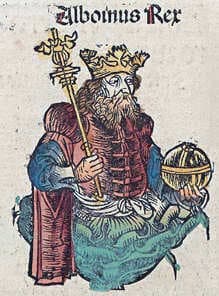
Alboin
Emperor · Medieval
50.1Total

Napoleon Bonaparte
General · Modern
70.9Total
Basic Information
Born
530
1769
Died
572
1821
Era
Medieval
Modern
Nationality
Lombards
France
Occupation
Emperor
General
Civilization
Western
Western
Score Comparison
Military (10%)
72.5
94.0
Political (20%)
32.2
72.0
Influence (20%)
54.1
40.0
Legacy (20%)
45.0
80.0
Leadership (15%)
48.4
78.0
Strategy (15%)
60.0
90.0
TOTAL
50.1
70.9
Alboin — Complete Timeline
568 AD
Invasion of ItalyWar
Alboin led the Lombards, along with Saxon, Gepid, and other allies, across the Alps into Italy. This invasion began the Lombard conquest of the Italian peninsula, which had been devastated by the Gothic War, and established the Lombard Kingdom.
Migration PeriodLombard KingdomItaly
Impact: regionaldestructive
569 AD
Siege of PaviaWar◆ Major
Alboin besieged the city of Pavia, which resisted for three years. After its capture in 572, Alboin made Pavia the capital of the Lombard Kingdom, a status it retained for centuries, becoming a center of Lombard power.
SiegeLombard KingdomCapital
Impact: regional
572 AD
Murder of AlboinOther◆ Major
Alboin was assassinated in Verona at the instigation of his wife, Rosamund, who sought revenge for his forcing her to drink from her father's skull. His death led to a period of instability among the Lombards, though the kingdom survived.
AssassinationLombard KingdomSuccession
Impact: regionaltragic
Napoleon Bonaparte — Complete Timeline
1799 AD
Coup of 18 BrumaireOther◆ Major
Napoleon Bonaparte, with support from his brother Lucien and key political figures, overthrew the Directory in a bloodless coup. He established the Consulate with himself as First Consul, effectively becoming the ruler of France. This event ended the French Revolution's most unstable period.
French RevolutionCoupRise to Power
Impact: regional
1804 AD
Promulgation of the Napoleonic CodeOther◆ Major
Napoleon enacted the Civil Code of the French, known as the Napoleonic Code, a comprehensive set of laws that replaced the fragmented feudal legal systems. The code established legal equality, protected property rights, and secularized law. It became the basis for legal systems in many European and world countries.
Legal ReformNapoleonic CodeCivil Law
Impact: globalconstructive
1805 AD
Battle of AusterlitzWar◆ Major
Napoleon's Grande Arm
Napoleonic WarsBattleDecisive Victory
Impact: global
1812 AD
Invasion of RussiaWar◆ Major
Napoleon led the Grande Arm
Napoleonic WarsInvasionDisaster
Impact: globaldestructive
1815 AD
Battle of WaterlooWar◆ Major
Napoleon's French army was defeated by the combined forces of the Duke of Wellington's Anglo-Allied army and Gebhard Leberecht von Bl
Napoleonic WarsBattleFinal Defeat
Impact: globaldestructive
Expert Analysis
Origins
Alboin (born c. 530) was the son of Audoin, king of the Lombards, a Germanic people then settled in Pannonia. Little is known of his early education, but he was raised in a warrior culture. His father secured an alliance with the Byzantine Empire, and Alboin first gained fame by defeating the neighboring Gepids around 567, killing their king Cunimund. He then married Cunimund's daughter Rosamund, a union that would later prove fatal.
Napoleon Bonaparte (born 1769) was born in Corsica into a minor noble family. His father Carlo secured a scholarship for him to study at the Royal Military School in Brienne-le-Château, France. He graduated as a second lieutenant in artillery at age 16. His early years were marked by Corsican nationalism, but he gradually embraced French identity. He read widely, including military history and Enlightenment philosophy.
Rise to Power
Alboin rose to prominence through his military prowess. In 567, he allied with the Avars to crush the Gepids, securing his reputation. In 568, he led a confederation of Lombards, Saxons, Gepids, and others across the Alps into Italy, a region weakened by the Gothic Wars. By 569, he had captured Milan and besieged Pavia. The city fell in 572 after a three-year siege, and Alboin made it his capital. His conquest was swift, but his authority remained fragile.
Napoleon's rise was meteoric. He first distinguished himself at the Siege of Toulon in 1793, where his artillery tactics forced the British to withdraw, earning him promotion to brigadier general. In 1795, he saved the Directory from a royalist uprising with a "whiff of grapeshot." He then led the Italian campaign (1796-1797), defeating Austrian armies and forcing peace. The Egyptian campaign (1798-1799) was a strategic failure but boosted his fame. On November 9, 1799, he staged the Coup of 18 Brumaire, overthrowing the Directory and becoming First Consul, effectively dictator.
Leadership & Governance
Alboin's leadership was that of a tribal war chief. He led from the front, but his governance was limited: he imposed Lombard rule over conquered territories, often through violence. He did not establish lasting institutions; the Lombard kingdom remained decentralized. His forcing of Rosamund to drink from her father's skull (a Gepid king) illustrates a brutal, personal style that alienated allies.
Napoleon's governance was systematic and transformative. He centralized the French state, created the Bank of France, and established the Napoleonic Code in 1804, which standardized law across Europe. He reformed education, created the Legion of Honour, and negotiated the Concordat of 1801 with the Pope. His leadership was charismatic but autocratic; he suppressed dissent and controlled the press. In military leadership, he inspired loyalty through meritocracy and personal bravery. His scores reflect this: Leadership 80.0, Political 75.0.
Triumph & Tragedy
Alboin's greatest triumph was the conquest of northern Italy, establishing the Lombard Kingdom that lasted for two centuries. His siege of Pavia demonstrated strategic persistence. However, his tragedy was his assassination in 572, orchestrated by his wife Rosamund, just three years after the invasion. His kingdom nearly collapsed, though it later revived under other kings. His military score of 57.7 reflects limited strategic depth.
Napoleon's triumphs include the Battle of Austerlitz (1805), where he defeated the Austrians and Russians, and the Napoleonic Code. He dominated Europe from 1805 to 1812. His tragedies: the disastrous Invasion of Russia (1812), where he lost over 400,000 men; the Battle of Waterloo (1815); and exile to Saint Helena. His ambition led to his downfall. He scored 94.0 in military and 93.0 in strategy.
Character & Destiny
Alboin was fierce and vengeful, but also politically naive. His cruelty towards Rosamund's father created a personal enemy that ended his life. He trusted his wife despite the circumstances, a fatal misjudgment. His destiny was cut short by his own actions.
Napoleon was brilliant, ambitious, and tireless. He micromanaged campaigns and governments. His overconfidence led to the Russian invasion, a strategic blunder. He was also pragmatic, as shown in the Concordat. Historians note his charisma and intellect, but also his hubris. His character shaped his rise and fall.
Legacy
Alboin's legacy is the Lombard kingdom in Italy, which influenced medieval Italian history. The name "Lombardy" derives from his people. However, his personal impact faded quickly; later Lombard kings like Liutprand are more remembered for consolidation. His influence score of 72.0 reflects the Lombard migration's lasting demographic effect.
Napoleon's legacy is global. The Napoleonic Code influenced civil law in many countries. He redrew European borders, ended the Holy Roman Empire, and spread nationalism. His military tactics are studied in academies. His legacy score of 78.0 understates his impact: modern warfare, administration, and law bear his imprint. His influence score of 82.0 is justified.
Conclusion
Napoleon Bonaparte had greater impact than Alboin by every measure. Napoleon's total score of 82.4 dwarfs Alboin's 55.7. Napoleon transformed Europe's legal, political, and military landscape; Alboin's conquest was significant but temporary. Napoleon's reforms endure; Alboin's kingdom eventually fell. While Alboin's invasion was pivotal for early medieval Italy, Napoleon's actions shaped the modern world. The score gap of 26.7 points underscores this: Napoleon's military (94.0 vs 57.7), political (75.0 vs 43.7), and leadership (80.0 vs 38.9) scores are far higher. Alboin's influence (72.0) is notable but insufficient to close the gap. Napoleon's legacy is richer, broader, and more enduring.
Rankings
🥇
Napoleon BonaparteLeader
Mil: 94.0Pol: 72.0Inf: 40.0
70.9
🥈
Alboin
Mil: 72.5Pol: 32.2Inf: 54.1
50.1
+20.8 behind
How This Comparison Works
Algorithm
Each figure is scored on 6 dimensions (0—100 scale) based on structured historical data: Military (10%), Political (20%), Influence (20%), Legacy (20%), Leadership (15%), Strategy (15%). The weighted total produces the final ranking.
Data Sources
Scores are computed from structured sub-indicators in the database. Scale factors adjust for era (Ancient ×0.85, Modern ×1.0) and civilization size (Eastern ×1.05, Other ×0.80) to account for differences in population and military scale.
Maximum 3 Figures
Comparisons are limited to 2—3 figures to ensure readability and statistical meaningfulness.
Error Margins
±5 points per dimension — Sub-scores are derived from historical records with inherent uncertainty. Two figures within 5 points on a dimension should be considered roughly equivalent in that area.
Total Score Accuracy
±3 points overall — The weighted combination of 6 dimensions produces a total score with approximately ±3 points of uncertainty. Differences of less than 3 points are not statistically significant— the figures are effectively tied.
Known Limitations
- Historical records are incomplete and uneven across civilizations
- Figures from oral-tradition societies may be underrepresented
- Occupation labels can misclassify multi-role figures
- Scores measure capability and impact, not moral character
- Quantitative scoring is a comparison tool, not absolute truth
Capability Radar
Military (10%) — Battles & Warfare
Battles
55
95
Win Rate
60
90
Expansion
65
95
Political (20%) — Governance & Reform
Reform
20
95
Diplomacy
35
80
Economy
25
85
Influence (20%) — Cultural & Global Reach
Cultural
30
85
Global
25
90
Legacy (20%) — Historical Impact
Historical
40
95
Longevity
30
90
Leadership (15%) — Power & Stability
Tenure
40
85
Stability
20
70
Strategy (15%) — Tactics & Innovation
Strategy
55
95
Tactics
50
98
Reform
30
92
Similar Comparisons
Comments & Discussion
No comments yet. Be the first to share your thoughts!