Loading...
Alaric I vs Aristides the Just
Alaric I leads by 2.1 pts · 2 figures compared
…
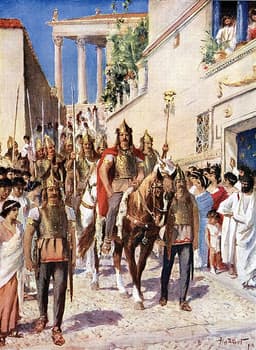
Alaric I
General · Ancient
53.5Total

Aristides the Just
General · Ancient
51.4Total
Basic Information
Born
370
-530
Died
410
-468
Era
Ancient
Ancient
Nationality
Visigothic Kingdom
Athens
Occupation
General
General
Civilization
Western
Western
Score Comparison
Military (10%)
74.7
30.0
Political (20%)
32.2
40.8
Influence (20%)
58.3
57.2
Legacy (20%)
52.0
49.2
Leadership (15%)
47.3
64.5
Strategy (15%)
65.4
60.0
TOTAL
53.5
51.4
Alaric I — Complete Timeline
378 AD
Battle of AdrianopleWar◆ Major
Alaric I fought as a commander of Gothic auxiliaries for the Roman Empire at the Battle of Adrianople. The Roman army was decisively defeated by the Goths, leading to the death of Emperor Valens and a major shift in Roman military policy.
Gothic WarRoman DefeatMigration Period
Impact: global
401 AD
Invasion of ItalyWar◆ Major
Alaric I led the Visigoths into Italy, seeking land and recognition from the Roman Empire. He defeated Roman forces at Pollentia and Verona, but was unable to secure a permanent settlement, leading to years of negotiation and conflict.
Gothic InvasionItaly Campaign
Impact: regional
410 AD
Sack of RomeWar
Alaric I led the Visigothic army in the sack of Rome. The city was plundered for three days, marking the first time Rome had been sacked in 800 years. The event shocked the Roman world and symbolized the decline of the Western Roman Empire.
Sack of RomeVisigothsFall of Rome
Impact: globaldestructive
Death near CosenzaOther
Alaric I died suddenly in Cosenza, southern Italy, shortly after the sack of Rome. His death was attributed to fever. According to legend, his body was buried in the bed of the Busento River, with the river diverted and then restored to conceal the grave.
DeathLegendVisigoths
Impact: regionaltragic
Aristides the Just — Complete Timeline
490 BC
Battle of MarathonWar◆ Major
Aristides served as one of the ten Athenian generals at Marathon. He commanded his tribe's contingent and later supported Miltiades' strategy. The Athenian victory repelled the first Persian invasion of Greece.
Greco-Persian WarsBattleAthens
Impact: regionalconstructive
482 BC
Ostracism of AristidesPolitical Action◆ Major
Aristides was ostracized from Athens, reportedly because his reputation for justice made him unpopular. According to tradition, an illiterate citizen voted for his ostracism because he was tired of hearing Aristides called 'the Just'.
OstracismAthenian PoliticsExile
Impact: national
480 BC
Battle of SalamisWar◆ Major
Aristides returned from exile to serve at Salamis. He led Athenian forces in capturing the island of Psyttaleia, eliminating a Persian garrison. The naval victory at Salamis was decisive in the Greco-Persian Wars.
Greco-Persian WarsNaval BattleAthens
Impact: regionalconstructive
478 BC
Formation of the Delian LeaguePolitical Action◆ Major
Aristides was appointed to assess the initial contributions of member states to the Delian League, the anti-Persian alliance led by Athens. His fair assessment earned him the trust of the allies and established the League's financial structure.
Delian LeagueAthenian EmpireAlliance
Impact: regionalconstructive
Expert Analysis
Origins
Alaric I was born around 370 AD on Peuce Island in the Danube Delta, into the Balti dynasty of the Visigoths. His early life was shaped by the aftermath of the Hunnic invasions, which forced his people to seek refuge within the Roman Empire. As a child, he experienced the trauma of the Gothic War and the Battle of Adrianople in 378, where the Goths defeated the Romans. He grew up in a society that valued martial prowess and resented Roman mistreatment. In contrast, Aristides the Just was born around 530 BC in Athens, into a wealthy aristocratic family. Little is known of his early education, but he likely received traditional Athenian training in rhetoric, music, and athletics. His family was part of the Alcmaeonid clan, though not its most prominent branch. Aristides' formative years were during the rise of Athenian democracy after the reforms of Cleisthenes.
Rise to Power
Alaric I first appears in historical records as a leader of Gothic foederati—barbarian auxiliaries serving the Roman Empire. He participated in the Battle of the Frigidus in 394 under the Roman general Theodosius I, but the heavy Gothic casualties there fueled his resentment. By 395, Alaric was elected king of the Visigoths and led a revolt, marching through Thrace and Greece. He was appointed magister militum (master of soldiers) by the Eastern Roman emperor Arcadius in 397, but the position gave him little real power. His major turning point came in 401 when he invaded Italy, seeking a permanent homeland. He defeated Roman forces at Pollentia and Verona in 402, but was unable to capture the emperor. Aristides rose to prominence as a general in the Persian Wars. He was one of the ten Athenian generals at the Battle of Marathon in 490 BC, where he commanded his tribe's contingent and supported Miltiades' strategy. His reputation for fairness led to his appointment as eponymous archon in 489 BC. However, his rivalry with Themistocles, who advocated naval expansion, led to his ostracism in 482 BC. Aristides was recalled from exile in 480 BC when Xerxes invaded Greece, and he fought at the Battle of Salamis, leading Athenian forces to capture the island of Psyttaleia.
Leadership & Governance
Alaric I's leadership style was that of a Germanic war king—he led by example in battle and maintained loyalty through promises of plunder and land. His governance was based on personal authority rather than institutions. He negotiated with Roman emperors for recognition and subsidies, but his demands were never fully met. In contrast, Aristides was a statesman who valued justice and cooperation. After the Persian Wars, he was chosen to assess the contributions of member states to the Delian League, the anti-Persian alliance led by Athens. His fair assessments earned him the nickname "the Just." He also helped establish the principle of equality among allies, though this later eroded under Athenian imperialism. Aristides' political score of 40.8 reflects his reputation for integrity, while Alaric's score of 32.2 indicates his limitations as a political leader.
Triumph & Tragedy
Alaric's greatest triumph was the sack of Rome in August 410 AD. After years of failed negotiations with Emperor Honorius, Alaric led the Visigoths into the city, plundering it for three days. This was the first time Rome had been sacked in 800 years, a psychological blow to the Roman world. However, his greatest tragedy was his sudden death later that year near Cosenza. According to legend, his body was buried in the Busento River, with the slaves who dug the grave killed to protect the secret. Aristides' greatest triumph was his role in the Greek victory at Salamis, where his capture of Psyttaleia eliminated a Persian garrison. He also helped shape the Delian League, which became the foundation of Athenian power. His tragedy was his ostracism—a punishment for his very virtue. According to tradition, an illiterate citizen voted to ostracize him because he was tired of hearing Aristides called "the Just." This highlights the tension between individual merit and democratic envy.
Character & Destiny
Alaric I was ambitious and persistent, but also pragmatic. He repeatedly tried to negotiate with Rome, only resorting to force when talks failed. His character was shaped by the Gothic experience of betrayal and marginalization. His destiny was to be the first barbarian to sack Rome, but also to die before securing a lasting homeland for his people. Aristides was known for his integrity and fairness, but also for his rivalry with Themistocles. His character made him a symbol of justice, but also a target for ostracism. His destiny was to be remembered as a model statesman, though his political influence was limited compared to Themistocles. Historians estimate Aristides' leadership score at 64.5, reflecting his principled approach, while Alaric's leadership score of 47.3 reflects his reliance on force.
Legacy
Alaric I's legacy is mixed. He demonstrated that the Roman Empire was vulnerable, paving the way for further barbarian incursions. The Visigoths under his successors eventually founded a kingdom in Gaul and Spain. His sack of Rome became a symbol of the decline of the Roman Empire. However, his immediate political achievements were limited. Aristides' legacy is more enduring in the realm of governance. He gave his name to the concept of "aristidean justice" and is often cited as a model of integrity. The Delian League's initial fairness under his assessment set a standard for international cooperation. However, the league soon became an Athenian empire. Aristides' legacy score is 49.2, slightly lower than Alaric's 52.0, reflecting the latter's greater historical impact on the course of events.
Conclusion
Alaric I had a greater immediate impact on history than Aristides the Just. His sack of Rome in 410 AD was a pivotal event that marked the beginning of the end for the Western Roman Empire. His actions accelerated the process of barbarian settlement and the fragmentation of Roman authority. In contrast, Aristides' contributions, while significant, were more about establishing principles of justice and cooperation within the framework of Athenian democracy. However, his influence was largely confined to the Greek world and did not fundamentally alter the course of civilizations. Alaric's total score of 53.5 edges out Aristides' 51.4, reflecting his greater military and strategic impact. While Aristides is a moral exemplar, Alaric changed the world.
Rankings
🥇
Alaric ILeader
Mil: 74.7Pol: 32.2Inf: 58.3
53.5
🥈
Aristides the Just
Mil: 30.0Pol: 40.8Inf: 57.2
51.4
+2.1 behind
How This Comparison Works
Algorithm
Each figure is scored on 6 dimensions (0—100 scale) based on structured historical data: Military (10%), Political (20%), Influence (20%), Legacy (20%), Leadership (15%), Strategy (15%). The weighted total produces the final ranking.
Data Sources
Scores are computed from structured sub-indicators in the database. Scale factors adjust for era (Ancient ×0.85, Modern ×1.0) and civilization size (Eastern ×1.05, Other ×0.80) to account for differences in population and military scale.
Maximum 3 Figures
Comparisons are limited to 2—3 figures to ensure readability and statistical meaningfulness.
Error Margins
±5 points per dimension — Sub-scores are derived from historical records with inherent uncertainty. Two figures within 5 points on a dimension should be considered roughly equivalent in that area.
Total Score Accuracy
±3 points overall — The weighted combination of 6 dimensions produces a total score with approximately ±3 points of uncertainty. Differences of less than 3 points are not statistically significant— the figures are effectively tied.
Known Limitations
- Historical records are incomplete and uneven across civilizations
- Figures from oral-tradition societies may be underrepresented
- Occupation labels can misclassify multi-role figures
- Scores measure capability and impact, not moral character
- Quantitative scoring is a comparison tool, not absolute truth
Capability Radar
Military (10%) — Battles & Warfare
Battles
65
30
Win Rate
60
40
Expansion
55
20
Political (20%) — Governance & Reform
Reform
40
50
Diplomacy
55
60
Economy
30
45
Influence (20%) — Cultural & Global Reach
Cultural
60
50
Global
60
45
Legacy (20%) — Historical Impact
Historical
65
55
Longevity
55
50
Leadership (15%) — Power & Stability
Tenure
50
55
Stability
35
55
Strategy (15%) — Tactics & Innovation
Strategy
65
40
Tactics
70
35
Reform
45
20
Similar Comparisons
Comments & Discussion
No comments yet. Be the first to share your thoughts!