Loading...
Alaric I vs Julius Caesar
Julius Caesar leads by 29.3 pts · 2 figures compared
…
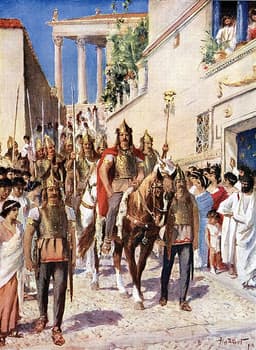
Alaric I
General · Ancient
53.5Total

Julius Caesar
General · Ancient
82.8Total
Basic Information
Born
370
-100
Died
410
-44
Era
Ancient
Ancient
Nationality
Visigothic Kingdom
Roman Republic
Occupation
General
General
Civilization
Western
Western
Score Comparison
Military (10%)
74.7
88.0
Political (20%)
32.2
78.0
Influence (20%)
58.3
85.0
Legacy (20%)
52.0
82.0
Leadership (15%)
47.3
80.0
Strategy (15%)
65.4
85.0
TOTAL
53.5
82.8
Alaric I — Complete Timeline
378 AD
Battle of AdrianopleWar◆ Major
Alaric I fought as a commander of Gothic auxiliaries for the Roman Empire at the Battle of Adrianople. The Roman army was decisively defeated by the Goths, leading to the death of Emperor Valens and a major shift in Roman military policy.
Gothic WarRoman DefeatMigration Period
Impact: global
401 AD
Invasion of ItalyWar◆ Major
Alaric I led the Visigoths into Italy, seeking land and recognition from the Roman Empire. He defeated Roman forces at Pollentia and Verona, but was unable to secure a permanent settlement, leading to years of negotiation and conflict.
Gothic InvasionItaly Campaign
Impact: regional
410 AD
Sack of RomeWar
Alaric I led the Visigothic army in the sack of Rome. The city was plundered for three days, marking the first time Rome had been sacked in 800 years. The event shocked the Roman world and symbolized the decline of the Western Roman Empire.
Sack of RomeVisigothsFall of Rome
Impact: globaldestructive
Death near CosenzaOther
Alaric I died suddenly in Cosenza, southern Italy, shortly after the sack of Rome. His death was attributed to fever. According to legend, his body was buried in the bed of the Busento River, with the river diverted and then restored to conceal the grave.
DeathLegendVisigoths
Impact: regionaltragic
Julius Caesar — Complete Timeline
58 BC
Gallic WarsWar◆ Major
Caesar, as proconsul of Gaul, launched a series of campaigns that conquered all of Gaul (modern France, Belgium, and parts of Switzerland). He fought numerous battles, including against the Helvetii, the Belgae, and the Gallic chieftain Vercingetorix. The wars brought immense wealth and a loyal army to Caesar.
Gallic WarsConquestRoman Expansion
Impact: regional
49 BC
Crossing the RubiconPolitical Action◆ Major
Caesar led Legio XIII across the Rubicon River into Italy, defying the Roman Senate's order to disband his army. This act triggered a civil war against Pompey and the Optimates, ultimately leading to Caesar's dictatorship and the end of the Roman Republic.
Roman Civil WarEnd of RepublicPower Struggle
Impact: global
48 BC
Battle of PharsalusWar◆ Major
Caesar's outnumbered army defeated the larger forces of Pompey the Great at Pharsalus in Greece. Caesar's tactical use of a reserve line to counter Pompey's cavalry charge proved decisive. Pompey fled to Egypt, where he was assassinated, leaving Caesar as the undisputed master of the Roman world.
Roman Civil WarBattleDecisive Victory
Impact: regional
44 BC
Appointment as Dictator for LifePolitical Action◆ Major
The Roman Senate appointed Caesar dictator perpetuo (dictator for life), granting him unprecedented personal power. This move concentrated military, legislative, and judicial authority in one person, effectively ending the Roman Republic's traditional system of checks and balances and alarming many senators.
DictatorshipEnd of RepublicPower Consolidation
Impact: regionaldestructive
Assassination on the Ides of MarchPolitical Action◆ Major
A group of Roman senators, led by Marcus Junius Brutus and Gaius Cassius Longinus, stabbed Caesar to death at a meeting of the Senate in the Theatre of Pompey. The assassination was intended to restore the Republic, but instead triggered another civil war that led to the rise of the Roman Empire.
AssassinationRoman PoliticsEnd of Republic
Impact: globaldestructive
Expert Analysis
alaric-i-vs-julius-caesar
# The Conqueror and the Barbarian: Two Paths to Rome's Heart
On a summer day in 47 BCE, Julius Caesar stood before the Roman Senate, having just returned from a campaign that had crushed his rivals and made him master of the known world. He wore a laurel wreath to hide his baldness, and his eyes, sharp and calculating, surveyed the men who would soon stab him to death. Sixty years later, in August 410 CE, another man—Alaric, king of the Visigoths—watched from his horse as his warriors poured through Rome's Salarian Gate. No laurel wreath for him, only the cold satisfaction of a man who had spent fifteen years demanding what the Romans refused to give. Two men, separated by generations, both driven by ambition, both seeking the same prize: the heart of Rome. One would become its greatest son, the other its most feared destroyer. Why did their fates diverge so dramatically?
Origins
Caesar was born into the patrician Julian clan, a family claiming descent from the goddess Venus. His childhood unfolded in the turbulent final decades of the Roman Republic, when senatorial infighting and civil wars had become routine. His father died when Caesar was sixteen, leaving him to navigate a world where political survival depended on alliances, bribes, and military command. He learned early that in Rome, glory was the only currency that mattered.
Alaric was born around 370 CE, somewhere along the Danube frontier, into a world already crumbling. The Visigoths had been pushed across the river by the Huns, seeking refuge inside Roman territory. They were treated as second-class subjects, cheated by Roman officials, starved, and finally driven to rebellion. Alaric grew up in refugee camps and battlefields. At the Battle of Adrianople in 378, when he was barely eight years old, he witnessed the Roman emperor Valens die in a catastrophic defeat that shattered the myth of Roman invincibility. Where Caesar saw Rome as a ladder to climb, Alaric saw it as a fortress to besiege—or a treasure to seize.
Rise to Power
Caesar's path was a masterclass in strategic patience. He served as a military tribune, then quaestor in Spain, then aedile, where he spent fortunes on public games to win popular favor. His capture by pirates as a young man—and his insistence that they raise his ransom, then return to crucify them—revealed a man who calculated every risk. His appointment as governor of Gaul in 58 BCE gave him the army he needed. Over eight years, he conquered all of Gaul, crossed the Rhine, and invaded Britain, building a legend and a loyal army.
Alaric's rise was more desperate. After Adrianople, the Visigoths were settled in the Balkans, but never trusted. Alaric emerged as a war leader among them, not by birthright but by proven ability. In 401, he led his people into Italy, demanding land and recognition. He defeated Roman forces at Pollentia and Verona, but each time the Romans bought him off with promises they never kept. He was a king without a kingdom, a general without a country. His rise was not a climb but a siege—each step forward met by Roman walls, both literal and political.
Leadership & Governance
Caesar governed with the brilliance of a man who understood that power is not just about winning battles but about winning hearts. As dictator, he reformed the calendar, granted citizenship to provincials, initiated public works, and redistributed land to veterans. His military genius lay in speed and surprise—at Alesia in 52 BCE, he besieged the Gauls while simultaneously fighting off a relief army, a feat of logistics and nerve. He led from the front, shared his soldiers' hardships, and wrote his own history in the third person, shaping his legacy as he lived it.
Alaric's leadership was fundamentally different. He was not a conqueror seeking to build an empire but a supplicant turned predator. He wanted what Caesar already had: a place within the Roman world. His military campaigns were aimed at negotiation as much as destruction. He besieged Rome three times, each time withdrawing when the Senate offered terms—land, gold, a military command. His sack of Rome in 410 lasted only three days, and while brutal, it was remarkably restrained by ancient standards. Churches were spared. Alaric was a Goth who admired Rome, which made him both more dangerous and more tragic.
Triumph & Tragedy
Caesar's greatest triumph was the conquest of Gaul, a feat that doubled Roman territory and made him the richest man in the Republic. His crossing of the Rubicon in 49 BCE—a river he knew he could not recross—was the moment that sealed his fate. His tragedy was that he could not stop. He refused to restore the Republic, accepted the title "dictator for life," and on the Ides of March, 44 BCE, sixty senators stabbed him to death in the very chamber where he had once been celebrated.
Alaric's triumph was the sack of Rome itself—the first time the Eternal City had fallen to a foreign enemy in 800 years. But his tragedy was that he died immediately after, in 410, near Cosenza in southern Italy, struck by fever. According to legend, his body was buried in the bed of the Busento River, its waters diverted and then released, so his grave would never be found. He had taken Rome but never held it, died a king without a kingdom.
Character & Destiny
Caesar was driven by an insatiable need for glory, a man who once said, "I would rather be first in a little village than second in Rome." His personality—calculating, charismatic, ruthless—shaped every decision. He forgave his enemies, which made them more dangerous. He trusted his luck, which made him careless. His destiny was to die at the peak of his power, a martyr to his own ambition.
Alaric was driven by desperation and pride. He wanted what Caesar had—recognition, land, a place in history—but he came from outside the walls. His character was shaped by rejection: every Roman promise broken, every treaty betrayed. He did not want to destroy Rome; he wanted to join it. When the Romans refused, he took what he could. His destiny was to be the man who proved Rome was mortal, a truth that haunted the empire for the next thousand years.
Legacy
Caesar's legacy is the Roman Empire itself. His adopted heir, Octavian, became Augustus, the first emperor. His name became a title: Kaiser, Tsar. His reforms outlasted the Republic. He is remembered as a military genius, a political master, and a cautionary tale about the seduction of absolute power.
Alaric's legacy is the sack of Rome, a single event that echoed through history as the symbolic end of the ancient world. He is remembered as a barbarian, but also as a king who exposed the empire's frailty. His Visigoths went on to found a kingdom in Gaul and Spain. He opened the door through which the Middle Ages would enter.
Conclusion
Two men, one city, two fates. Caesar climbed to the top of Rome and was destroyed by those who feared him. Alaric battered at its gates and died with the prize in his hands. One built an empire; the other proved it could fall. The difference between them was not talent or ambition—both had those in abundance. It was the accident of birth: Caesar was born inside the walls, Alaric outside. And in the end, the walls did not matter. Rome fell not to a barbarian but to its own exhaustion. Alaric was merely the messenger.
Rankings
🥇
Julius CaesarLeader
Mil: 88.0Pol: 78.0Inf: 85.0
82.8
🥈
Alaric I
Mil: 74.7Pol: 32.2Inf: 58.3
53.5
+29.3 behind
How This Comparison Works
Algorithm
Each figure is scored on 6 dimensions (0—100 scale) based on structured historical data: Military (10%), Political (20%), Influence (20%), Legacy (20%), Leadership (15%), Strategy (15%). The weighted total produces the final ranking.
Data Sources
Scores are computed from structured sub-indicators in the database. Scale factors adjust for era (Ancient ×0.85, Modern ×1.0) and civilization size (Eastern ×1.05, Other ×0.80) to account for differences in population and military scale.
Maximum 3 Figures
Comparisons are limited to 2—3 figures to ensure readability and statistical meaningfulness.
Error Margins
±5 points per dimension — Sub-scores are derived from historical records with inherent uncertainty. Two figures within 5 points on a dimension should be considered roughly equivalent in that area.
Total Score Accuracy
±3 points overall — The weighted combination of 6 dimensions produces a total score with approximately ±3 points of uncertainty. Differences of less than 3 points are not statistically significant— the figures are effectively tied.
Known Limitations
- Historical records are incomplete and uneven across civilizations
- Figures from oral-tradition societies may be underrepresented
- Occupation labels can misclassify multi-role figures
- Scores measure capability and impact, not moral character
- Quantitative scoring is a comparison tool, not absolute truth
Capability Radar
Military (10%) — Battles & Warfare
Battles
65
95
Win Rate
60
92
Expansion
55
97
Political (20%) — Governance & Reform
Reform
40
90
Diplomacy
55
85
Economy
30
82
Influence (20%) — Cultural & Global Reach
Cultural
60
88
Global
60
94
Legacy (20%) — Historical Impact
Historical
65
95
Longevity
55
96
Leadership (15%) — Power & Stability
Tenure
50
75
Stability
35
60
Strategy (15%) — Tactics & Innovation
Strategy
65
94
Tactics
70
96
Reform
45
88
Similar Comparisons
Comments & Discussion
No comments yet. Be the first to share your thoughts!