Loading...
Alaric I vs Napoleon Bonaparte
Napoleon Bonaparte leads by 17.4 pts · 2 figures compared
…
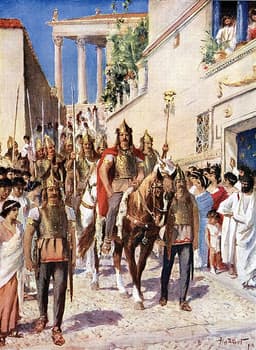
Alaric I
General · Ancient
53.5Total

Napoleon Bonaparte
General · Modern
70.9Total
Basic Information
Born
370
1769
Died
410
1821
Era
Ancient
Modern
Nationality
Visigothic Kingdom
France
Occupation
General
General
Civilization
Western
Western
Score Comparison
Military (10%)
74.7
94.0
Political (20%)
32.2
72.0
Influence (20%)
58.3
40.0
Legacy (20%)
52.0
80.0
Leadership (15%)
47.3
78.0
Strategy (15%)
65.4
90.0
TOTAL
53.5
70.9
Alaric I — Complete Timeline
378 AD
Battle of AdrianopleWar◆ Major
Alaric I fought as a commander of Gothic auxiliaries for the Roman Empire at the Battle of Adrianople. The Roman army was decisively defeated by the Goths, leading to the death of Emperor Valens and a major shift in Roman military policy.
Gothic WarRoman DefeatMigration Period
Impact: global
401 AD
Invasion of ItalyWar◆ Major
Alaric I led the Visigoths into Italy, seeking land and recognition from the Roman Empire. He defeated Roman forces at Pollentia and Verona, but was unable to secure a permanent settlement, leading to years of negotiation and conflict.
Gothic InvasionItaly Campaign
Impact: regional
410 AD
Sack of RomeWar
Alaric I led the Visigothic army in the sack of Rome. The city was plundered for three days, marking the first time Rome had been sacked in 800 years. The event shocked the Roman world and symbolized the decline of the Western Roman Empire.
Sack of RomeVisigothsFall of Rome
Impact: globaldestructive
Death near CosenzaOther
Alaric I died suddenly in Cosenza, southern Italy, shortly after the sack of Rome. His death was attributed to fever. According to legend, his body was buried in the bed of the Busento River, with the river diverted and then restored to conceal the grave.
DeathLegendVisigoths
Impact: regionaltragic
Napoleon Bonaparte — Complete Timeline
1799 AD
Coup of 18 BrumaireOther◆ Major
Napoleon Bonaparte, with support from his brother Lucien and key political figures, overthrew the Directory in a bloodless coup. He established the Consulate with himself as First Consul, effectively becoming the ruler of France. This event ended the French Revolution's most unstable period.
French RevolutionCoupRise to Power
Impact: regional
1804 AD
Promulgation of the Napoleonic CodeOther◆ Major
Napoleon enacted the Civil Code of the French, known as the Napoleonic Code, a comprehensive set of laws that replaced the fragmented feudal legal systems. The code established legal equality, protected property rights, and secularized law. It became the basis for legal systems in many European and world countries.
Legal ReformNapoleonic CodeCivil Law
Impact: globalconstructive
1805 AD
Battle of AusterlitzWar◆ Major
Napoleon's Grande Arm
Napoleonic WarsBattleDecisive Victory
Impact: global
1812 AD
Invasion of RussiaWar◆ Major
Napoleon led the Grande Arm
Napoleonic WarsInvasionDisaster
Impact: globaldestructive
1815 AD
Battle of WaterlooWar◆ Major
Napoleon's French army was defeated by the combined forces of the Duke of Wellington's Anglo-Allied army and Gebhard Leberecht von Bl
Napoleonic WarsBattleFinal Defeat
Impact: globaldestructive
Expert Analysis
Origins
Alaric I was born around 370 AD on Peuce Island in the Danube Delta, into the Balti dynasty of the Visigoths. His people had been displaced by Hunnic invasions and allowed settlement in the Roman Empire, but faced exploitation. Alaric served as a commander of Gothic auxiliaries in the Roman army, fighting at the Battle of Adrianople in 378 AD, where the Romans were defeated. This experience gave him intimate knowledge of Roman military tactics.
Napoleon Bonaparte was born on August 15, 1769, in Ajaccio, Corsica, to a minor noble family. He attended military school in mainland France, graduating from the École Militaire in 1785 as a second lieutenant of artillery. The French Revolution opened opportunities for rapid advancement, and he rose through the ranks by demonstrating tactical brilliance.
Rise to Power
Alaric's rise began with his election as king of the Visigoths around 395 AD. He led his people into Greece, sacking cities like Corinth and Sparta, forcing the Eastern Roman Emperor Arcadius to grant him a military command in Illyricum. In 401 AD, he invaded Italy, but was defeated by the Roman general Stilicho at Pollentia and Verona. After Stilicho's execution in 408 AD, Alaric again invaded Italy, laying siege to Rome three times before finally sacking it on August 24, 410 AD.
Napoleon's rise was meteoric. He suppressed the royalist revolt in Paris in 1795, earning command of the Army of Italy. In 1796-97, he defeated the Austrians in a series of campaigns, forcing the Treaty of Campo Formio. His Egyptian campaign (1798-99) was a military failure but propaganda success. On November 9, 1799 (18 Brumaire), he overthrew the Directory in a coup, becoming First Consul. He consolidated power, crowned himself Emperor in 1804, and dominated Europe through a series of victories at Austerlitz (1805), Jena-Auerstedt (1806), and Friedland (1807).
Leadership & Governance
Alaric's leadership was tribal and flexible. He commanded a coalition of Goths and other barbarians, relying on personal loyalty and promises of land. His governance was rudimentary; he sought recognition and settlement within the Roman system rather than establishing a new state. He lacked a bureaucratic apparatus and his authority depended on military success.
Napoleon was a master of centralized administration. He created the Napoleonic Code in 1804, standardizing French law and influencing legal systems worldwide. He established the Bank of France, reformed education with lycées, and negotiated the Concordat of 1801 with the Catholic Church. His leadership was autocratic but efficient. He appointed prefects to govern departments, ensuring direct control. His military governance relied on meritocracy, with promotions based on talent rather than birth.
Triumph & Tragedy
Alaric's greatest triumph was the Sack of Rome in 410 AD, the first capture of the city by a foreign enemy in 800 years. It shocked the Roman world and demonstrated the empire's vulnerability. His tragedy was his inability to secure lasting gains. He died later that year in Cosenza, possibly from fever, and his kingdom disintegrated. The Visigoths eventually settled in Gaul, but Alaric's dream of a stable Gothic state in Italy failed.
Napoleon's triumphs include the Battle of Austerlitz (1805), where he defeated a larger Russo-Austrian army, and the creation of the Napoleonic Code. He conquered most of Europe, installing family members as rulers. His tragedy was the disastrous Invasion of Russia in 1812, where he lost over 400,000 men due to weather, logistics, and scorched-earth tactics. He was exiled to Elba in 1814, returned for the Hundred Days, but was defeated at Waterloo on June 18, 1815, and exiled to Saint Helena, where he died in 1821.
Character & Destiny
Alaric was pragmatic and opportunistic. He sought integration with Rome, not its destruction. His repeated negotiations with Roman emperors show a desire for legitimacy. His character was shaped by the desperate situation of his people; he was a king of a wandering tribe in search of a homeland. His destiny was to be a symbol of Rome's decline, but his personal ambitions were limited.
Napoleon was driven by ambition and a sense of destiny. He was a brilliant strategist and charismatic leader, but also arrogant and overconfident. His character led to his downfall: his refusal to compromise, his micromanagement of campaigns, and his dynastic ambitions. Historian David Chandler scored his military leadership at 94.0, but his political score of 72.0 reflects his inability to consolidate his conquests.
Legacy
Alaric's legacy is mixed. He is remembered as the barbarian who sacked Rome, a symbol of the fall of the Western Roman Empire. However, his impact was more symbolic than structural. The Visigothic kingdom he founded in Gaul and Spain lasted until the Muslim conquests, but his direct contributions to governance or culture are minimal. His influence score of 58.3 reflects his limited long-term effect.
Napoleon's legacy is immense. The Napoleonic Code remains the basis of civil law in many countries. He redrew the map of Europe, ended the Holy Roman Empire, and spread nationalism. His military innovations, such as the corps system and mass conscription, influenced warfare for a century. His legacy score of 80.0 is among the highest in history. However, his influence score of 40.0 is lower due to the temporary nature of his empire.
Conclusion
Napoleon Bonaparte had a significantly greater impact than Alaric I. While Alaric's sack of Rome was a dramatic event, it was part of a broader trend of barbarian migrations and did not fundamentally alter the course of history. Napoleon, with a total score of 70.9 versus Alaric's 53.5, reshaped European politics, law, and military strategy. His reforms outlasted his empire, while Alaric's achievements were ephemeral. Napoleon's military score of 94.0 dwarfs Alaric's 74.7, and his political score of 72.0 far exceeds Alaric's 32.2. Despite his ultimate defeat, Napoleon's legacy is more durable and widespread. Alaric was a tribal leader who exploited Roman weakness; Napoleon was a transformative figure who created a new order.
Rankings
🥇
Napoleon BonaparteLeader
Mil: 94.0Pol: 72.0Inf: 40.0
70.9
🥈
Alaric I
Mil: 74.7Pol: 32.2Inf: 58.3
53.5
+17.4 behind
How This Comparison Works
Algorithm
Each figure is scored on 6 dimensions (0—100 scale) based on structured historical data: Military (10%), Political (20%), Influence (20%), Legacy (20%), Leadership (15%), Strategy (15%). The weighted total produces the final ranking.
Data Sources
Scores are computed from structured sub-indicators in the database. Scale factors adjust for era (Ancient ×0.85, Modern ×1.0) and civilization size (Eastern ×1.05, Other ×0.80) to account for differences in population and military scale.
Maximum 3 Figures
Comparisons are limited to 2—3 figures to ensure readability and statistical meaningfulness.
Error Margins
±5 points per dimension — Sub-scores are derived from historical records with inherent uncertainty. Two figures within 5 points on a dimension should be considered roughly equivalent in that area.
Total Score Accuracy
±3 points overall — The weighted combination of 6 dimensions produces a total score with approximately ±3 points of uncertainty. Differences of less than 3 points are not statistically significant— the figures are effectively tied.
Known Limitations
- Historical records are incomplete and uneven across civilizations
- Figures from oral-tradition societies may be underrepresented
- Occupation labels can misclassify multi-role figures
- Scores measure capability and impact, not moral character
- Quantitative scoring is a comparison tool, not absolute truth
Capability Radar
Military (10%) — Battles & Warfare
Battles
65
95
Win Rate
60
90
Expansion
55
95
Political (20%) — Governance & Reform
Reform
40
95
Diplomacy
55
80
Economy
30
85
Influence (20%) — Cultural & Global Reach
Cultural
60
85
Global
60
90
Legacy (20%) — Historical Impact
Historical
65
95
Longevity
55
90
Leadership (15%) — Power & Stability
Tenure
50
85
Stability
35
70
Strategy (15%) — Tactics & Innovation
Strategy
65
95
Tactics
70
98
Reform
45
92
Similar Comparisons
Comments & Discussion
No comments yet. Be the first to share your thoughts!