Loading...
Alan Brooke vs Marcos Perez Jimenez
Alan Brooke leads by 10.6 pts · 2 figures compared
…
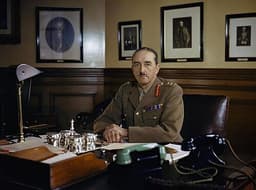
Alan Brooke
General · Modern
64.5Total

Marcos Perez Jimenez
General · Modern
53.9Total
Basic Information
Born
1883
1914
Died
1963
2001
Era
Modern
Modern
Nationality
United Kingdom
Venezuela
Occupation
General
General
Civilization
Western
Western
Score Comparison
Military (10%)
55.0
50.0
Political (20%)
72.0
53.8
Influence (20%)
61.0
54.1
Legacy (20%)
55.0
42.5
Leadership (15%)
80.0
71.0
Strategy (15%)
72.0
60.0
TOTAL
64.5
53.9
Alan Brooke — Complete Timeline
1941 AD
Appointed Chief of the Imperial General StaffOther◆ Major
In December 1941, Alan Brooke was appointed Chief of the Imperial General Staff (CIGS), the professional head of the British Army. He served in this role throughout World War II, overseeing military strategy and operations, and was a key member of the Chiefs of Staff Committee that advised Prime Minister Winston Churchill.
World War IIBritish ArmyMilitary Leadership
Impact: global
1943 AD
Participated in the Casablanca ConferenceOther◆ Major
In January 1943, Brooke attended the Casablanca Conference with Churchill and Roosevelt, where Allied strategy for the remainder of World War II was discussed. The conference agreed on the policy of 'unconditional surrender' for the Axis powers and the invasion of Sicily, with Brooke playing a key role in shaping military plans.
World War IIAllied StrategyCasablanca
Impact: global
Attended the Tehran ConferenceOther◆ Major
In November-December 1943, Brooke attended the Tehran Conference with Churchill, Roosevelt, and Stalin. The conference coordinated Allied military strategy against Germany, including the timing of the cross-channel invasion (Operation Overlord) and the Soviet offensive, with Brooke providing military advice on the feasibility of operations.
World War IIAllied StrategyTehran
Impact: global
1944 AD
Oversaw the D-Day PlanningOther◆ Major
As CIGS, Brooke was instrumental in planning the Normandy landings (D-Day) on June 6, 1944. He coordinated with Allied commanders to develop the invasion strategy, including the selection of landing beaches and the allocation of forces, which led to the successful liberation of Western Europe from Nazi occupation.
World War IID-DayNormandy Invasion
Impact: globalconstructive
Promoted to Field MarshalOther◆ Major
On January 1, 1944, Alan Brooke was promoted to the rank of Field Marshal, the highest rank in the British Army. This promotion recognized his exceptional service as CIGS and his contributions to Allied victory in World War II.
World War IIPromotionField Marshal
Impact: nationalconstructive
Marcos Perez Jimenez — Complete Timeline
1948 AD
Participation in the 1948 coupPolitical Action◆ Major
Pérez Jiménez was a key military officer in the coup that overthrew President Rómulo Gallegos. He served as defense minister in the subsequent junta, consolidating his power within the military.
CoupMilitaryPower Consolidation
Impact: nationaldestructive
1952 AD
Assumption of presidencyPolitical Action
Pérez Jiménez assumed the presidency after a rigged election in 1952. He dissolved the constituent assembly and ruled as a dictator, suppressing political opposition and controlling the media.
DictatorshipElection FraudPresidency
Impact: nationaldestructive
1953 AD
Construction of Caracas infrastructureReform◆ Major
Pérez Jiménez launched a massive public works program, building highways, housing projects, and the Caracas subway. These projects modernized the capital but were financed by oil revenue and often involved corruption.
InfrastructureUrban DevelopmentOil Revenue
Impact: nationalconstructive
Repression of political opponentsPolitical Action◆ Major
Pérez Jiménez's regime used the National Security Police (SN) to arrest, torture, and exile political opponents. Thousands were imprisoned, and the regime maintained control through fear and censorship.
RepressionHuman RightsDictatorship
Impact: nationaldestructive
1958 AD
Overthrow and exilePolitical Action
Pérez Jiménez was overthrown by a civilian-military uprising on January 23, 1958. He fled to the Dominican Republic and later to Spain, where he lived in exile until his death.
CoupExileEnd of Dictatorship
Impact: national
Expert Analysis
Origins
**Alan Brooke** was born on July 23, 1883, in Bagnères-de-Bigorre, France, to a prominent Anglo-Irish military family. He was educated at the Royal Military Academy, Woolwich, and commissioned into the Royal Artillery in 1902. His early career included service in India and on the Western Front during World War I, where he earned a reputation for meticulous planning and technical expertise. Brooke's formative experiences in the Great War shaped his strategic thinking, emphasizing logistics and combined arms operations.
**Marcos Pérez Jiménez** was born on April 25, 1914, in Michelena, Venezuela, into a modest family. He attended the Military Academy of Venezuela, graduating as a sub-lieutenant in 1934. His early career was marked by rapid advancement through the ranks, aided by his involvement in military politics. Pérez Jiménez was part of a generation of officers who saw the military as a modernizing force for Venezuela, influenced by the positivist ideas of order and progress.
Rise to Power
Brooke's rise to prominence accelerated during World War II. In December 1941, he was appointed Chief of the Imperial General Staff (CIGS), the professional head of the British Army. This appointment came at a critical moment, with Britain facing defeats in North Africa and the Far East. Brooke quickly established himself as Churchill's principal military advisor, often clashing with the Prime Minister over strategic priorities. His role in shaping Allied strategy was cemented at the Casablanca Conference in January 1943, where he advocated for the Mediterranean strategy and the invasion of Sicily.
Pérez Jiménez rose to power through a military coup. In 1948, he was a key officer in the overthrow of President Rómulo Gallegos, after which he served as defense minister in the subsequent junta. In 1952, after a rigged election, he assumed the presidency, dissolving the constituent assembly and ruling as a dictator. His regime consolidated power through the National Security Police (SN), which suppressed political opposition, while he promoted a nationalist and anti-communist agenda.
Leadership & Governance
Brooke's leadership style was methodical and detail-oriented. As CIGS, he oversaw the planning of D-Day, coordinating with Allied commanders to develop the invasion strategy. He scored 80.0 in leadership and 72.0 in strategy, reflecting his ability to manage complex operations. However, his relationship with Churchill was often strained; Brooke found the Prime Minister's impulsiveness frustrating, but he balanced strategic caution with bold decisions. His governance approach was purely military, focused on winning the war through coalition warfare and logistical efficiency.
Pérez Jiménez ruled as a dictator, scoring 71.0 in leadership but only 53.8 in political acumen. His governance was characterized by massive public works, including highways, housing projects, and the Caracas subway, which modernized the capital. However, these achievements came at the cost of political repression. His regime used the SN to arrest, torture, and exile opponents, with thousands imprisoned. He centralized power, eliminated democratic institutions, and maintained control through the military and security forces.
Triumph & Tragedy
Brooke's greatest triumph was his role in Allied victory in World War II. He was instrumental in planning the Normandy landings (D-Day) on June 6, 1944, and coordinating the broader Allied strategy. His strategic vision helped ensure the defeat of Nazi Germany. However, his tragedy was the lack of public recognition; he was often overshadowed by more flamboyant commanders like Montgomery and Patton. Brooke also faced criticism for his cautious approach, which some argued prolonged the war.
Pérez Jiménez's greatest success was the infrastructure modernization of Venezuela. His public works program transformed Caracas and other cities, leaving a physical legacy. However, his tragedy was the brutal repression and economic mismanagement. His regime's corruption and lavish spending led to fiscal deficits, and his overthrow on January 23, 1958, ended his rule. He lived in exile in Spain, and his legacy is marred by human rights abuses, with a legacy score of only 42.5.
Character & Destiny
Brooke was reserved, analytical, and often pessimistic. He kept detailed diaries that reveal his frustration with Churchill's interference and his doubts about Allied strategies. His character shaped his role as a stabilizing force within the Allied command, but it also limited his personal ambition. He was promoted to Field Marshal on January 1, 1944, but his destiny was to be the architect of victory rather than its public face.
Pérez Jiménez was ambitious, authoritarian, and pragmatic. He believed in the military's role as a modernizing force, but his character led him to suppress dissent ruthlessly. His destiny was tied to the cyclical nature of Venezuelan politics; his overthrow reflected the instability of military dictatorships. He spent his later years in Spain, attempting to rehabilitate his image but largely failing.
Legacy
Brooke's legacy is that of a key architect of Allied victory. His strategic contributions are recognized by historians, and his diaries provide invaluable insight into wartime decision-making. He scored 55.0 in legacy, reflecting his enduring impact on military strategy and the post-war British army. His influence is seen in the continued emphasis on coalition warfare and logistical planning.
Pérez Jiménez's legacy is mixed. His infrastructure projects remain, but his authoritarian rule left a legacy of political instability. His score of 42.5 in legacy reflects the negative perception of his regime. In Venezuela, he is remembered as a dictator who modernized the country while suppressing freedoms. His influence on subsequent military regimes in Latin America is notable, but his model of development-through-repression has been largely discredited.
Conclusion
Alan Brooke had a greater impact on world history than Marcos Pérez Jiménez. Brooke's strategic leadership helped defeat Nazi Germany, shaping the post-war world order. His total score of 64.5 versus Pérez Jiménez's 53.9 reflects his superior influence and historical significance. While Pérez Jiménez's infrastructure projects had local importance, Brooke's decisions affected millions across the globe. The victory in World War II and the establishment of NATO and the United Nations owe much to Brooke's behind-the-scenes work. Pérez Jiménez's legacy, by contrast, is confined to Venezuela and serves as a cautionary tale of authoritarian modernization. Alan Brooke stands as a figure of global consequence.
Rankings
🥇
Alan BrookeLeader
Mil: 55.0Pol: 72.0Inf: 61.0
64.5
🥈
Marcos Perez Jimenez
Mil: 50.0Pol: 53.8Inf: 54.1
53.9
+10.6 behind
How This Comparison Works
Algorithm
Each figure is scored on 6 dimensions (0—100 scale) based on structured historical data: Military (10%), Political (20%), Influence (20%), Legacy (20%), Leadership (15%), Strategy (15%). The weighted total produces the final ranking.
Data Sources
Scores are computed from structured sub-indicators in the database. Scale factors adjust for era (Ancient ×0.85, Modern ×1.0) and civilization size (Eastern ×1.05, Other ×0.80) to account for differences in population and military scale.
Maximum 3 Figures
Comparisons are limited to 2—3 figures to ensure readability and statistical meaningfulness.
Error Margins
±5 points per dimension — Sub-scores are derived from historical records with inherent uncertainty. Two figures within 5 points on a dimension should be considered roughly equivalent in that area.
Total Score Accuracy
±3 points overall — The weighted combination of 6 dimensions produces a total score with approximately ±3 points of uncertainty. Differences of less than 3 points are not statistically significant— the figures are effectively tied.
Known Limitations
- Historical records are incomplete and uneven across civilizations
- Figures from oral-tradition societies may be underrepresented
- Occupation labels can misclassify multi-role figures
- Scores measure capability and impact, not moral character
- Quantitative scoring is a comparison tool, not absolute truth
Capability Radar
Military (10%) — Battles & Warfare
Battles
60
15
Win Rate
55
20
Expansion
20
10
Political (20%) — Governance & Reform
Reform
60
55
Diplomacy
80
40
Economy
50
65
Influence (20%) — Cultural & Global Reach
Cultural
30
30
Global
65
25
Legacy (20%) — Historical Impact
Historical
75
35
Longevity
60
20
Leadership (15%) — Power & Stability
Tenure
70
60
Stability
85
30
Strategy (15%) — Tactics & Innovation
Strategy
90
30
Tactics
75
25
Reform
85
40
Similar Comparisons
Comments & Discussion
No comments yet. Be the first to share your thoughts!