Loading...
This comparison has not been analyzed yet.
One-time AI generation (~1 minute). Scores and timeline are already available below.
Alan Brooke vs Jassa Singh Ramgarhia
Alan Brooke leads by 8.4 pts · 2 figures compared
…
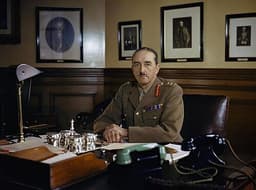
Alan Brooke
General · Modern
64.5Total

Jassa Singh Ramgarhia
General · Modern
56.1Total
Basic Information
Born
1883
1723
Died
1963
1803
Era
Modern
Modern
Nationality
United Kingdom
India
Occupation
General
General
Civilization
Western
Indian
Score Comparison
Military (10%)
55.0
70.0
Political (20%)
72.0
48.0
Influence (20%)
61.0
56.4
Legacy (20%)
55.0
49.2
Leadership (15%)
80.0
65.0
Strategy (15%)
72.0
57.5
TOTAL
64.5
56.1
Alan Brooke — Complete Timeline
1941 AD
Appointed Chief of the Imperial General StaffOther◆ Major
In December 1941, Alan Brooke was appointed Chief of the Imperial General Staff (CIGS), the professional head of the British Army. He served in this role throughout World War II, overseeing military strategy and operations, and was a key member of the Chiefs of Staff Committee that advised Prime Minister Winston Churchill.
World War IIBritish ArmyMilitary Leadership
Impact: global
1943 AD
Participated in the Casablanca ConferenceOther◆ Major
In January 1943, Brooke attended the Casablanca Conference with Churchill and Roosevelt, where Allied strategy for the remainder of World War II was discussed. The conference agreed on the policy of 'unconditional surrender' for the Axis powers and the invasion of Sicily, with Brooke playing a key role in shaping military plans.
World War IIAllied StrategyCasablanca
Impact: global
Attended the Tehran ConferenceOther◆ Major
In November-December 1943, Brooke attended the Tehran Conference with Churchill, Roosevelt, and Stalin. The conference coordinated Allied military strategy against Germany, including the timing of the cross-channel invasion (Operation Overlord) and the Soviet offensive, with Brooke providing military advice on the feasibility of operations.
World War IIAllied StrategyTehran
Impact: global
1944 AD
Oversaw the D-Day PlanningOther◆ Major
As CIGS, Brooke was instrumental in planning the Normandy landings (D-Day) on June 6, 1944. He coordinated with Allied commanders to develop the invasion strategy, including the selection of landing beaches and the allocation of forces, which led to the successful liberation of Western Europe from Nazi occupation.
World War IID-DayNormandy Invasion
Impact: globalconstructive
Promoted to Field MarshalOther◆ Major
On January 1, 1944, Alan Brooke was promoted to the rank of Field Marshal, the highest rank in the British Army. This promotion recognized his exceptional service as CIGS and his contributions to Allied victory in World War II.
World War IIPromotionField Marshal
Impact: nationalconstructive
Jassa Singh Ramgarhia — Complete Timeline
1754 AD
Construction of Ramgarh FortPolitical Action◆ Major
Jassa Singh Ramgarhia built the Ramgarh Fort near Amritsar, which became the stronghold of his misl. The fort's construction solidified his control over the region and gave his misl its name, establishing him as a major Sikh leader.
Sikh MislFortificationPunjab
Impact: regionalconstructive
1764 AD
Capture of SirhindWar◆ Major
Jassa Singh Ramgarhia participated in the Sikh capture of Sirhind from the Afghan Durrani Empire. The victory avenged the 1762 Vadda Ghalughara massacre and established Sikh control over the strategic city, boosting his misl's power.
Sikh-Afghan WarsBattlePunjab
Impact: regional
1770 AD
Conflict with Jassa Singh AhluwaliaWar
Jassa Singh Ramgarhia fought against the Dal Khalsa led by Jassa Singh Ahluwalia over leadership disputes. He was defeated and forced to flee to the desert, losing his territories temporarily, which weakened his misl's influence.
Sikh Civil WarPower StrugglePunjab
Impact: regionaldestructive
1803 AD
Alliance with the BritishPolitical Action
Jassa Singh Ramgarhia allied with the British East India Company against the Marathas. This alliance secured his territories under British protection, but also marked the beginning of British influence over Sikh misls.
British AllianceSikh MislPunjab
Impact: regional
This comparison has not been analyzed yet.
One-time AI generation (~1 minute). Scores and timeline are already available below.
Rankings
🥇
Alan BrookeLeader
Mil: 55.0Pol: 72.0Inf: 61.0
64.5
🥈
Jassa Singh Ramgarhia
Mil: 70.0Pol: 48.0Inf: 56.4
56.1
+8.4 behind
How This Comparison Works
Algorithm
Each figure is scored on 6 dimensions (0—100 scale) based on structured historical data: Military (10%), Political (20%), Influence (20%), Legacy (20%), Leadership (15%), Strategy (15%). The weighted total produces the final ranking.
Data Sources
Scores are computed from structured sub-indicators in the database. Scale factors adjust for era (Ancient ×0.85, Modern ×1.0) and civilization size (Eastern ×1.05, Other ×0.80) to account for differences in population and military scale.
Maximum 3 Figures
Comparisons are limited to 2—3 figures to ensure readability and statistical meaningfulness.
Error Margins
±5 points per dimension — Sub-scores are derived from historical records with inherent uncertainty. Two figures within 5 points on a dimension should be considered roughly equivalent in that area.
Total Score Accuracy
±3 points overall — The weighted combination of 6 dimensions produces a total score with approximately ±3 points of uncertainty. Differences of less than 3 points are not statistically significant— the figures are effectively tied.
Known Limitations
- Historical records are incomplete and uneven across civilizations
- Figures from oral-tradition societies may be underrepresented
- Occupation labels can misclassify multi-role figures
- Scores measure capability and impact, not moral character
- Quantitative scoring is a comparison tool, not absolute truth
Capability Radar
Military (10%) — Battles & Warfare
Battles
60
55
Win Rate
55
60
Expansion
20
50
Political (20%) — Governance & Reform
Reform
60
35
Diplomacy
80
40
Economy
50
30
Influence (20%) — Cultural & Global Reach
Cultural
30
40
Global
65
30
Legacy (20%) — Historical Impact
Historical
75
45
Longevity
60
40
Leadership (15%) — Power & Stability
Tenure
70
45
Stability
85
35
Strategy (15%) — Tactics & Innovation
Strategy
90
55
Tactics
75
50
Reform
85
40
Similar Comparisons
Comments & Discussion
No comments yet. Be the first to share your thoughts!