Loading...
Al-Ashath ibn Qays vs Gongsun Zan
Gongsun Zan leads by 2.3 pts · 2 figures compared
…

Al-Ashath ibn Qays
General · Ancient
43.2Total
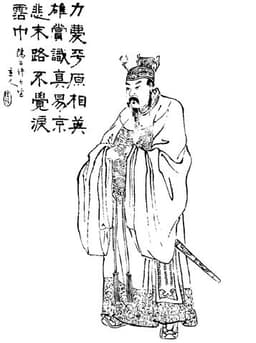
Gongsun Zan
General · Ancient
45.5Total
Basic Information
Born
-599
151
Died
—
199
Era
Ancient
Ancient
Nationality
Kinda
China
Occupation
General
General
Civilization
Middle Eastern
Eastern
Score Comparison
Military (10%)
55.0
61.7
Political (20%)
35.0
32.1
Influence (20%)
47.1
50.2
Legacy (20%)
38.3
43.3
Leadership (15%)
40.9
33.5
Strategy (15%)
50.0
60.7
TOTAL
43.2
45.5
Al-Ashath ibn Qays — Complete Timeline
636 BC
Participated in the Muslim conquest of PersiaWar◆ Major
Al-Ashath served as a commander in the Muslim conquest of Persia, notably at the Battle of al-Qadisiyyah. He later governed parts of the conquered territories, demonstrating his loyalty to the caliphate.
Muslim ConquestsPersiaGeneral
Impact: globalconstructive
632 BC
Led the Kinda rebellion against Abu BakrWar◆ Major
Al-Ashath ibn Qays led the Kinda tribe in rebellion against the caliphate during the Ridda Wars. He was captured by Muslim forces and brought before Caliph Abu Bakr.
Ridda WarsRebellionKinda
Impact: regionaldestructive
Pardoned by Abu Bakr and converted to IslamPolitical Action◆ Major
After his capture, Al-Ashath was pardoned by Caliph Abu Bakr and converted to Islam. He was given a prominent position, including marriage to Abu Bakr's sister, integrating him into the Muslim elite.
Ridda WarsPardonConversion
Impact: regionalconstructive
Gongsun Zan — Complete Timeline
191 AD
Battle of JieqiaoWar◆ Major
Gongsun Zan fought Yuan Shao at the Battle of Jieqiao. Despite using his elite White Horse Cavalry, Gongsun Zan was defeated by Yuan Shao's infantry tactics, marking a turning point in their rivalry for control of northern China.
Three KingdomsBattleDefeat
Impact: regionaldestructive
199 AD
Siege of YijingWar◆ Major
Gongsun Zan was besieged in his fortress at Yijing by Yuan Shao's forces. After a prolonged siege, Gongsun Zan committed suicide by setting his palace on fire, ending his rule over the northeast.
Three KingdomsSiegeDeath
Impact: regionaltragic
Expert Analysis
Origins
Al-Ashath ibn Qays was born around 570 CE into the prominent Kinda tribe in South Arabia. His full name was Ma'dikarib ibn Qays, but he was known as Al-Ashath (meaning "disheveled hair") due to a battle wound that left his hair perpetually tangled. He inherited chieftainship of the Kinda, a powerful tribal confederation that had once ruled a kingdom but was fragmented by the time of his birth. His early life involved typical inter-tribal conflicts, building a reputation as a fierce warrior and cunning negotiator.
Gongsun Zan (c. 160–199 CE) was born into a prestigious military family in Liaoxi, northeastern China. His father served as a commandery governor, but Gongsun Zan initially held a low-ranking post due to his mother's humble status. He gained attention for his exceptional height (over 8 feet) and booming voice, which earned him a position as a minor official at the frontier. His early career was marked by service in the Han dynasty's campaigns against northern nomads, where he developed his signature white horse cavalry.
Rise to Power
Al-Ashath's rise came during the Ridda Wars (632–633 CE) after Prophet Muhammad's death. As many Arabian tribes rebelled against the new caliphate, Al-Ashath led the Kinda in revolt against Caliph Abu Bakr. He was captured at the Battle of al-Nujayr in 633 CE after a fierce resistance. Brought before Abu Bakr in chains, Al-Ashath impressed the caliph with his eloquence and was pardoned, converting to Islam. This act of clemency transformed him from rebel to loyal commander, marrying Abu Bakr's sister Umm Farwa and gaining influence in the nascent Islamic state.
Gongsun Zan rose during the collapse of the Han dynasty (c. 180s–190s CE). He distinguished himself in campaigns against the Wuhuan and Xianbei nomads, earning the title "General of the Household" and building a reputation for ferocity. His elite White Horse Cavalry became legendary, as white horses were rare and symbolized his personal prestige. In 191 CE, he seized control of the northern commanderies of Youzhou and Qingzhou, becoming a major warlord. His rivalry with Yuan Shao, another powerful northern warlord, defined his career.
Leadership & Governance
Al-Ashath's leadership style was pragmatic and adaptive. As a tribal chief turned Muslim commander, he balanced traditional Arabian tribal politics with the centralized demands of the caliphate. He governed parts of conquered Persian territory (e.g., in Isfahan) with a focus on tax collection and maintaining order. His political score of 35.0 reflects a tendency to switch allegiances when expedient—he was among the conspirators who assassinated Caliph Uthman in 656 CE, then later fought for Ali at the Battle of Siffin (657 CE). This flexibility kept him alive but damaged his reputation.
Gongsun Zan was a rigid and paranoid leader. He ruled his territories through fear, executing anyone he suspected of disloyalty. He built an isolated fortress at Yijing (in modern Hebei) with massive grain stores, believing he could outlast any siege. His political score of 32.1 reflects his inability to form lasting alliances or delegate authority. He alienated his subordinates, including his general Zhao Yun, who defected to Liu Bei. Unlike Al-Ashath's pragmatic shifts, Gongsun Zan's stubbornness led to his downfall.
Triumph & Tragedy
Al-Ashath's greatest success was surviving the Ridda Wars and rising to become a key commander in the Muslim conquest of Persia. He fought at the decisive Battle of al-Qadisiyyah (636 CE), which opened Persia to Muslim rule. His political maneuvering also allowed him to die in his bed around 661 CE, a rare feat for a rebel-turned-governor. However, his involvement in Uthman's assassination tainted his legacy, and he never achieved independent power. His military score of 55.0 reflects competence but not brilliance.
Gongsun Zan's triumph was the Battle of Sishui (192 CE), where he defeated Yuan Shu's forces, and his early victories against Yuan Shao, such as the capture of Jizhou in 191 CE. His White Horse Cavalry terrorized enemies, earning him a reputation as the "White Horse General." Yet his tragedy was the Battle of Jieqiao (192 CE), where Yuan Shao's infantry used crossbows to break his cavalry charge, killing 30,000 of his men. This defeat marked the beginning of his decline. His final tragedy was the Siege of Yijing (199 CE): after a two-year siege, with supplies exhausted and his troops deserting, he burned his palace and committed suicide, scoring a military score of 61.7 but a leadership score of only 33.5.
Character & Destiny
Al-Ashath was a survivor, skilled in rhetoric and negotiation. His character was shaped by the tribal ethos of honor and pragmatism—he rebelled when it served his people, then converted when it saved his life. His decision to join the conspirators against Uthman showed a willingness to betray for personal gain. This flexibility allowed him to navigate the violent early Islamic civil wars but prevented him from becoming a truly influential figure. His influence score of 47.1 reflects his moderate impact.
Gongsun Zan was a man of extremes: bold in battle but paranoid in peace. His height and voice made him a commanding presence, but his inability to trust others led to isolation. He famously said, "I would rather be a broken jade than a whole tile," preferring death to surrender. This uncompromising attitude doomed him. His strategy score of 60.7 shows tactical skill, but his leadership score of 33.5 reveals a fatal flaw in managing men.
Legacy
Al-Ashath is remembered as a controversial figure in Islamic history—a rebel who became a companion of the Prophet (through conversion) but also a participant in the first civil war. His descendants, the Ash'athites, remained influential in early Islamic politics. He is a cautionary example of how tribal loyalties persisted in the Islamic empire. His legacy score of 38.3 reflects his limited long-term impact beyond his immediate family.
Gongsun Zan is immortalized in Chinese literature, especially the 14th-century historical novel "Romance of the Three Kingdoms," where he is portrayed as a tragic warlord. His White Horse Cavalry became a symbol of elite cavalry, and his story illustrates the brutal struggles of the Three Kingdoms period. His legacy score of 43.3 is slightly higher than Al-Ashath's, due to cultural resonance in China.
Conclusion
Gongsun Zan edges out Al-Ashath ibn Qays in total score (45.5 vs 43.2), but the gap is narrow. While Gongsun Zan had a higher military score (61.7 vs 55.0) and strategy (60.7 vs 50.0), Al-Ashath had a slightly better leadership score (40.9 vs 33.5). However, Gongsun Zan's greater cultural impact through literature and his iconic cavalry gives him a stronger legacy. His story resonates more in world history, while Al-Ashath remains a footnote in the early Islamic conquests. Therefore, Gongsun Zan has the greater overall impact.
Rankings
🥇
Gongsun ZanLeader
Mil: 61.7Pol: 32.1Inf: 50.2
45.5
🥈
Al-Ashath ibn Qays
Mil: 55.0Pol: 35.0Inf: 47.1
43.2
+2.3 behind
How This Comparison Works
Algorithm
Each figure is scored on 6 dimensions (0—100 scale) based on structured historical data: Military (10%), Political (20%), Influence (20%), Legacy (20%), Leadership (15%), Strategy (15%). The weighted total produces the final ranking.
Data Sources
Scores are computed from structured sub-indicators in the database. Scale factors adjust for era (Ancient ×0.85, Modern ×1.0) and civilization size (Eastern ×1.05, Other ×0.80) to account for differences in population and military scale.
Maximum 3 Figures
Comparisons are limited to 2—3 figures to ensure readability and statistical meaningfulness.
Error Margins
±5 points per dimension — Sub-scores are derived from historical records with inherent uncertainty. Two figures within 5 points on a dimension should be considered roughly equivalent in that area.
Total Score Accuracy
±3 points overall — The weighted combination of 6 dimensions produces a total score with approximately ±3 points of uncertainty. Differences of less than 3 points are not statistically significant— the figures are effectively tied.
Known Limitations
- Historical records are incomplete and uneven across civilizations
- Figures from oral-tradition societies may be underrepresented
- Occupation labels can misclassify multi-role figures
- Scores measure capability and impact, not moral character
- Quantitative scoring is a comparison tool, not absolute truth
Capability Radar
Military (10%) — Battles & Warfare
Battles
25
55
Win Rate
20
45
Expansion
10
55
Political (20%) — Governance & Reform
Reform
10
20
Diplomacy
35
25
Economy
15
30
Influence (20%) — Cultural & Global Reach
Cultural
20
35
Global
10
15
Legacy (20%) — Historical Impact
Historical
25
40
Longevity
15
30
Leadership (15%) — Power & Stability
Tenure
30
40
Stability
20
25
Strategy (15%) — Tactics & Innovation
Strategy
15
50
Tactics
20
60
Reform
5
40
Similar Comparisons
Comments & Discussion
No comments yet. Be the first to share your thoughts!